The global demand for sustainable packaging and heavy-duty corrugated boxes has reached unprecedented levels. Shifting consumer preferences, the explosion of e-commerce, and increasingly stringent environmental regulations largely drive this growth. At the heart of this booming industry is the production of resilient, high-quality packaging materials. However, paper mill owners and investors frequently encounter a critical technical dilemma when setting up or upgrading their production lines. Does a high-quality manufacturing line absolutely require expensive, newly harvested wood pulp to operate efficiently and produce commercially viable paper?
The short answer is no. Fresh timber undeniably offers unmatched natural strength and structural integrity. Yet, modern papermaking technology has evolved to become highly versatile. You do not strictly need entirely fresh wood pulp to run a profitable operation. By understanding how to strategically blend different raw materials, precisely manage chemical properties, and optimize your mechanical stock preparation, you can achieve rigorous industry standards using predominantly recycled inputs.
Looking at recent market shifts, the corrugated packaging sector is undergoing a massive transformation. Driven by volatile global timber prices and aggressive corporate environmental mandates, the industry is rapidly pivoting toward circular economy models. Market analysts note a sharp increase in mills retrofitting their wet-end sections to accommodate higher ratios of secondary fibers. This transition proves that sustainability and profitability can coexist when backed by the right mechanical upgrades. This comprehensive guide explores the mechanics of modern industrial forming machinery, evaluates the pros and cons of recycled versus fresh materials, and provides objective engineering insights on configuring your setup to match specific supply chain realities.
Key Takeaways
Modern papermaking equipment is engineered for ultimate flexibility, capable of operating on entirely fresh timber, entirely recycled materials like Old Corrugated Containers, or a calculated blend of both.
Fresh wood remains the industry standard for achieving maximum durability and producing premium outer-layer packaging, though it incurs significantly higher operational costs.
Monitoring the residual lignin in your pulp serves as a crucial operational metric for balancing overall yield and continuous machine runnability.
Advanced manufacturing lines feature customizable mechanical components to produce high-quality recycled alternatives without relying heavily on expensive raw timber.
Choosing the right machinery partner ensures your stock preparation and wet-end equipment are perfectly calibrated to your chosen fiber type, basis weight, and daily production goals.
What is a Kraft Paper Making Machine and How Does it Work?
The Core Function of the Machine
Fundamentally, an industrial paper machine functions as a massive dewatering and sheet-forming apparatus. The process begins with a highly dilute stock suspension. This slurry typically contains 99 percent water and merely 1 percent solid cellulose. The primary engineering challenge involves transforming this liquid into a continuous, dry sheet of durable packaging material. Walking onto the mill floor, you immediately notice the high-decibel hum of vacuum pumps at the wet end, contrasted by the intense thermal energy radiating from the drying section.
The manufacturing sequence initiates in the headbox. This critical component precisely distributes the liquid slurry onto a rapidly moving fabric mesh in the wire section. As gravity and powerful vacuum suction boxes pull water away, the suspended particles begin to interlock, forming a fragile wet web. Subsequently, the sheet travels through the press section. Here, heavy mechanical rollers wrapped in synthetic felts physically squeeze out additional moisture. Finally, the web enters the drying section. The paper winds around dozens of massive, steam-heated cast-iron cylinders that flash-evaporate the remaining water. The finished sheet is then tightly wound onto large steel spools in the reeling section.
Versatility in Raw Material Intake
Historically, early manufacturing lines were somewhat rigid. They possessed a narrow tolerance for specific pulp types. In contrast, contemporary machines stand as highly engineered feats of versatility. They feature adjustable drainage elements, customizable press nip loads, and advanced multi-layering capabilities. This inherent mechanical flexibility allows control room operators to tweak vacuum pressures and wire speeds on the fly. As a result, the equipment seamlessly adapts to varying raw materials. It is precisely this adaptability that fuels the ongoing industry debate. Mill managers must constantly balance the superior physical traits of fresh wood against the compelling economic benefits of secondary materials.
The Role of Virgin Fiber in Kraft Pulp Production
What is Virgin Fiber?
Freshly harvested wood that has never been previously processed into consumer products forms the foundation of traditional papermaking. To create premium Kraft Pulp, timber chips undergo a specialized chemical cooking method known as the sulfate process. Inside massive, pressurized digesters, wood chips boil in a highly alkaline mixture of sodium hydroxide and sodium sulfide. This intense thermal and chemical reaction dissolves the natural lignin binding the wood matrix together. What remains is a dark, robust slurry of long, intact cellulose strands. These strands have entirely bypassed the physical degradation associated with recycling.
Why is it the Traditional Gold Standard?
The primary advantage of fresh wood pulp lies in its pristine physical morphology. Softwood varieties, such as pine or spruce, naturally possess long, robust cellular structures. When these undamaged strands distribute onto the wire section of a machine, they overlap and interlock extensively. This high degree of surface-area contact creates a dense, heavily bonded matrix.
Consequently, packaging derived from pure fresh timber exhibits superior tear resistance, exceptional tensile strength, and structural rigidity. Consider heavy-duty industrial goods, agricultural sacks, or cold-chain export boxes. These products must survive severe supply chain stresses and high-humidity environments. For such demanding applications, this unmatched physical performance provides a reliable baseline that secondary materials simply struggle to replicate organically.
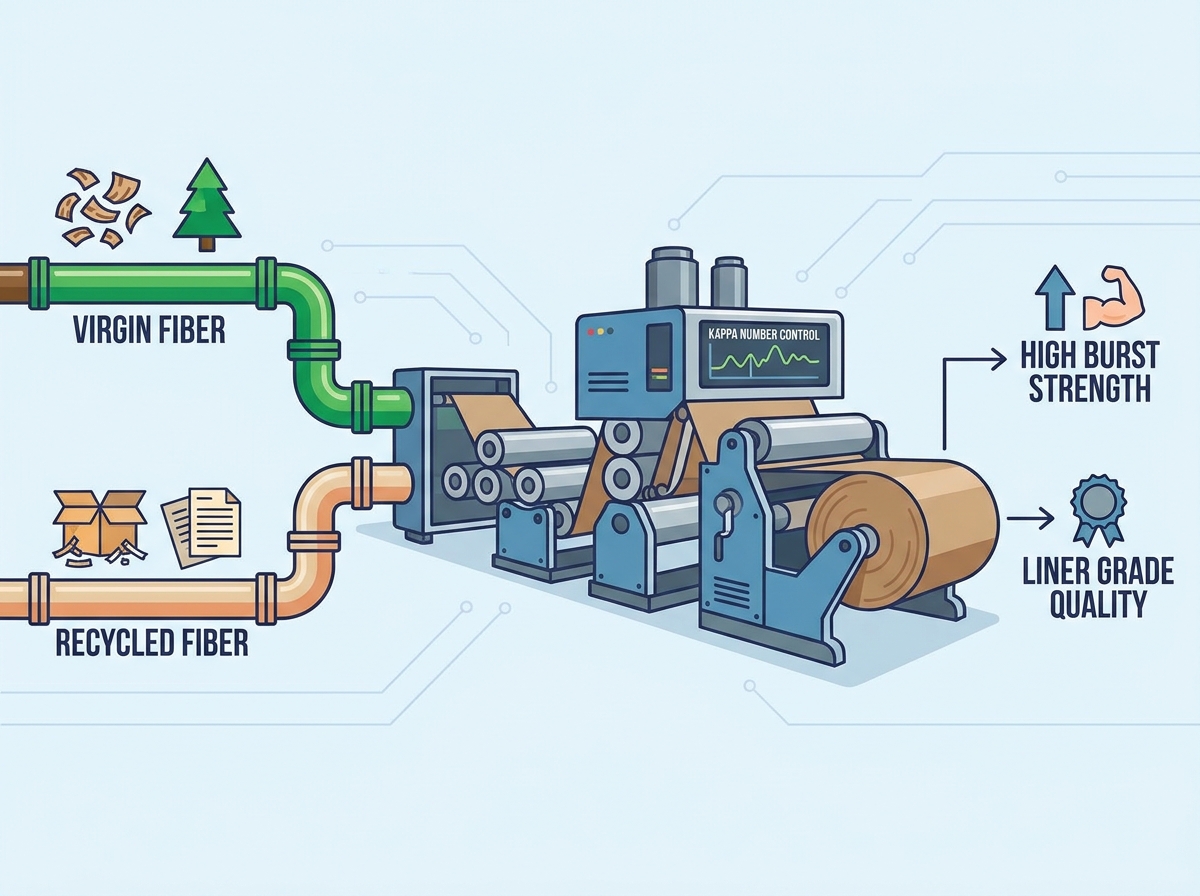
Can a Kraft Paper Making Machine Run on 100% Recycled Fiber?
The Rise of Old Corrugated Containers
Recent industry trends highlight a massive, permanent shift away from exclusive timber reliance. Unpredictable global timber costs, supply chain bottlenecks, and aggressive corporate sustainability mandates drive this change. Mills are increasingly pivoting toward Old Corrugated Containers. This material consists of recovered cardboard boxes and discarded packaging repulped, rigorously cleaned, and reintroduced into the manufacturing loop. Prevailing market analysis suggests that facilities capable of efficiently processing high volumes of recycled cardboard hold a distinct competitive edge in today's circular economy.
Pros and Cons of Going Fully Recycled
Operating a facility entirely on secondary materials presents distinct operational realities that plant managers must weigh carefully.
Economic and Environmental Benefits: Utilizing recycled cardboard is highly cost-effective, drastically lowering raw material procurement expenses. Furthermore, it directly supports global sustainability targets by diverting massive amounts of solid waste from landfills and reducing the need for aggressive deforestation.
Operational Challenges: Every time paper is repulped and dried, the cellulose strands undergo hornification. They become shorter, stiffer, and inherently weaker. Because of this diminished natural strength, a mill cannot simply feed Virgin Fiber substitutes directly into a standard machine. Running entirely on recycled stock demands aggressive capital investment in advanced stock preparation equipment. High-density cleaners, fine slotted screens, and thermal dispersion units become mandatory to extract staples, hot-melt glues, and micro-plastics hidden within recycled bales.
The Blending Strategy
To mitigate the structural weaknesses of recycled pulp while maintaining strict cost-efficiency, forward-thinking operators employ a strategic blending approach. Utilizing multi-ply headboxes, a machine can simultaneously lay down different types of slurry to create a single composite sheet. A common setup involves extruding a thick, bulky base layer of inexpensive recycled material. This base is immediately topped with a thin, smooth layer of premium fresh timber pulp. This hybrid method optimizes both the aesthetic printability and the load-bearing integrity of the final product.
| Production Feature | 100% Fresh Timber | 100% Recycled Cardboard | Hybrid/Blended (Multi-ply) |
| Raw Material Cost | Very High | Low | Moderate |
| Physical Strength | Exceptional | Moderate (Requires chemical sizing) | High |
| Machine Runnability | Excellent (Fewer web breaks) | Challenging (Requires advanced screening) | Very Good |
| Capital Expenditure Focus | Standard Wet End | Heavy Stock Preparation | Multi-wire Forming Section |
Understanding Kappa Number and Its Impact on Your Machine
What is the Kappa Number?
In the realm of pulp chemistry, laboratory technicians rely on a standardized metric known as the Kappa Number. Simply put, this empirical value indicates the residual lignin content remaining in a batch of pulp after the chemical cooking phase. A higher measurement signifies that more of the natural wood glue has been left intact. Conversely, a lower number indicates extensive delignification, a state typically required before bleaching paper pristine white.
How Lignin Affects Paper Strength and Machine Runnability
For unbleached, heavy-duty packaging grades, a higher reading—often deliberately targeted between 40 and 100—is not only acceptable but economically advantageous. Leaving a controlled fraction of lignin in the slurry significantly increases the overall yield extracted from the raw timber. Moreover, it results in stiffer, more rigid individual strands.
However, this residual lignin directly dictates how the slurry behaves once it hits the rapidly moving wire. Stiff, high-yield pulps drain water much faster than flexible, highly refined pulps. Operators must continuously monitor sensor feedback and calibrate the vacuum suction boxes. This prevents the wet web from drying too quickly or unevenly. Additionally, if the lignin content drifts too high, the material resists the mechanical fibrillation needed to create strong bonds. This resistance can potentially cause web breaks in the press section and disrupt continuous runnability.
Achieving Optimal Burst Strength: Virgin vs. Recycled Fibers
Why Burst Strength Matters in Packaging
In quality control laboratories across the globe, technicians routinely subject paper samples to the Mullen test to determine their Burst Strength. This metric defines the maximum hydrostatic pressure a sheet can tolerate before it violently ruptures. In the corrugated logistics industry, this stands as arguably the most critical performance indicator. When a cardboard box is stacked high in a humid warehouse or jolted during transit, the paper walls must resist puncturing from the inside out to ensure the cargo remains secure.
Engineering Durability Without Pure Timber
If a facility opts to utilize a high percentage of recycled stock, the natural pressure tolerance of the paper will be inherently lower. Nevertheless, engineers can artificially boost this metric through aggressive mechanical and chemical interventions.
Mechanically, the recycled slurry is forced through refiners. These heavy-duty machines house grooved, rotating metal discs. As the pulp passes through the microscopic gaps between these plates, the fibers are physically bruised and frayed. This intense fibrillation creates tiny micro-hairs on the surface, drastically expanding the surface area available for hydrogen bonding. Chemically, operators leverage the size press integrated near the end of the drying section. By uniformly spraying a layer of cationic liquid starch over the semi-dried web, the machine effectively glues the shorter recycled strands together. This process bridges microscopic gaps and artificially elevates the pressure tolerance to meet rigorous shipping standards.
Producing Premium Liner Grade Paper: Material Requirements
Kraftliner vs. Testliner
The flat, smooth outer and inner layers of a corrugated board are known as the linerboard. The industry strictly categorizes this Liner Grade based on its raw material origins. True Kraftliner requires a minimum of 80 percent fresh timber pulp. It offers maximum moisture resistance and flawless printability for high-end retail packaging. In contrast, Testliner serves as the economical alternative, manufactured predominantly or entirely from recycled cardboard. While it relies heavily on chemical sizing to achieve its durability, Testliner has rapidly become the backbone of domestic e-commerce shipping boxes.
Optimizing Your Machine for High-End Production
To manufacture top-tier outer-layer paper, especially when incorporating secondary inputs, the architectural configuration of the wet end is paramount. Multi-wire forming sections represent the industry standard for this specific application. These sophisticated layouts allow a mill to form separate wet webs simultaneously and press them together before drying. By burying lower-quality, bulky recycled materials in the core of the sheet and surfacing it with highly refined, clean pulp, mills can achieve the premium look and feel of Kraftliner at a fraction of the traditional raw material cost.
How to Choose the Right Kraft Paper Making Machine for Your Pulp
Assessing Your Raw Material Supply Chain
Before allocating millions in capital expenditure for new machinery or facility upgrades, owners must conduct a ruthless, objective audit of their regional supply chain. If your mill is situated near sustainably managed commercial forests with stable timber prices, a setup optimized for fresh wood processing will likely yield the highest long-term return on investment. On the other hand, if your facility operates within a dense urban industrial zone with cheap, abundant access to municipal recycling streams, designing your production line around recycled processing is the most logical, financially sound strategy.
Customizing Your Equipment Setup Based on Real Parameters
Your primary fiber source dictates the complexity of your entire plant layout. When selecting a machine, engineering specifications must align with your production goals. For modern industrial setups, you need to evaluate core parameters:
Production Capacity: Depending on market demand, machines typically range from 15 to 500 tons per day. A fully recycled line might require higher capacity to offset lower profit margins per ton.
Operating Speed: To maintain profitability, look for equipment capable of running between 150 and 800 meters per minute, ensuring stable web tension regardless of fiber length.
Trimmed Width: Commercial viability often requires a trimmed paper width ranging from 1575 to 5800 millimeters to fit standard corrugated box plant corrugators.
Basis Weight: Ensure the headbox and press section can reliably handle basis weights between 80 and 220 grams per square meter, which covers both lightweight fluting and heavy-duty linerboard.
Furthermore, a facility relying heavily on recycled materials requires a massively robust stock preparation line. Without high-consistency pulpers, centrifugal cleaners, and fine slotted screens, abrasive contaminants like sand, glass, and sticky adhesives will inevitably carry over onto the forming fabrics. This contamination causes frequent, costly web breaks, severely damages delicate synthetic felts, and ultimately ruins final product quality.
Partnering with Industry Experts
Because the fluid dynamics of sheet formation and the mechanics of stock preparation are so deeply intertwined, procuring equipment from established manufacturers is non-negotiable. Top-tier engineering firms offer customizable solutions that bridge the gap between unpredictable raw materials and strict final product specifications. Collaborating with specialized machinery providers ensures your facility can smoothly transition between fresh and secondary inputs as global market prices fluctuate, safeguarding your operational profitability.
Conclusion
In summary, a modern industrial papermaking setup does not strictly require purely fresh timber to operate successfully. The decision between utilizing virgin wood or recycled cardboard is a delicate balancing act of local economics, environmental sustainability, and technical engineering. Your choice of raw input directly dictates the acceptable lignin levels during pulping, the aggressive mechanical strategies required to achieve target pressure tolerances, and the ultimate market classification of your finished packaging products.
The most successful, forward-thinking facilities today adopt a hybrid approach. By leveraging advanced multi-ply machinery, operators can maximize the immense cost-efficiency of recycled materials while deploying fresh timber strategically where structural integrity is absolutely paramount. We strongly encourage mill operators and investors to thoroughly evaluate their regional supply chains and consider modernizing their production lines to handle flexible inputs. If you are planning a new mill setup or upgrading an existing line, evaluating high-performance equipment is your next crucial step. Explore advanced manufacturing solutions and find the exact machine parameters that fit your production goals at Leizhan Paper Tech.
FAQ
Q1: Can I make high-quality kraft paper without any virgin fiber?
Yes, you can successfully manufacture high-quality Testliner using purely recycled fiber. However, this requires that your facility is equipped with an advanced, highly efficient stock preparation system to screen out all contaminants. You will also need a surface sizing press to apply starch and artificially enhance the paper's overall structural integrity.
Q2: What is a good Kappa number for kraft paper?
For unbleached packaging grades, a higher measurement—typically ranging between 40 and 100—is considered standard and optimal in the industry. Leaving a specific amount of residual lignin in the pulp helps maintain a high wood-to-paper yield and provides the necessary stiffness required for durable corrugated boxes.
Q3: How does virgin fiber improve burst strength?
Fresh wood fibers have never been subjected to the physical stresses of repulping and drying. Therefore, they remain significantly longer and more pliable than recycled fibers. These pristine strands interweave much more tightly on the forming wire, naturally resulting in a heavily bonded sheet with a much higher tolerance to internal hydrostatic pressure.
Q4: What is the difference between liner grade and fluting medium?
The flat, smooth outer and inner layers of a corrugated cardboard box are referred to as the liner. This layer requires exceptionally high tensile and pressure strength to protect the contents. Conversely, the fluting medium is the wavy, corrugated inner layer designed specifically to provide vertical crush resistance and structural cushioning.
Q5: Where can I buy a machine that handles both virgin and recycled kraft pulp?
Top industrial manufacturers offer highly customizable, multi-wire solutions specifically engineered to handle diverse raw material inputs. You can explore versatile, high-efficiency machinery options designed to optimize both fresh and recycled pulp processing by consulting with established industry leaders who specialize in custom mill configurations.
Q6: What is the minimum percentage of virgin fiber required for heavy-duty corrugated boxes?
While there is no universal legal minimum, true Kraftliner typically requires at least 80 percent fresh timber pulp to meet strict international shipping certifications for heavy-duty and cold-chain logistics. However, many modern mills successfully produce high-performance alternatives using a 30 to 50 percent fresh fiber top layer combined with a high-quality recycled base.
Q7: How does stock preparation differ when switching from virgin to recycled fiber?
Processing fresh timber primarily involves chemical cooking and washing to remove lignin. In contrast, preparing recycled fiber is a mechanical decontamination process. It requires high-density cleaners to remove heavy metals and glass, fine screens to catch plastics, and thermal dispersion units to melt and disperse sticky adhesives that would otherwise blind the paper machine's forming fabrics.


