Producing high-quality corrugated boxes starts with a fundamental engineering decision. You must match the right raw materials to the appropriate equipment. Many plant managers struggle with operational inefficiencies on a daily basis. Sudden web breaks and poor box crush test results are common headaches on the production floor. Why do these issues happen? Often, the chosen paper specifications simply do not align with the machine's mechanical capabilities. This comprehensive guide explores the intricate relationship between different paper categories and your cardboard paper making machine. Whether your facility processes virgin kraft pulp or recycled old corrugated containers, understanding this synergy is crucial for optimizing your entire production line.
Before diving into the technical specifications of multi-layer setups and downstream converting equipment, we must review the core principles of liner classifications. Different paper categories require specific machine configurations to ensure optimal strength and printability. Proper mechanical alignment prevents material waste. It maximizes production output and allows businesses to pivot smoothly based on shifting market demands.
Industry Trends: The Push for Lightweight and Sustainable Packaging
Recent market shifts heavily influence how engineers approach equipment alignment. Global e-commerce requires packaging that is both lightweight and exceptionally durable. Consequently, paper mills face immense pressure to produce lower basis weight liners without sacrificing burst strength. This prevailing trend forces manufacturers to upgrade their wet-end configurations. Advanced retention aids and micro-fibrillated cellulose processing are now standard requirements to maintain structural integrity in thinner sheets.
Furthermore, stringent environmental regulations drive the industry toward 100% recycled fibers. Handling highly contaminated waste paper bales introduces significant variables into the stock preparation phase. Modern facilities must deploy advanced screening and dispersion systems to ensure these eco-friendly materials perform just as reliably as virgin pulp.
Understanding Liner Board and Board Grade Classifications
Serving as the flat, essential outer and inner facing of a corrugated box, the Liner Board provides the necessary structural containment and surface finish for branding. When operators thread the machine for a new run, they must distinguish between two primary categories: Kraft liner and Testliner.
Kraft Liner vs. Testliner
Kraft liner is primarily composed of virgin wood pulp, typically containing at least 80 percent fresh fibers. Its long, uncompromised fibers offer superior tensile strength and excellent moisture resistance. This grade remains the gold standard for heavy-duty shipping containers exposed to harsh logistical environments. In contrast, Testliner is manufactured from 100 percent recycled fibers. While historically viewed as a lower-tier option, modern stock preparation technology has dramatically narrowed the quality gap. Today, Testliner serves as a highly cost-effective solution for a vast array of consumer packaging needs.
| Feature | Kraft Liner | Testliner | Machine Requirement Impact |
| Fiber Source | Virgin wood pulp | 100% Recycled fibers | High drying capacity vs. Advanced contaminant screening |
| Tensile Strength | Extremely High | Moderate to High | Standard press section vs. High-intensity shoe press |
| Moisture Resistance | Excellent | Average | Minimal surface sizing vs. Heavy film press sizing |
How Board Grade Impacts Machine Choice
Your desired output directly dictates the mechanical requirements of your facility. A higher basis weight demands significantly more robust pressing sections to extract water effectively before the drying cylinders. Machines producing premium Kraft liner require immense drying power to maintain fiber integrity without scorching the sheet. Conversely, if you prioritize burst strength for lightweight packaging, your paper machine must feature specialized wet-end configurations to maximize fiber bonding.
How the Cardboard Paper Making Machine Adapts to Different Liner Grades
Modern paper machines are marvels of heavy engineering. They must constantly balance raw material variability with strict end-product specifications. To handle different Board Grade classifications, the machine parameters must be highly versatile. For instance, a high-performance cardboard machine typically features a trimmed width ranging from 3200mm to 5800mm. Operating speeds can scale up to 800 meters per minute, processing a basis weight range spanning 90 to 300 grams per square meter.
Single-Layer vs. Multi-Layer Configurations
To meet evolving market standards, multi-layer machines offer the highest level of operational customization. You can engineer a superior-quality liner by utilizing a virgin pulp top layer over a recycled base layer. This hybrid approach optimizes production costs while preserving premium printability and surface smoothness. Specifically, specialized primary and secondary headboxes, alongside extended wire sections, are mandatory. These components keep the distinct pulp slurries from mixing improperly during the initial forming process.
The Role of the Pulping and Pumping System
Consistency on the reel starts deep within the stock preparation area. A reliable pulping system ensures that fibers are refined and fibrillated to the exact required length. By deploying advanced pressure screens and high-performance pulp pumps, mills prevent abrasive impurities from reaching the forming fabric. Meticulous screening keeps the finished surface uniform and completely free of visual defects. This step is especially vital when navigating the complexities of recycled pulp.
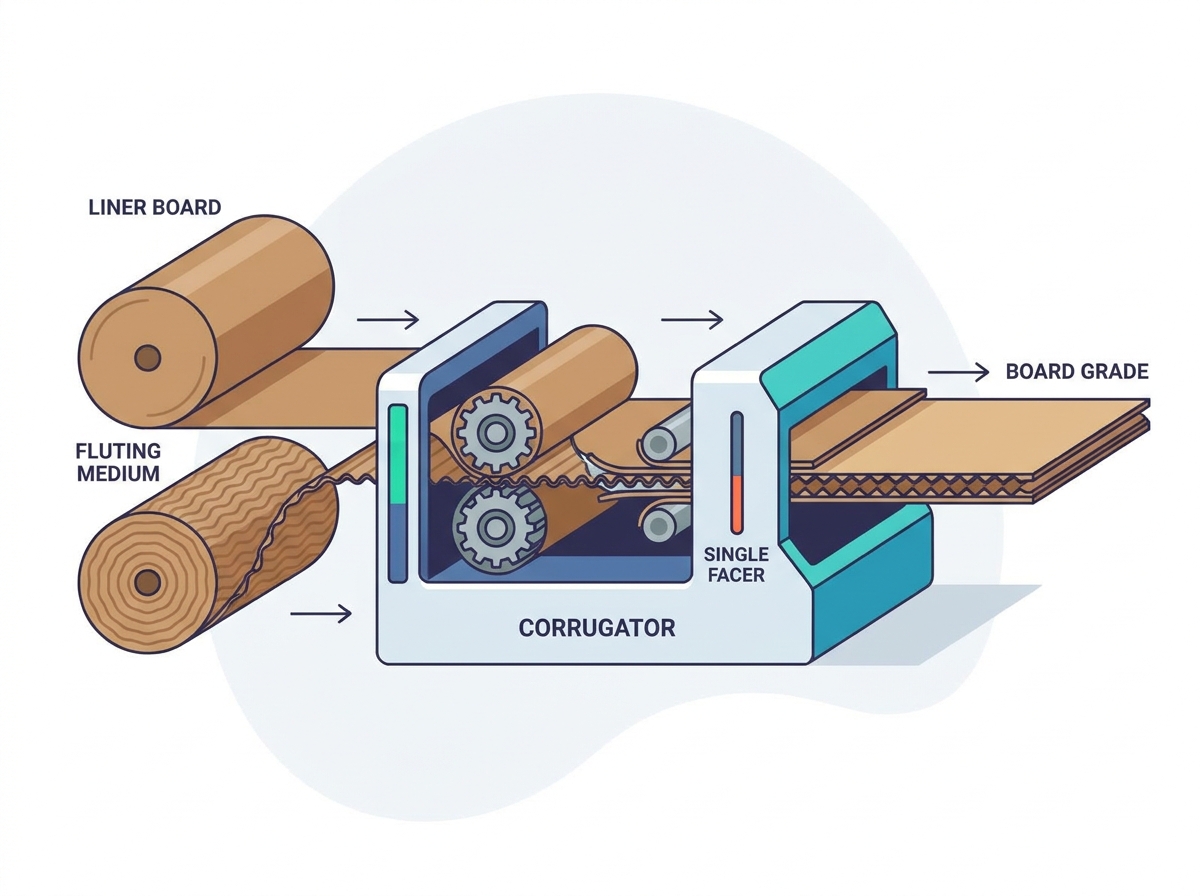
The Critical Role of Fluting Medium in Corrugated Production
While the outer liners provide the aesthetic appeal and tensile exterior, the internal architecture relies heavily on the corrugated core. Without a robust middle layer, the entire box structure would be compromised entirely.
What is Fluting Medium?
Fluting is the wavy, undulating middle layer of a corrugated board. It acts as a continuous arch, providing necessary resistance to crushing forces and vertical impacts. If a facility produces substandard fluting, the resulting boxes will inevitably collapse under the immense weight of warehouse stacking.
Producing Fluting on a Cardboard Paper Making Machine
Manufacturing a high-quality Fluting Medium requires a completely different operational focus compared to liner production. Instead of prioritizing a silky surface smoothness for printing, operators must maximize stiffness. Machine settings are explicitly tuned to achieve high Corrugating Medium Test values. By adjusting the pressing intensity and refining the short fibers to enhance rigidity, mills can achieve the exceptional crush resistance demanded by rigorous modern logistics chains.
Synergizing Your Corrugator and Single Facer with the Right Liner
The papermaking journey does not conclude once the jumbo roll is wound at the reel. It transitions immediately into the converting phase. Here, flat paper is transformed into three-dimensional corrugated board. Picture the conversion floor: paper unwinds at breakneck speeds, entering a maze of heating cylinders and tension rollers.
The Single Facer's Function
The critical component known as the Single Facer is where the structural magic happens. It applies intense heat, steam, and starch adhesive to bond the fluted medium to the first flat liner. Different liner grades absorb this heat and moisture at varying rates. If your paper has an inconsistent moisture profile, the adhesive will fail to penetrate evenly. This results in delamination, which is a catastrophic failure point in packaging.
Maximizing Corrugator Efficiency
A well-calibrated converting line relies entirely on the quality of the paper fed into it. Consistent web tension and uniform moisture profiles dramatically reduce the risk of paper snapping during high-speed runs. If your paper machine is poorly matched to your converting equipment, you will experience excessive board warping. Standardizing the trim width to match the operational requirements of your Corrugator minimizes edge trim waste, thereby maximizing raw material utilization.
Key Specifications: Width, Capacity, and Customization
When configuring a production facility, selecting the precise physical and operational specifications of your equipment is a critical engineering decision. Operational width, throughput capacity, and the ability to process specific raw materials directly dictate your facility's market competitiveness.
Machine Widths: Comparing 3600mm vs. 4200mm Configurations
The operating width determines the volume of paper produced and how efficiently the finished parent rolls can be processed downstream. A 4200mm recycling kraft liner machine inherently offers massive throughput. It can easily exceed 500 tons per day, making it highly suitable for large-scale operations aiming to dominate national markets. In contrast, a 3600mm testliner machine provides exceptional operational agility. It allows mid-sized regional facilities to execute shorter production runs, making it easier to switch between standard liners and specialized fluting without incurring massive downtime costs.
Customization for Recycled Content
Modern sustainability mandates compel the industry to rely heavily on recycled waste paper. However, recycled bales introduce significant variables, including fluctuating fiber lengths and high levels of plastics or adhesives. To maintain consistency, the machine must feature highly customized stock preparation systems. Advanced multi-stage centrifugal cleaners and specialized disperser systems are integrated to eradicate contaminants. This ensures that recycled content never compromises the structural integrity of the final packaging.
Upgrading Your Production Line: When to Invest in New Equipment
Equipment lifecycle management is a fundamental aspect of industrial manufacturing. Running aging machinery beyond its optimal lifespan often results in diminishing returns. These are typically characterized by soaring energy consumption and frequent mechanical failures.
Signs Your Current Machine is Limiting Your Production
Manufacturers must continuously monitor their output quality against stringent industry standards. Are you experiencing frequent, unexplained downtime? Does your current setup struggle to produce the lightweight, high-strength packaging that modern brands demand? If your equipment cannot achieve required Edge Crush Test values without excessively increasing the paper's basis weight, your pressing and forming sections are likely obsolete.
ROI of a Modern Cardboard Paper Making Machine
While the capital expenditure on a new paper machine is significant, the return on investment is realized rapidly through multi-faceted operational savings. Modern machines are engineered with advanced variable frequency drives and closed-loop steam recovery systems. These technologies drastically reduce electricity and thermal energy consumption. The ability to produce premium grades allows you to access lucrative high-end retail markets, transforming a capital expense into a long-term competitive advantage.
Choosing the Right Solution for Your Business Needs
Selecting the optimal machinery requires a systematic evaluation of your supply chain, your target demographic, and your long-term expansion goals. A strategic procurement process minimizes risk and ensures seamless installation.
Assessing Your Raw Material Supply
Before finalizing any machine blueprints, analyze your raw material stream. Facilities located near abundant forestry resources may prioritize virgin kraft pulp. This requires specific refining equipment to maximize the fibrillation of long wood fibers. Alternatively, urban facilities relying on localized waste paper collection must weight their capital investment heavily toward robust, high-contamination pulping lines.
Partnering with the Right Manufacturer
The sheer complexity of paper manufacturing means that purchasing individual components from disparate vendors often leads to integration nightmares. Plant managers should prioritize collaborating with equipment providers who offer comprehensive, end-to-end solutions. A reliable partner views your production line as a complete ecosystem, ensuring that the pulping vats, the paper machine, and the automated rewinder communicate seamlessly to maximize overall equipment effectiveness.
The synergy between your raw materials, liner specifications, and cardboard paper making machine forms the absolute foundation of a profitable packaging business. Whether you are pushing the limits of a high-speed corrugating line or refining your internal stock preparation processes, exceptional output depends entirely on the precision of your hardware. We strongly encourage operators to audit their current setups. Explore the comprehensive range of high-efficiency cardboard and carton machinery at Leizhan to find the exact equipment specifications that match your production goals and drive sustainable, long-term growth.
FAQ
Can a single cardboard paper making machine produce both Kraft liner and Testliner?
Yes, highly customizable, multi-layer machines are engineered to switch between different raw materials. By adjusting the refining intensity in the pulping system, modifying the headbox consistency, and altering the wet-pressing parameters, operators can transition between virgin pulp and recycled pulp. However, achieving peak efficiency requires specialized configurations for each specific paper type.
How does the fluting medium differ from liner board in the manufacturing process?
While both materials are essential components of corrugated packaging and can be manufactured on similar machinery, their production focuses on entirely different physical properties. Manufacturing fluting prioritizes stiffness, crush resistance, and high corrugating medium test values to ensure structural integrity. Conversely, producing liner board focuses on achieving high tensile strength, moisture resistance, and a smooth, uniform surface profile for printing.
What causes paper to break at the single facer or corrugator?
Web breaks during the converting process are a primary source of operational inefficiency. These breaks are almost always traced back to inconsistencies generated by the paper machine. Common culprits include uneven cross-directional moisture profiles, poor tensile strength due to inadequate fiber bonding, or localized defects like shives and holes. The high tension and intense heat applied during conversion will instantly expose these weaknesses.
What does board grade actually mean?
The term board grade is an industry classification system used to define the specific physical and mechanical properties of paperboard. It is determined by a combination of factors, including the paper's basis weight measured in grams per square meter, burst strength, Edge Crush Test rating, and its raw material composition. Buyers rely on these grades to ensure packaging meets specific load-bearing requirements.
Why is the width of the paper machine important?
The operational width of the machine dictates both your total production capacity and your material efficiency. The finished parent rolls must be cut and fed into downstream converting equipment. If the width of the paper machine does not mathematically align with the operational width of your converting line, you will generate excessive edge trim waste, severely impacting overall plant profitability.
What is the ideal moisture content for liner board before corrugating?
The ideal moisture content for liner board typically ranges between 7 and 9 percent. Maintaining this specific moisture profile is critical. It prevents the board from warping under the intense heat of the corrugator and ensures that the starch adhesive penetrates evenly for a secure bond.
How does basis weight affect the operational speed of a paper making machine?
A higher basis weight requires significantly more time and thermal energy in the drying section to remove moisture, which naturally forces the machine to operate at lower speeds. Conversely, producing lighter weight paper allows the machine to run at much higher speeds, though this demands highly precise web tension control to prevent tearing.


