Introduction
When setting up a paper manufacturing facility, mastering optical metrics is absolutely critical. For mills producing exercise books, journals, and legal pads, understanding the exact optical parameters required for your production line is the key to balancing chemical costs with consumer satisfaction. This metric affects everything from reader eye strain to the perceived premium quality of the final stationary product.
Achieving the perfect optical balance is not just about aggressively bleaching the raw pulp. It requires a deep, mechanical understanding of how your equipment handles various production stages. This includes fiber distribution in the wet end, chemical application at the size press, and light-scattering control throughout the drying section. In this comprehensive engineering guide, we will explore the ideal optical levels for stationery, how specific machine components influence these metrics, and what technical specifications you need to look for when investing in a high-performance manufacturing setup.
Key Takeaways
Target Optical Range: The optimal reflectance for standard writing material typically falls between 70 percent and 90 percent on the ISO scale. This strikes a necessary balance between text contrast and the prevention of long-term visual fatigue.
Equipment Influence: A high-quality production line controls optical properties through precise chemical mixing, efficient multi-stage bleaching, and advanced surface treatments.
Interconnected Metrics: You cannot adjust reflectance in isolation. Pushing it higher heavily impacts the sheet's ability to block light, requiring careful calibration during the wet-end formation stage.
Surface Treatment Matters: Proper surface application improves ink holdout while locking in optical brightening agents to maintain consistent page color over time.
Technical Distinctions: Mill operators must understand the technical difference between blue light reflection and total visible light reflection to meet specific market demands accurately.
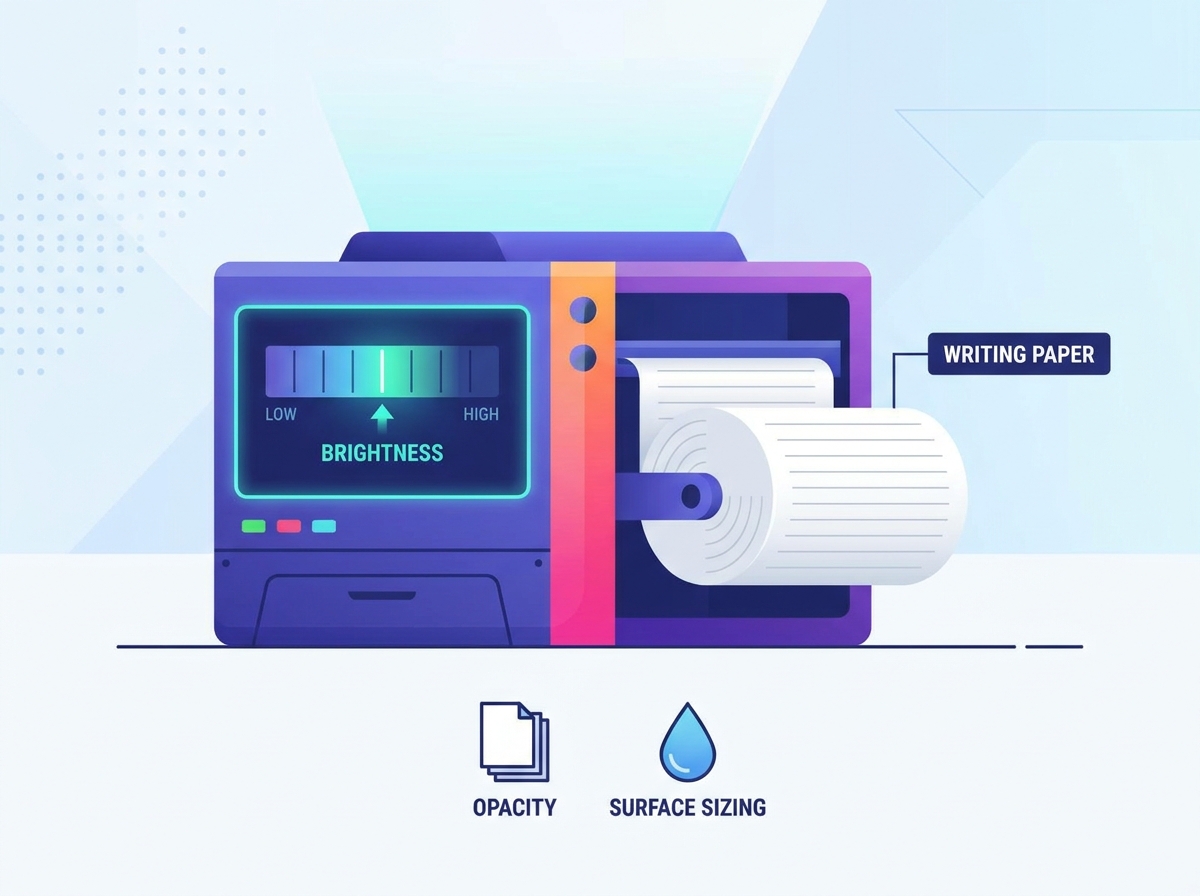
What Does Paper Brightness Mean on the Mill Floor?
Defining the Metric in Manufacturing
In the paper engineering sector, this is not merely a subjective visual trait. It is a strictly defined technical measurement. Specifically, it refers to the volume of blue light—measured exactly at a wavelength of 457 nanometers—that reflects off the surface of the sheet. In the operational context of a high-speed production line, this metric serves as a primary indicator of pulp purity, lignin removal, and the overall effectiveness of the chemical bleaching process. Industry standards like ISO 2470-1 and TAPPI T452 dictate exactly how this reflectance is quantified in the quality control lab.
Why This Metric is Crucial for Notebooks
Understanding and controlling this parameter is vital for several operational and commercial reasons. Higher reflectance provides a starker background contrast for black, blue, or red ink. This makes the Writing Paper significantly easier to read. Such stark contrast is a fundamental requirement for educational and professional notebooks alike.
Furthermore, market data consistently indicates that consumers inherently associate brighter sheets with higher manufacturing quality. Hitting the target reflectance allows manufacturers to position their products in premium market tiers. Different geographical regions and educational boards enforce strict procurement standards. Your machinery must be capable of adapting to varying ISO or TAPPI requirements consistently to avoid costly batch rejections.
The Ideal Brightness Range for High-Quality Writing Paper
Finding the Sweet Spot for Eye Health
Inexperienced operators often assume that maximizing Brightness is the ultimate goal. However, ultra-bright paper measuring above 95 percent ISO can actually be detrimental to the end-user. Under harsh classroom fluorescent lights or bright office environments, highly reflective pages cause severe glare. This glare leads directly to visual strain, headaches, and early eye fatigue during prolonged reading or writing sessions.
Industry best practices dictate specific target zones depending on the final application of the product. Standard exercise books aimed at everyday student use typically target 70 to 80 percent ISO. This offers a soft, cream-like tint that is highly eye-friendly. Premium journals and executive planners generally aim for 85 to 90 percent ISO. This provides a crisp, clean white aesthetic without crossing into the territory of overwhelming glare.
Core Comparison: Target Optical Ranges
| Product Application | Target ISO Range | Visual Effect & User Experience | Manufacturing Focus |
| Standard Student Exercise Books | 70% - 80% | Soft cream tint, minimizes eye fatigue under harsh lighting. | Lower chemical bleaching costs, higher natural fiber retention. |
| Premium Executive Journals | 85% - 90% | Crisp, clean white, high contrast for fountain pens. | Precise OBA dosing, advanced surface sizing application. |
| Eco-Friendly / Sustainable Notebooks | 65% - 75% | Natural, earthy appearance, visible unbleached fibers. | Minimal chemical usage, strict control of recycled pulp impurities. |
Industry Trends: The Shift Toward Sustainable Aesthetics
The global paper manufacturing landscape is currently undergoing a massive shift driven by environmental sustainability. Recent industry analyses reveal a distinct change in consumer preferences regarding notebook aesthetics. There is a rapidly rising demand for unbleached, recycled, or minimally bleached paper. Eco-conscious buyers, particularly in European and North American markets, are increasingly drawn to notebooks with a natural, earthy appearance.
This trend directly impacts how mills operate. Lower reflectance levels are no longer seen as a sign of poor quality but rather as a badge of environmental responsibility. Consequently, modern mills must be highly agile. A state-of-the-art production line must utilize smart optical sensors and automated dosing systems to quickly transition from producing ultra-bright executive paper to eco-friendly student grades. This flexibility prevents raw material waste and eliminates prolonged machine downtime during grade changes.
How Sheet Formation and Opacity Impact Optical Properties
The Tug-of-War in Paper Engineering
On the mill floor, there is a well-documented inverse relationship between light reflection and Opacity. The latter measures the paper's ability to block light from passing through it. This prevents text written on one side from showing through to the reverse side. As manufacturers aggressively remove lignin and add bright fillers to elevate reflectance, the physical barriers that scatter light within the internal structure are diminished. The sheet's ability to hide ink drops significantly. For double-sided notebooks, high light-blocking capability is a non-negotiable quality standard. Manufacturers must carefully balance chemical bleaching with high-opacity fillers like titanium dioxide.
The Critical Role of the Wet End
The physical structure of the web plays a massive role in how light interacts with it. Excellent Sheet Formation refers to the uniformity, orientation, and even distribution of wood fibers as they are laid down from the headbox onto the forming fabric. When operators watch a jumbo roll form at high speeds, they know that poor distribution leads to fiber clumping. Clumped fibers create a mottled, cloudy appearance. This makes the surface look patchy to the human eye. Even fiber distribution ensures that light scatters optimally across the entire sheet. This allows manufacturers to push optical levels higher without compromising the paper's ability to hide ink bleed-through.
The Crucial Role of Surface Sizing in Production
Defining the Application Process
Applying Surface Sizing is a critical physical treatment executed during the later stages of the manufacturing process. It involves applying a continuous, thin layer of modified starch, synthetic sizing agents, or specialized polymers directly to the paper web. This process occurs at the size press, which is typically located right between the main drying section and the after-drying section.
Enhancing Quality and Locking in Color
This sizing process drastically alters the surface chemistry and physical properties of the page. Optical brightening agents—commonly referred to as OBAs—are highly sensitive to ultraviolet light and environmental degradation. The sizing layer effectively seals the paper fibers. It creates a protective barrier that prevents these brighteners from oxidizing and fading. This ensures the stationary does not prematurely yellow while sitting in warehouse storage.
Beyond protecting color, sealing the microscopic pores created during initial wet-end formation ensures that liquid ink sits on top of the page rather than bleeding into the fiber network. This ink holdout indirectly preserves the clean look of the page by preventing unwanted ink spread and feathering. To achieve this uniform application, a top-tier paper machine utilizes a precision film size press that applies agents evenly across the high-speed web without causing web breaks.
Brightness vs. Whiteness: A Technical Distinction
Understanding the Difference
It is a frequent technical pitfall for new manufacturers to use these two terms interchangeably. In paper science, these are two distinct optical properties. As previously defined, one measures the reflection of a specific, narrow wavelength of blue light. It is strictly a metric of the pulp's bleaching level. Whiteness measures the reflection of all wavelengths of light across the entire visible spectrum. It dictates the overall color shade of the sheet. It determines whether the paper looks warm with a yellowish tint or cool with a bluish tint to the naked eye.
Adjusting Your Machine for Both Metrics
To master both metrics and meet exact client specifications, operators must balance multiple chemical inputs simultaneously. Bleaching agents increase the baseline reflectance. To achieve a high whiteness score, operators utilize the machine's dosing systems to add specific blue or violet dyes alongside OBAs. These additives absorb invisible ultraviolet light and re-emit it as visible blue light. This pushes the color profile into the cool spectrum, which the human eye perceives as a purer, crisper white.
Achieving Consistent Brightness: Equipment & Parameters
Pulp Preparation and Multi-Stage Bleaching
The journey to achieving perfect, consistent optical properties begins long before the pulp reaches the forming wire. It starts in the stock preparation area. The system must efficiently wash and screen the raw pulp to remove dirt, shives, and impurities. Following this, the pulp undergoes a multi-stage bleaching process. This safely elevates the baseline reflectance of the fibers without degrading their mechanical tensile strength.
Precision Chemical Dosing at High Speeds
To prevent costly batch-to-batch variations, modern equipment relies heavily on automated chemical dosing systems. For instance, a high-speed culture paper machine designed by Leizhan for 40 to 120 grams per square meter basis weights must maintain precise OBA dosing at operating speeds up to 1200 meters per minute. These systems are integrated with Distributed Control Systems and Quality Control Systems. Inline optical scanners monitor the pulp's properties in real-time as it flows through the machine. If a drop in reflectance is detected, the system automatically adds exact micro-doses of hydrogen peroxide or OBAs to the stock. This ensures a steady, unwavering level throughout the entire jumbo roll.
Calendering for a Smooth Finish
The final mechanical step that influences optical properties is the calender section. Located at the tail end of the machine, heavy steel rollers press the web under high pressure and temperature to make the surface uniformly smooth. A smoother surface reflects ambient light much more evenly than a rough, porous surface. This physical smoothing enhances the visual gloss and perceived premium feel of the writing material.
Maximizing ROI and Minimizing Downtime in Notebook Manufacturing
The True Cost of Inconsistent Quality
In the fiercely competitive landscape of paper manufacturing, maintaining a stable profit margin requires strict control over raw material costs and product rejection rates. If your production line produces rolls with fluctuating optical levels, the financial repercussions are severe. Entire jumbo rolls may be downgraded or rejected by quality control departments. When a batch fails to meet specified standards, manufacturers are forced to sell the rejected paper at a significant loss or repulp it. Repulping consumes massive amounts of additional water, electricity, and time.
Strategies for Minimal Downtime
To protect your bottom line, minimizing machine downtime while maintaining optimal optical properties is paramount. Automated quality scanners represent the most effective way to eliminate downtime associated with grade changes. Inline scanners mounted directly on the scanner frame utilize advanced optical sensors to measure reflectance, whiteness, and moisture content in real-time. This closed-loop control means the machine does not need to be stopped to take manual laboratory samples. It drastically reduces chemical waste.
Routine maintenance is equally critical. The physical condition of your machine directly impacts optical properties. Excellent fiber distribution relies entirely on the cleanliness and integrity of the forming fabrics and press felts. If the wire section becomes clogged with sticky contaminants, the wood fibers will not distribute evenly. This causes localized variations in light reflection. Implementing a strict high-pressure shower cleaning regimen ensures uniform fiber distribution.
Choosing the Right Notebook Paper Making Machine
Actionable Selection Criteria
When establishing a new production line or upgrading an existing facility, selecting the right equipment is the most critical engineering decision a manufacturer will make. A high-performance paper machine must provide granular control over the delicate balance between reflectance, opacity, and smoothness. When evaluating potential machinery, prioritize the following technical features based on industry-leading standards like those provided by Leizhan.
First, advanced headbox technology is essential. The headbox is the heart of the paper machine. Look for equipment featuring a hydraulic step-diffuser headbox. This specific design creates micro-turbulence to prevent fibers from clumping, ensuring the uniform formation required for consistent light scattering.
Second, an efficient size press configuration is necessary. Modern machines should feature a film size press rather than a traditional puddle size press. A film size press pre-meters the starch and OBA mixture. This allows for a much thinner, more uniform layer of sizing at higher machine speeds, which is crucial for locking in the paper's color profile.
Finally, ensure that the machinery integrates seamlessly with top-tier automated control systems. The ability to monitor and adjust optical metrics on the fly without human intervention is what separates profitable, modern mills from outdated operations. Robust high-speed finishing capabilities—such as automated precision slitting and rewinding—are also required to efficiently convert jumbo rolls into consumer-ready products.
Conclusion
Determining the exact optical parameters for your production line ultimately depends on your target market. Aiming for a consistent 70 to 90 percent ISO is the industry standard for high-quality writing material. Achieving this requires much more than just aggressively bleaching raw pulp. It demands a holistic, engineering-driven approach to paper manufacturing. By optimizing wet-end formation to maintain light-blocking capabilities, utilizing effective surface treatments for ink holdout, and investing in state-of-the-art machinery, you can produce premium notebooks that drive your business's profitability. If you are looking to upgrade your finishing equipment or start a highly efficient new production line, explore the advanced culture paper machine solutions at Leizhan to find equipment that offers automated, real-time quality controls to minimize downtime and maximize yield.
FAQ
What is the standard brightness for notebook writing paper?
The standard reflectance for everyday notebook writing paper typically falls between 70 percent and 80 percent on the ISO 2470 scale. This specific range is considered the ergonomic sweet spot for educational and office environments. It provides sufficient contrast for reading without reflecting harsh glare. For premium journals and corporate stationery, manufacturers often target a higher range of 85 to 90 percent ISO to convey a sense of luxury and superior quality.
Can a notebook paper making machine produce both low and high-brightness paper?
Yes, a modern, well-engineered paper machine is highly versatile. Operators can transition between low and high-brightness grades by altering the pulp furnish, adjusting the intensity of the bleaching stages, and modifying the dosage of optical brightening agents and tinting dyes. Automated chemical dosing systems allow for seamless grade transitions on a single production line without halting the machine.
Why does high brightness sometimes cause ink to bleed through?
High reflectance itself is not the direct cause of ink bleed-through. Rather, the aggressive bleaching processes required to achieve it can weaken fibers and lower the paper's opacity. If fiber distribution is poorly managed during the formation stage, the paper becomes more porous. When the paper lacks sufficient internal density, liquid ink penetrates deeply into these pores and becomes visible on the reverse side of the page.
What is the difference between brightness and whiteness in notebook paper?
Brightness is a highly specific metric that measures the percentage of blue light reflected by the paper at a narrow wavelength of 457 nanometers. It indicates how effectively the pulp has been bleached. Whiteness is a broader measurement that evaluates how the paper reflects all wavelengths of light across the entire visible spectrum. It determines whether the paper appears to have a warm yellow or cool blue tint.
How does surface sizing affect the brightness of notebook paper?
Applying a sizing layer acts as an excellent carrier for optical brighteners. By applying these agents directly to the surface rather than mixing them entirely into the wet pulp, manufacturers achieve a higher perceived reflectance with fewer chemicals. Additionally, this protective barrier prevents rapid oxidation caused by ultraviolet light exposure, ensuring the paper does not prematurely yellow.
How do I prevent downtime on my notebook paper making machine when changing brightness levels?
Preventing downtime during grade changes requires utilizing a machine equipped with a sophisticated Quality Control System integrated with a Distributed Control System. The scanner continuously monitors the moving web and automatically calculates the exact feed-forward adjustments needed for the chemical dosing pumps. This eliminates the need to stop the machine for manual laboratory testing.
How does the basis weight of notebook paper affect perceived brightness?
Basis weight, measured in grams per square meter, plays a significant role in optical perception. Heavier papers naturally contain more fiber mass, which increases internal light scattering and opacity. This added density prevents background surfaces from showing through the sheet, which can artificially lower the perceived reflectance. Consequently, a 100-gram sheet will often look brighter and more opaque than a 60-gram sheet made from the exact same pulp furnish.
What are the environmental impacts of achieving high ISO brightness?
Achieving ultra-high ISO levels requires intensive chemical bleaching, typically utilizing chlorine dioxide, hydrogen peroxide, and ozone. While modern elemental chlorine-free and totally chlorine-free processes have drastically reduced toxic byproducts, high-brightness production still demands significantly more water and energy. This is why the industry is seeing a strong consumer-driven trend toward lower-brightness, unbleached, or recycled papers that carry a much smaller environmental footprint.


