Introduction
Walk into any active paper mill, and the sheer scale of energy consumption hits you immediately. In the modern paper industry, fuel and electricity costs represent a massive chunk of operational expenses. The paper making machine serves as the primary energy consumer on the factory floor. It demands immense amounts of heat to dry the wet web. The heating network within the dryer section often becomes a hidden source of massive energy waste. Microscopic leaks, poor fluid management, and degraded heat transfer are usually to blame. Imagine standing near a busy production line and hearing the faint hiss of a leaking valve. That sound is quite literally your profit margin evaporating into the atmosphere.
This guide breaks down the critical process of mapping these invisible thermal losses. By helping mill managers and frontline engineers identify inefficiencies on the floor, facilities can drastically improve their operational metrics. Ultimately, this structural optimization directly reduces the cost per ton of paper produced.
Key Takeaways
Pinpoint the Source: Energy waste on the production floor is rarely an isolated event. It usually stems from a compounding mix of valve leaks, degraded pipe insulation, and mechanical drainage failures.
Master Fluid Management: Rapid liquid removal from the drying drums is non-negotiable. It maintains high heat transfer rates and prevents severe thermal blocking.
Protect System Integrity: Proactive, routine monitoring of the thermal network and its surrounding air enclosures stops uncontrolled ambient heat dissipation in its tracks.
Leverage Hard Data: Swapping outdated, reactive maintenance habits for advanced diagnostic tools transforms how a mill handles energy management.
Drive ROI: Cutting vapor consumption directly lowers the facility's carbon footprint while structurally boosting profit margins.
Understanding the Steam Network Dynamics
To truly grasp the magnitude of potential losses, you must first trace how thermal energy travels through your facility. Heat originates in the boiler and cascades down into the drying section through a complex web of pipes, distribution headers, and rotary joints. A high-performance paper line requires razor-sharp pressure and temperature controls. This precision ensures the paper web dries evenly without cooking or compromising the internal fiber integrity.
However, operators frequently make the mistake of relying solely on main header gauges. These macro-level readings completely miss the subtle, hidden losses occurring downstream. A microscopic leak in a flange gasket, a jammed pressure-reducing valve, or a stripped segment of pipe insulation will continuously vent high-pressure vapor into the ambient air. Identifying these hidden inefficiencies within the steam system is the foundational step in any optimization strategy. You must shift from simple visual walkthroughs to strict empirical mapping.
The Dryer Cylinder: Where Thermal Efficiency is Won or Lost
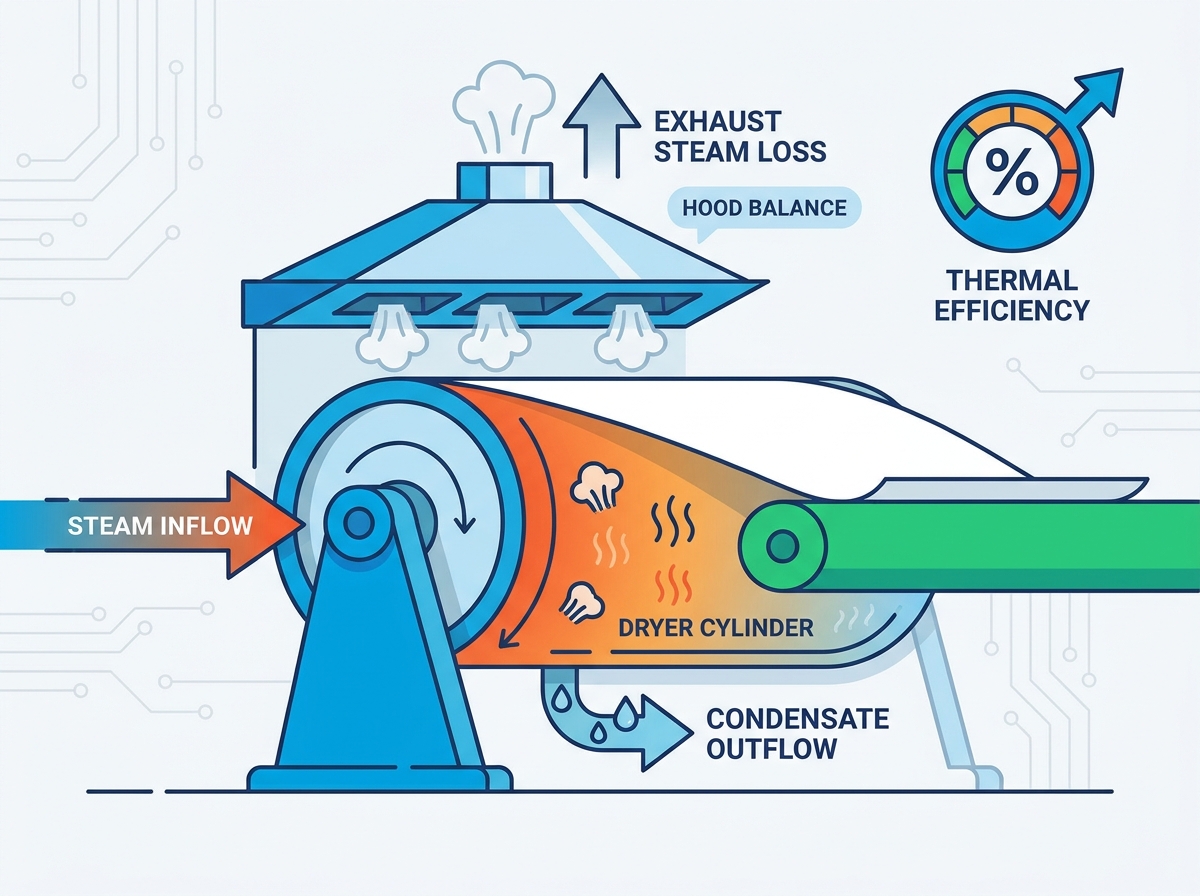
Once the distribution network is secure, your focus must shift to the primary heat exchangers on the line. The mechanical link between vapor quality and the drying rate is absolute. As hot vapor rushes into the rotating drums, it releases latent heat straight through the cast-iron shell and into the wet paper web.
Surface temperature uniformity across the drum face dictates your final paper quality. If a dryer cylinder experiences flooding—a scenario where water pools inside due to failing extraction—operators will immediately notice wet streaks on the paper web. This defect leads to rejected batches and frustrated quality control teams. Worse, it severely depresses overall production speed. Spotting these localized cold spots early prevents massive downstream energy waste.
Managing Condensate: Preventing Energy Bottlenecks
Delivering heat is only half the battle. Removing the cooled liquid is equally critical to the machine's survival. Siphons and mechanical traps perform the vital job of evacuating liquid from the rotating cylinders. When these internal components wear down from constant friction, they create severe operational bottlenecks.
Poor liquid removal creates immense internal backpressure. To compensate for this sudden drop in drying capacity, the boiler works overtime. It pushes vapor at much higher pressures just to maintain baseline production speeds. By implementing non-intrusive acoustic testing on steam traps, maintenance teams can verify the flow of condensate without ever needing to shut down the machine or interrupt a profitable production run.
Mapping Steam Loss: Diagnostic Techniques and Tools
Given the sheer complexity of modern paper lines, how do frontline mechanics actually locate invisible leaks? Relying on the naked eye is a guaranteed way to lose money. Today, facilities deploy thermal imaging as their first line of defense. By scanning external piping and valves with infrared cameras, technicians instantly spot glowing heat signatures. These bright spots clearly indicate degraded insulation or external venting.
For internal diagnostics, ultrasonic sensors are your best friend. These handheld devices detect the high-frequency hiss of gas blowing past a closed valve seal. They also easily identify a trap that has failed in the open position. To truly understand the financial damage, engineers must establish a baseline. You calculate the mass flow of gas entering the section and compare it against the theoretical energy required to evaporate water from the sheet. This mass-balance calculation translates abstract leaks into hard dollars lost.
| Diagnostic Method | Detection Capability | Implementation Cost | Best Used For |
| Visual & Tactile Inspection | Low. Only catches massive, obvious failures. | Zero | Daily operator walk-arounds. |
| Thermal Imaging (Infrared) | High. Maps surface temperatures and insulation gaps. | Moderate | Checking uninsulated pipes, header heat loss, and drum surface uniformity. |
| Ultrasonic Acoustic Testing | Very High. Hears internal bypasses invisible to the eye. | Moderate to High | Pinpointing blown steam traps and leaking rotary joints. |
| Digital Mass-Balance Monitoring | Comprehensive. Tracks real-time flow vs. consumption. | High | Plant-wide energy audits and predictive AI maintenance. |
Hood Balance and Ambient Heat Loss
Beyond internal piping dynamics, external atmospheric conditions heavily influence your total energy bill. The drying section is typically enclosed in a massive canopy designed to capture hot, humid air. The precise relationship between the dry makeup air supplied to this enclosure and the moisture-laden air exhausted from it dictates your baseline steam demand.
Poor exhaust control leads to a tragic loss of latent heat. If the exhaust fans pull too aggressively, freezing ambient air from the mill floor is dragged right into the canopy. This cold air chills the cylinders and forces the boiler to overcompensate. Calibrating humidity sensors and installing variable frequency drives ensures a perfect hood balance. This guarantees that every unit of heat is squeezed for maximum value within the drying chamber rather than vented uselessly to the outdoors.
Equipment Selection and Technical Specifications
When upgrading a facility to stop thermal leaks, the engineering interventions must perfectly match the machine's specific production parameters. You cannot apply a one-size-fits-all fix. For instance, a high-speed kraft paper line operating at 800 meters per minute demands a vastly different vapor flow rate compared to a specialized coating board machine running at lower speeds.
Engineers must evaluate the basis weight of the paper—typically ranging from 50 to 300 grams per square meter—to determine the required drying capacity. Upgrading legacy equipment to high-performance stationary siphons and modern rotary joints drastically improves heat transfer rates. Implementing cascading thermodynamic setups, where blow-through vapor from high-pressure sections is captured and recycled into lower-pressure groups, creates a highly efficient closed-loop energy cycle.
Industry Trends: The Shift to Predictive Energy Management
Looking at the broader manufacturing landscape, the paper industry is facing unprecedented pressure to decarbonize. Volatile global energy prices and strict environmental regulations are forcing mills to abandon reactive maintenance. Waiting for a pipe to hiss is no longer an acceptable strategy. Industrial digitalization has shifted from a luxury concept to a core survival mechanism.
Facilities are aggressively adopting digital twin technology and IoT-enabled acoustic monitoring. This transition from manual, periodic audits to real-time digital oversight is revolutionary. Control rooms now track pressure drops, vapor dryness, and valve health on a minute-by-minute basis. Machine learning algorithms analyze these historical trends to predict maintenance needs weeks before a minor leak escalates into a catastrophic, line-stopping failure. This proactive stance is driving unparalleled improvements in overall thermal efficiency.
Calculating the ROI of System Optimization
Ultimately, every engineering upgrade, sensor installation, and siphon replacement must be justified financially. Balancing capital expenditure against projected operational savings is a rigorous exercise for mill management.
Consider the impact of just a five percent reduction in annual fuel consumption for a mid-sized facility. The cash generated from reduced boiler fuel usage typically eclipses the initial hardware costs within a matter of months. Industry data consistently proves that modernizing the heating components of a paper line pays for itself rapidly. It structurally lowers the cost to produce every single roll of paper rolling off the winder.
Conclusion
Mapping vapor loss goes far beyond routine maintenance. It is a fundamental engineering strategy for sustainable, highly profitable manufacturing. By focusing on the structural health of your cylinders, refining your liquid evacuation management, and maintaining an optimized atmospheric enclosure, you can drastically enhance the performance of your entire production line. Embracing data-driven diagnostics ensures your facility remains competitive and primed for long-term success.
Ready to eliminate hidden thermal losses and upgrade your production line? Evaluate your facility's specific requirements and explore high-performance solutions tailored to your exact capacity. Visit Leizhan Paper Tech to find the ideal paper making machine configuration that aligns perfectly with your operational goals and drives your energy costs down.
FAQ
Q1: What is the most common cause of steam loss in a paper making machine?
Steam traps failing in the open position and leaking rotary joints are the top offenders. Because these components endure brutal thermal cycling and constant mechanical friction, they degrade over time. They often remain completely undetected without routine acoustic or thermal monitoring.
Q2: How does condensate accumulation affect paper quality?
When liquid is not effectively removed, it creates a stagnant layer of water inside the rotating drum. This water acts as a powerful thermal insulator, causing highly uneven surface temperatures. Consequently, the paper web develops moisture streaks, inconsistent caliper, and uneven tensile strength.
Q3: What is hood balance and why does it matter?
Hood balance refers to the precise equilibrium between the dry air entering the dryer canopy and the humid air exiting it. If this ratio is broken, you either lose heated air to the surrounding factory floor or allow humidity to build up. Both scenarios force the boiler to consume more fuel to maintain target drying temperatures.
Q4: How do you calculate steam consumption per ton of paper?
Engineers calculate this by measuring the total mass of steam supplied to the dryer section over a specific period, subtracting the mass of returned condensate, and dividing that net energy usage by the total tons of saleable paper produced in that same timeframe. A rising ratio indicates hidden leaks or failing heat transfer.
Q5: What is the acceptable pressure drop in a paper machine steam group?
While specific numbers vary based on machine design and operating speed, a typical acceptable differential pressure between the steam supply header and the condensate return header ranges from 2 to 5 psi for optimal siphon evacuation. Anything higher often indicates a blockage or severe blow-through.
Q6: How often should I conduct a thermal loss audit?
Ideally, a comprehensive thermal and acoustic audit should be performed every six to twelve months. However, if operators notice an unexplained spike in the energy-to-production ratio or a sudden drop in drying speeds, an immediate diagnostic check must be initiated.
Q7: Can old paper making machines be retrofitted for better thermal efficiency?
Absolutely. Many older lines see incredible performance gains by simply upgrading to modern rotary joints, improved stationary siphon technology, and automated control valves. These targeted retrofits offer a rapid return on investment without the massive capital expense of replacing the entire production line.


