Investing in a paper manufacturing plant is a monumental financial commitment. Picture yourself standing on a massive, empty factory floor. You hold the blueprints in hand, envisioning a relentless production line. For plant managers and investors nearing the bottom of the purchasing funnel, simply knowing the ballpark price of a production line falls short. You need a granular, nuts-and-bolts look at exactly where every dollar is routed.
The financial outlay varies wildly depending on your target capacity, the specific end-product, and the technological configurations required to stay competitive. This comprehensive guide delivers an empirical breakdown of machinery components by section. It helps you accurately forecast your overall investment, sidestep hidden installation fees, and establish a realistic timeline for your plant's return on investment.
Key Takeaways
Drying is the Largest Expense: The dryer section typically consumes the largest portion, roughly 30 to 40 percent, of the equipment budget due to the sheer volume of heavy cast-iron cylinders and complex steam management systems.
Capacity Dictates Price: Machine width and operating speed are the two primary engineering variables that exponentially inflate or reduce the baseline cost.
Automation is an Investment: Expanding digital control networks increases upfront costs but drastically slashes long-term labor expenses and material waste.
Don't Forget Installation: Physical assembly alongside civil engineering works can tack an additional 15 to 25 percent onto the base machinery purchase price.
Total Capital Matters: Evaluating the entire project expenditure, including stock preparation, the main machine, and essential auxiliary systems, is crucial for accurate project financing and risk mitigation.
Understanding the Total Capex for Paper Manufacturing
What is Total Capex in Paper Making?
When mapping out a new facility, grasping the complete financial picture is non-negotiable for securing funding and projecting a realistic ROI. Capital expenditure in the context of a paper mill project extends far beyond the initial invoice for the main manufacturing equipment. It represents the total funds utilized to acquire, upgrade, and maintain physical assets. Many industry newcomers mistakenly equate the quotation for the bare machinery with the entire project budget. However, a comprehensive evaluation of your Capex for paper making machine setup must account for land acquisition, heavy civil works, utility grid connections, and the initial working capital required to keep the lights on until the mill turns a profit.
The Four Pillars of Paper Mill Capex
To accurately assess the financial requirements of a new facility, the total budget is generally divided into four foundational pillars. Stock preparation equipment is the first phase. Before paper can be formed, raw materials must be processed. This requires pulpers, cleaners, screens, and refiners to transform recycled waste or virgin wood into a uniform fiber suspension. Next is the main paper making machine. This core production unit forms, presses, dries, and rolls the pulp. It represents the largest single capital outlay in the facility. Auxiliary systems form the third pillar. A paper mill cannot function without supporting infrastructure, including industrial boilers for steam generation, wastewater treatment plants to meet environmental compliance, air compressors, and vacuum pump networks. Finally, infrastructure and installation require significant funds. Factory construction, specialized concrete foundations, and the final mechanical assembly are mandatory expenditures that must be calculated early in the feasibility stage.
Cost Breakdown by Major Manufacturing Sections
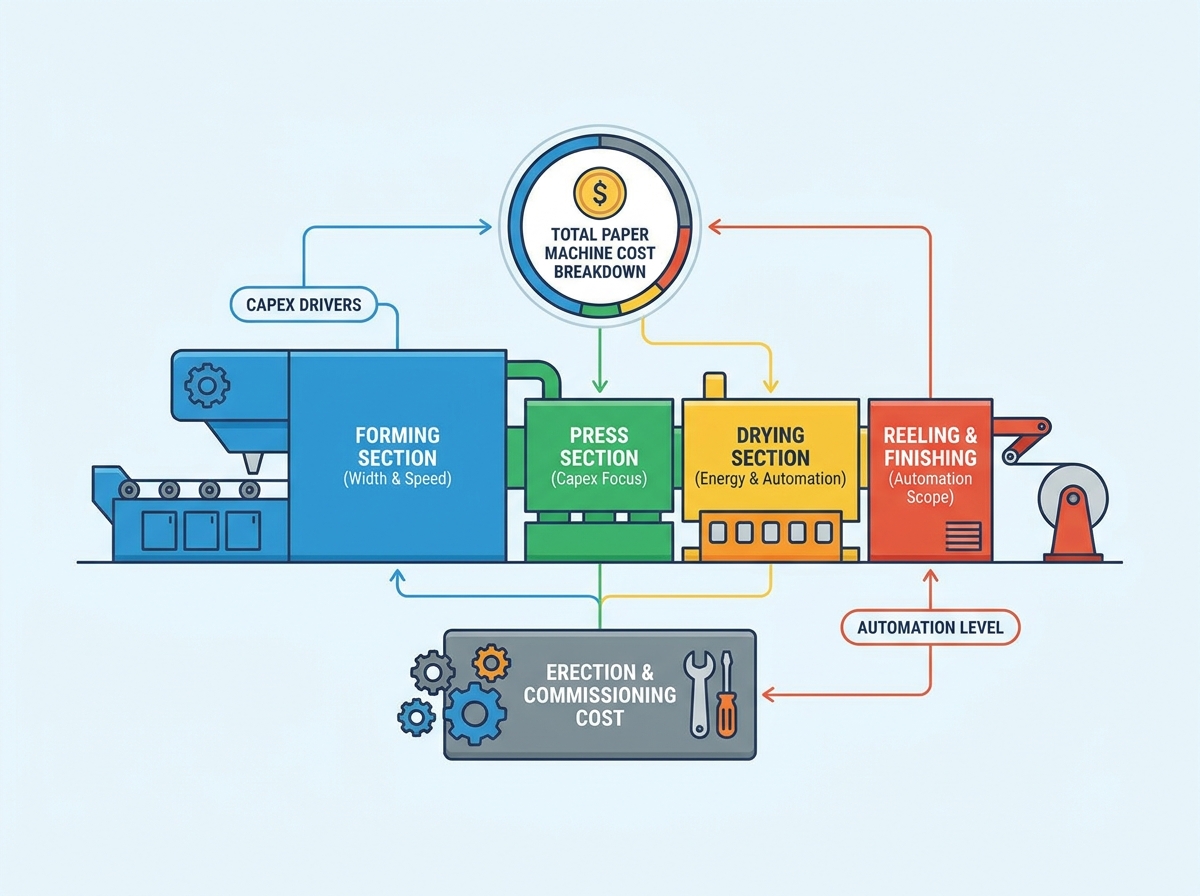
To give buyers a tangible financial framework, we must deconstruct the core manufacturing line module by module. A modern mill is not a single monolith. It is a sequence of highly specialized zones, each carrying distinct engineering hurdles and associated price tags.
| Production Section | Estimated Budget Allocation | Key Engineering Focus |
| Headbox & Wire Section | 15 to 20 percent | Fluid dynamics, precision stainless steel, uniform fiber distribution |
| Press Section | 15 to 20 percent | Mechanical dewatering, heavy roller durability, Jumbo/Shoe press integration |
| Dryer Section | 30 to 40 percent | Thermal efficiency, cast-iron cylinders, enclosed hoods, steam recovery |
| Size Press & Coating | 5 to 10 percent | Surface treatment precision, chemical application uniformity |
| Finishing Equipment | 10 to 15 percent | Automated roll-handling, web tension control, high-speed slitting |
The Headbox and Wire Section
This section is responsible for distributing the diluted pulp suspension evenly across the forming fabric. The wire section then allows rapid initial water drainage, forming a continuous wet web of paper. The price here is heavily driven by fluid dynamics engineering and material quality. High-precision stainless steel construction is mandatory to prevent corrosion and ensure a uniform basis weight. Advanced hydraulic or air-cushioned headboxes command a significant premium over standard open-type designs. Yet, they are absolutely essential for high-speed operations.
The Press Section
Once the wet sheet leaves the wire, it enters the press section. Here, intense mechanical pressure is applied via heavy rollers and specialized felts to squeeze out maximum moisture. Mechanical dewatering is drastically cheaper than thermal drying. Therefore, investing heavily in this phase pays phenomenal dividends in future energy savings. The inclusion of cutting-edge technologies, such as Jumbo presses or Shoe presses, noticeably increases the initial equipment setup cost. However, it drastically improves the dryness of the sheet before it hits the evaporators.
The Dryer Section
The delicate paper web passes over a series of massive, steam-heated cylinders to evaporate the remaining moisture, bringing the product to its final dry state. Historically, this remains the most expensive territory of the entire line. Costs are dictated by the sheer volume of raw materials required, specifically dozens of heavy, precision-machined cast-iron dryer cylinders. Furthermore, the mandatory inclusion of a fully enclosed hood system, rotary steam joints, siphons, and complex heat recovery infrastructure drives the price steadily upward.
Size Press and Coating
For specific grades of paper, starch or chemical coatings are applied to the surface to improve structural tensile strength, water resistance, and printability. This section is highly dependent on your end product. While completely optional for standard tissue or basic kraft liner machines, a precision size press is mandatory for fine writing paper, high-grade packaging, and coated boards.
Calender, Reel, and Winder
The calender uses polished steel rolls to iron the paper, ensuring a smooth surface and uniform thickness. The paper is then wound into massive jumbo rolls at the reel, and finally sliced to customer-specified dimensions at the winder. Pricing in the finishing section is dictated by the level of precision and automation. Automated roll-handling systems, computerized tension controls to prevent web breaks, and high-speed slitting knives require sophisticated engineering. This adds noticeable weight to the overall equipment valuation.
How Machine Width Impacts Equipment Cost
When configuring a production line, the physical scale directly dictates your quotation. The relationship between width and price is exponential, not linear. Upgrading the Machine Width of your paper equipment requires far more than just stretching the rollers. For instance, jumping from a standard 1092 millimeter web to a massive 5800 millimeter span introduces severe structural challenges.
As the span increases, the structural integrity of the machine must be drastically reinforced to prevent the rollers from deflecting or bending under their own immense weight and operational tension. This demands exponentially thicker steel framing, colossal custom bearings, and highly robust foundations. Additionally, opting for standard industry widths allows suppliers to use existing engineering blueprints. Requesting highly customized dimensions forces the manufacturer to redesign framing from scratch, resulting in steep engineering premiums. Despite the higher initial purchase price, a wider web produces significantly more tonnage per hour without requiring a proportional increase in administrative overhead. This ultimately accelerates the ROI for industrial-scale operations.
The Role of Operating Speed in Equipment Pricing
Alongside physical dimensions, the operational velocity of your line is a primary determinant of capital requirements. Driving a machine past standard limits introduces severe physical challenges, most notably high-frequency vibration and intense centrifugal forces. Achieving an ultra-high Speed in paper manufacturing operations necessitates strict mechanical tolerances.
When evaluating quotes, it is vital to distinguish between design speed and working speed. Manufacturers price machines based on their maximum design speed, as this dictates the engineering safety standards applied to the entire line. Pushing beyond 800 meters per minute, or aiming for 1200 meters per minute on advanced tissue lines, requires dynamic balancing of every single rotating cylinder. It demands advanced lubrication networks for high-temperature bearings and specialized vibration dampening structures. Investors must carefully calculate whether the premium paid for a high-speed configuration is justified. Undersizing limits revenue potential, while oversizing for a modest market results in wasted capital.
Industry Insight: The Shift Towards Eco-Centric and Smart Manufacturing
Recent industry analyses highlight a significant pivot in how capital is allocated within modern mills. Driven by stringent global carbon emission regulations and volatile energy prices, manufacturers are heavily front-loading their budgets into thermal optimization. Upgrading to closed-loop steam recovery systems and advanced shoe presses is no longer seen as an optional premium. It has become a regulatory necessity. Furthermore, the rising cost of skilled labor has accelerated the adoption of AI-driven predictive maintenance and smart sensors. While these technological leaps inflate the initial purchase price, field engineers note that the payback period has drastically shortened. Mills often neutralize the premium within the first 36 months of operation through massive energy and material savings.
Factoring in Automation Scope and Control Systems
Modern paper manufacturing thrives on digital precision. The extent of your Automation Scope across the production line will heavily influence both the initial invoice and your future profitability. A comprehensive control infrastructure typically includes Distributed Control Systems for overall plant management, Quality Control Systems utilizing radioactive or infrared sensors to monitor basis weight, and Machine Control Systems for motor synchronization.
A basic setup relying on manual valves and simple relay controls is undeniably cheaper upfront. In contrast, integrating state-of-the-art programmable logic controller automated systems requires a substantial financial commitment. Yet, this digital infrastructure minimizes human error, slashes the frequency of paper breaks during production, and guarantees strict adherence to quality parameters. The drastic reduction in rejected paper alone often pays for the automation systems within the first few years, making it a mandatory investment for competitive mills.
Hidden Expenses: Erection Cost, Civil Works, and Commissioning
A notorious pitfall for ambitious investors is neglecting the logistics of transforming crated components into a breathing, operational plant. These hidden expenses can severely disrupt project financing if ignored during the planning phase.
The physical assembly, commonly known as the Erection Cost of the paper making machinery, involves heavy lifting cranes, specialized installation crews, and weeks of meticulous alignment. Depending on geographical location and line complexity, this phase can easily tack on an additional 15 to 25 percent to the base equipment bill. Furthermore, paper machines generate significant vibrational forces, requiring highly specialized civil engineering. Pouring deep concrete foundations with specific trenches for water drainage and pulp piping is rarely included in the machinery quote. Finally, the cost of commissioning carries its own daily rates and travel expenses. Having the manufacturer's chief engineers on-site to run water tests, calibrate automation systems, and train local operators is essential but costly.
Actionable Selection Guide for Plant Managers
How do you translate these cost factors into a practical purchasing decision? The scale of your ambition ultimately drafts your financial blueprint. The paper industry accommodates a wide spectrum of production scales, each carrying distinct economic profiles.
For localized, niche markets, setups producing 50 to 150 tons daily are highly viable. These setups are ideal for producing tissue paper or medium-batch corrugated fluting. They require a fraction of the land, a simpler control system, and a vastly reduced installation budget. Conversely, industrial-scale behemoths designed for international supply chains demand massive capital deployment, strict environmental compliance, and relentless operational efficiency.
To optimize your investment, define your target capacity clearly. Align your tonnage requirements with standard machine models to avoid custom engineering fees. Prioritize the press section by spending extra capital on advanced dewatering technologies, which reduces the thermal load on the dryer section. Finally, evaluate supplier capabilities rigorously. Ensure the manufacturer has a proven track record of delivering turnkey solutions, including robust stock preparation lines and reliable auxiliary systems.
Conclusion
Calculating the true financial requirements of a paper mill setup requires looking far beyond a single price tag on a proforma invoice. By breaking down the costs section by section, from the precision fluid dynamics of the headbox to the heavy cast iron of the dryer section, you gain a clear, objective picture of where your capital is being allocated. Remember that structural and operational variables like target width, operational velocity, and your chosen digital control systems will heavily influence the final quote. Furthermore, overlooking auxiliary systems and the final assembly logistics can lead to devastating budget overruns. Armed with this comprehensive breakdown, you are now prepared to approach suppliers, request detailed quotations, and make a data-driven investment decision that ensures the long-term viability of your manufacturing project.
Ready to configure a highly efficient, cost-effective paper production line tailored to your exact specifications? Explore the robust portfolio of industrial solutions at Leizhan Paper Tech. From advanced kraft paper machines to high-speed tissue lines, our engineering team provides customized equipment that maximizes your ROI. Visit our official website to request a detailed, itemized quotation today.
FAQ: Cost of Paper Making Machine
What is the average cost of a paper making machine?
The cost can range anywhere from 100,000 dollars for a small, basic tissue-making machine to over 20 million dollars for a high-speed, wide-width industrial packaging paper machine. The final price depends entirely on targeted production capacity, design speed, and the level of automation required.
Which section of the paper machine requires the most maintenance cost?
The press section and the dryer section generally incur the highest ongoing maintenance costs. The press section requires frequent replacement of expensive press felts, while the dryer section involves the constant maintenance of steam joints, rotary siphons, and the continuous lubrication of high-temperature bearings.
How much does the Automation Scope actually add to the total cost?
A comprehensive automation package featuring advanced Quality Control Systems and Distributed Control Systems can add 10 to 15 percent to the total machine cost. Despite this premium, it is universally recommended for modern mills to ensure product consistency and drastically reduce material waste.
Is the Erection Cost usually included in the equipment quote?
Not always. Many manufacturers quote Free On Board or Cost, Insurance, and Freight prices for the machinery only. Investors must explicitly ask if the provided quote includes installation labor, on-site engineering supervision, heavy lifting equipment, and final commissioning procedures.
Can I reduce my Capex by buying a narrower machine?
Yes, reducing the machine's width significantly lowers the initial capital expenditure. However, investors must ensure that the narrower width aligns perfectly with standard market roll sizes for their specific paper grade. Failing to match market standards can result in excessive trimming waste, which quickly eliminates any initial financial savings.
How long does it take to install and commission a new paper production line?
The installation and commissioning phase typically spans 3 to 6 months depending on the scale and complexity of the machinery. This timeframe accounts for precise mechanical alignment, heavy civil works, electrical integration, and rigorous water testing before live pulp is introduced.
What is the typical ROI period for a new paper mill investment?
The return on investment period for a well-planned paper mill generally ranges from 3 to 5 years. This timeline is highly dependent on local market demand, raw material costs, and the energy efficiency of the chosen equipment, which directly impacts daily operational margins.


