When investing in tissue manufacturing equipment, plant operators face a critical engineering crossroad. You must decide whether your production line requires an advanced adhesive unit. For B2B manufacturers, selecting the precise machine configuration is a delicate balancing act. You want to minimize production costs while elevating product quality. Standard daily-use tissues rely on simple mechanical pressing to hold their delicate layers together. However, the surging consumer demand for premium, ultra-soft, and highly absorbent hygiene products has propelled adhesive technologies to the forefront of the converting industry.
Looking at recent market shifts, the global hygiene sector is undergoing a massive wave of premiumization. Consumers no longer view paper products as mere functional commodities. Instead, there is a distinct preference for lotion-infused, 4-ply, and ultra-durable sheets. Industry data reveals that production lines equipped with advanced adhesive units are capturing a substantially larger market share in urban retail sectors. Consequently, upgrading to multi-ply capability is rapidly transitioning from a luxury add-on to a strategic survival tactic for forward-thinking converters.
This comprehensive guide breaks down the intricate mechanics of multi-layer bonding. We will explore how modern adhesive applications compare with traditional pressing methods. Ultimately, this will help you determine exactly what technical specifications your production line needs to secure a competitive edge and maximize your return on investment.
Key Takeaways
An Optional Yet Lucrative Upgrade: A standard line does not strictly require an adhesive unit to churn out basic 2-ply commodities. Yet, it becomes an absolute necessity for manufacturing the plush 3-ply or 4-ply products dominating modern retail shelves.
Mechanical Pressure vs. Chemical Bonding: Traditional edge pressing relies on sheer mechanical force to interlock fibers. In stark contrast, chemical bonding utilizes a specialized, skin-safe glue. This results in a noticeably softer, bulkier, and structurally superior final sheet.
Strategy Dictates Machinery: Your target demographic should drive your equipment purchases. If your objective is to disrupt the luxury hygiene market, investing in advanced bonding capabilities is highly recommended.
Downstream Mechanical Impact: Integrating moisture and glue fundamentally alters the physical properties of the paper web. This heavier material necessitates highly precise tension control mechanisms during the folding phase to prevent frustrating jams.
Understanding Lamination in Tissue Manufacturing
To make an informed purchasing decision, one must first grasp the underlying chemistry and mechanics of the process. In the context of paper converting, tissue lamination equipment executes a highly controlled operation used to bond multiple independent plies of raw paper together. Instead of merely crushing the edges, this method applies a microscopic, highly uniform layer of water-soluble adhesive between the sheets. This technique secures the layers while simultaneously creating microscopic air pockets. These tiny voids are the secret behind the superior liquid absorbency and cloud-like tactile softness found in top-tier consumer brands.
Picture the factory floor. Massive jumbo rolls of raw cellulose unwind, and the separate webs of paper feed through a labyrinth of tension-control rollers. One specific ply glides over a precisely engraved applicator cylinder. This cylinder transfers a micro-layer of glue onto the surface. Immediately following this application, the separate plies converge. They pass through a set of marrying rollers, typically a combination of forged steel and dense rubber. The synchronization here must be flawless. Advanced programmable logic controllers govern the servo motors. This ensures web tension remains absolutely constant so the adhesive cures perfectly before the heavy web reaches the final cutting stages.
Mechanical Ply Bonding vs. Glue Lamination
For facility managers expanding their converting operations, choosing between mechanical interlocking and chemical bonding is a foundational engineering dilemma. Each methodology presents distinct operational realities.
Frequently referred to as edge embossing, mechanical ply bonding technology is the legacy method utilized in standard tissue manufacturing. The machine deploys steel-to-steel rollers to physically crush the extreme edges of the paper web. This intense, localized pressure forces the cellulose fibers to intertwine. It locks the layers together without introducing any liquid adhesives.
Pros: The most glaring advantage is the lower barrier to entry regarding machinery costs. Furthermore, operators enjoy zero ongoing consumable expenses for glue. The equipment demands far less maintenance since there are no sticky applicator baths to clean or calibrate.
Cons: The mechanically crushed borders can feel noticeably abrasive against the skin. Specifically, this technique loses its efficacy when attempting to merge three or more layers. It often results in a rigid product with disappointing sheet bulk.
Conversely, the modern standard for premium tissue integrates liquid adhesive directly into the decorative stamping phase. This fuses multiple layers into a unified, breathable sheet.
Pros: By trapping structural air pockets between the layers, this method delivers ultimate softness and remarkable liquid retention. It remains the most reliable engineering solution for producing thick 4-ply items.
Cons: Upgrading to this technology requires a steeper initial capital investment. It also introduces perpetual operational costs for the adhesive and demands a workforce with specialized technical training.
| Feature | Mechanical Ply Bonding | Glue Lamination |
| Bonding Mechanism | Steel-to-steel edge crushing | Water-soluble adhesive application |
| Ideal Ply Count | 1-ply to 2-ply | 3-ply, 4-ply, and above |
| Product Softness | Standard, edges can be stiff | Premium, high bulk and cloud-like feel |
| Maintenance Level | Low | Medium to High requires glue bath cleaning |
| Initial Investment | Economical | Higher capital expenditure |
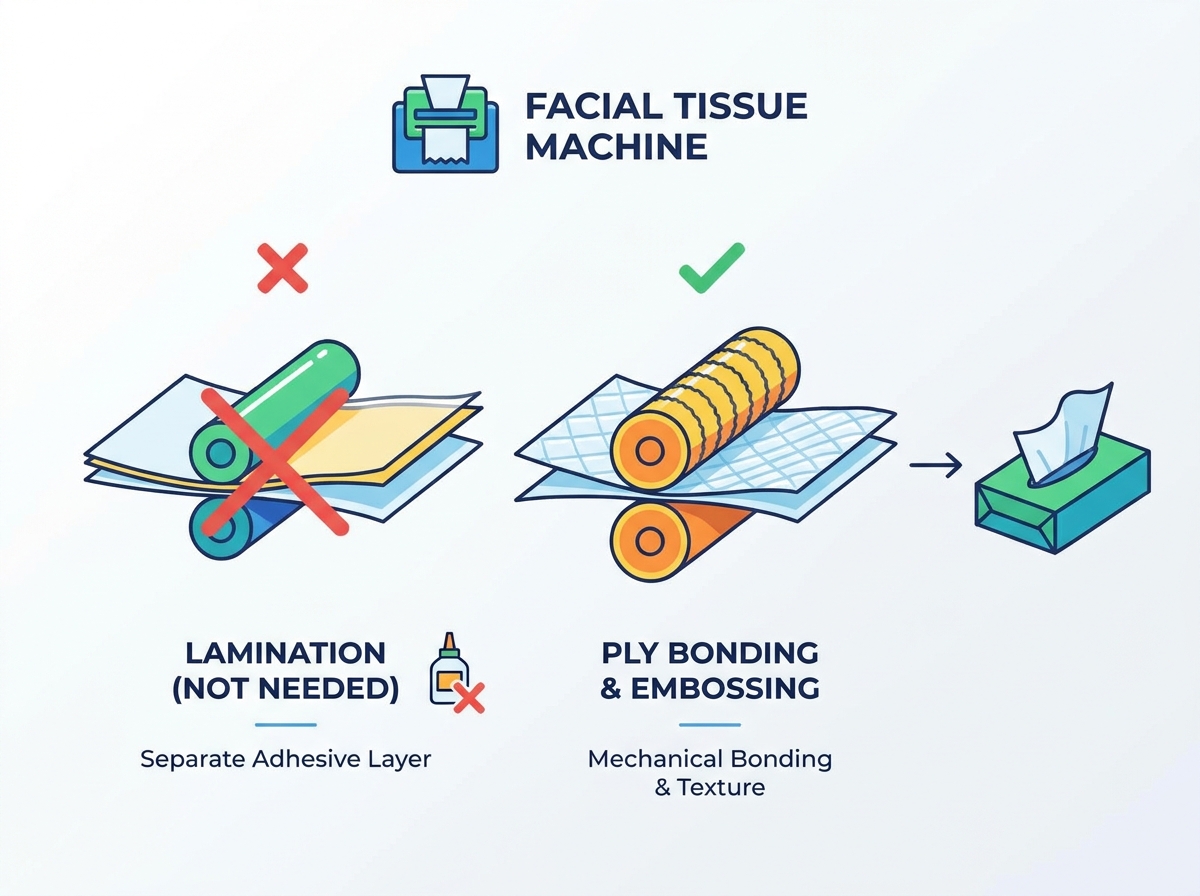
Does Your Facial Tissue Paper Making Machine Actually Need Lamination?
Not every factory floor requires top-tier adhesive capabilities. You can safely bypass this feature if your primary business model centers on churning out economy-grade, standard 2-ply facial tissue products for bulk commercial or institutional markets. If your target demographic prioritizes rock-bottom retail pricing over cloud-like softness, the added expense of glue systems will erode your margins. Facilities operating in regions with strict budget constraints for raw materials will benefit from sticking to reliable mechanical presses.
In contrast, chemical bonding is non-negotiable for specific market segments. If your strategic roadmap includes launching premium 3-ply, 4-ply, or specialized balsam-treated tissues, this technology is a strict prerequisite. It is equally essential for manufacturing customized goods featuring high-definition decorative stamping. The adhesive acts as a structural anchor for intricate designs. Finally, if you aim to utilize a single machine chassis to produce diverse product types, the operational versatility provided by an adhesive unit is indispensable.
The Role of Embossing and the Folder in Laminated Tissues
The addition of moisture and glue fundamentally alters how the continuous paper web behaves as it surges through the downstream components of the machine.
Stamping patterns into paper is not merely an aesthetic choice. It plays a critical role in the structural integrity of the sheet. When paired with an adhesive system, tissue embossing machinery reaches its peak effectiveness. In a premium setup, the glue is applied directly to the raised points of the pattern. This technique is known as nested or point-to-point bonding. When the plies are compressed, the glue actively locks the decorative crests in place. Without this chemical anchor, a beautifully stamped pattern can easily flatten out during the harsh packaging process.
Furthermore, processing this enhanced paper introduces specific engineering hurdles for the downstream folding mechanisms. Glued paper is inherently thicker, significantly heavier, and possesses vastly different tensile characteristics than dry-bonded paper. As this bulky web rushes into the vacuum cylinders, maintaining exact tension is critical. Too tight, and the bonded plies will delaminate or snap. Too loose, and the interfolding mechanism will suffer catastrophic jams. Modern equipment must therefore feature upgraded, servo-driven tissue folder systems and robust vacuum pumps. These industrial-grade components accurately grip and manipulate the heavier web without sacrificing commercial output speeds.
Facial Tissue Machine vs. Napkin Paper Machine: Feature Variations
To allocate capital wisely, buyers must understand the engineering nuances separating different types of converting machinery. While they may look identical to an untrained eye, their internal configurations are tailored for vastly different end-user experiences.
Napkin machines frequently deploy aggressive point-to-point stamping combined with heavy adhesive applications. The primary engineering objective for a napkin is to forge a stiff, highly absorbent, and structurally rigid square. It must withstand rigorous wiping and maintain elaborate folded shapes on a restaurant table.
Facial tissue equipment, however, focuses obsessively on continuous V-folding or interfolding mechanisms. These are engineered for seamless pop-up dispensing from a cardboard carton. When adhesives are applied in this context, the primary goal is maximizing sheer softness and trapped air volume, explicitly avoiding stiffness. Recognizing this distinction ensures that factory managers procure the correct cylinder specifications and glue viscosity settings. This prevents the accidental production of rough, cardboard-like tissues.
Cost vs. ROI: Is a Laminating Facial Tissue Machine Worth the Investment?
Transitioning to advanced multi-ply manufacturing requires meticulous financial forecasting. An objective breakdown of capital and operational expenditures against anticipated profit margins is crucial.
The initial capital expenditure difference between a bare-bones mechanical machine and a fully loaded adhesive-capable line can be substantial. This premium accounts for the precision glue applicators, specialized engraved cylinders, and heavy-duty servo motors for micro-tension adjustments. It also covers the enhanced vacuum systems required to wrangle the heavier paper web.
In addition, operational expenditure will rise. Managers must budget for the continuous procurement of water-soluble adhesives. Laminated systems also draw slightly more electrical power to run the auxiliary rollers, vacuum pumps, and minor heating elements that keep the glue at an optimal viscosity. Maintenance labor also increases due to mandatory cleaning protocols for the applicator baths.
Despite these elevated costs, the return on investment is frequently compelling. Premium multi-ply tissues command a drastically higher retail price point compared to standard economy packs. Industry case studies routinely demonstrate that the expanded profit margin per unit quickly offsets the higher machinery and consumable costs. For aggressively positioned brands, the premium product tier often justifies the heavier initial investment within 12 to 18 months of uninterrupted commercial production.
Key Guidelines for Choosing the Right Equipment
Selecting the optimal machinery demands a systematic audit of your daily production targets and the equipment's technical limits. Instead of looking at abstract features, evaluate these concrete engineering parameters:
Assess Your Production Capacity: Begin by defining your exact speed requirements. For instance, high-performance machines from industry leaders like Leizhan Paper Tech often feature a design speed of 150 to 200 meters per minute. Understand that integrating wet glue can marginally affect top operational speeds due to the required curing time. Ensure the machine’s rated output aligns with your facility's daily quotas.
Evaluate the Ply Bonding System: Even if you purchase an advanced adhesive system, ensure the machine retains a reliable mechanical edge-pressing feature as a baseline. The most versatile machines offer adhesive application as a bypassable modular unit. This grants you the agility to run both budget and luxury product lines on the exact same chassis.
Check Folder Precision: Because premium tissues are significantly bulkier, the folding architecture must be exceptionally durable. Prioritize equipment utilizing CNC-machined folding rollers paired with high-capacity vacuum blowers. Look for machines that support flexible folding widths and precise web tension control. These industrial-grade features are vital for manipulating thick paper webs without inducing irregular folds or line-stopping jams.
Partner with Reliable Manufacturers: The inherent complexity of fluid dynamics and web tension requires steadfast technical support. Emphasize procurement from veteran vendors who provide comprehensive on-site installation, rigorous operator training for the glue systems, and rapid after-sales spare parts delivery.
Conclusion
Deciding whether your production line requires an advanced adhesive unit ultimately boils down to your strategic market positioning. Traditional mechanical pressing is perfectly adequate for churning out everyday 2-ply commodities. However, integrating an adhesive system unlocks the lucrative ability to manufacture the ultra-soft, premium multi-ply products that modern consumers crave. By combining high-definition stamping with precision folding technology, a fully equipped machine delivers unmatched operational versatility and a robust ROI for forward-thinking paper converters.
If you are ready to upgrade your facility and capture the premium hygiene market, selecting the right machinery partner is critical. Explore the high-performance tissue paper finishing equipment at Leizhan Paper Tech to find the exact configuration that meets your production goals and future-proofs your product catalog.
FAQ
Q1: Can a facial tissue paper making machine run without glue lamination?
Yes, absolutely. The vast majority of standard production lines operate using mechanical edge embossing. This legacy process utilizes heavy steel rollers to physically crush the edges of the paper layers together. It securely interlocks the cellulose fibers without a single drop of adhesive. Glue application is considered an optional, high-end upgrade designed specifically for luxury, multi-ply items.
Q2: What is the difference between ply bonding and lamination in tissue making?
In standard manufacturing terminology, ply bonding refers to the mechanical pressing and crushing of tissue edges to fuse the layers. It requires zero consumables other than the raw paper. Lamination, conversely, is a chemical-mechanical hybrid process. It involves spreading a microscopic film of water-soluble glue between the sheets before pressing them. This creates a dramatically stronger, thicker, and more cohesive final product.
Q3: Does lamination make facial tissue softer?
Yes. By applying adhesive in a highly precise, nested pattern, the process creates and permanently locks in microscopic air pockets between the layers of paper. This increased internal volume makes the tissue feel significantly bulkier and spongier to the human touch. It delivers the premium, cushion-like softness expected from top-tier brands.
Q4: Can one machine make both facial tissue and kitchen towels if it has lamination?
While face tissues and kitchen towels generally require entirely different downstream finishing modules, the core adhesive technology remains the same. Highly customized, versatile converting machines can sometimes leverage the same adhesive unit to bond multiple plies for both product categories. This achieves premium absorbency across the board.
Q5: Will adding a lamination unit slow down my folder?
In older or budget-grade machinery, the added weight and moisture of the glued paper often caused web tension issues. This forced operators to dial back the machine speed. However, modern, high-quality equipment is engineered with advanced servo-driven synchronization and high-powered vacuum folding cylinders. These contemporary systems seamlessly handle the heavier web, allowing facilities to run premium glued products at blistering commercial speeds without significant delays.
Q6: What type of glue is used for tissue lamination?
Tissue converting lines utilize specialized, water-soluble, and skin-safe adhesives. These glues are formulated to be non-toxic, hypoallergenic, and environmentally friendly. They are designed to cure rapidly under ambient factory temperatures, ensuring the paper web does not tear during the high-speed folding process.
Q7: How much does a lamination unit add to the machine cost?
The cost varies significantly based on the machine's width, design speed, and automation level. Generally, adding a high-precision adhesive unit with engraved applicator cylinders and servo-motor controls can increase the initial capital expenditure by 20 to 40 percent compared to a basic mechanical model. However, the higher retail margins of premium tissues typically offset this cost rapidly.


