Introduction
In the highly competitive pulp and paper sector, a massive capital asset like an industrial paper machine demands relentless monitoring. Every single minute this heavy-duty equipment sits idle translates directly to thousands of dollars in lost potential revenue. Unplanned stops do more than just destroy your daily efficiency. They create a severe ripple effect that disrupts your entire downstream supply chain.
Recent market data reveals a rapid shift in operational expectations across the globe. Driven by tight margins and rising energy costs, facility leaders are no longer satisfied with merely keeping the lights on. The integration of digital twins and real-time IoT sensors is actively pushing the baseline for acceptable performance much higher. Modern mills are leveraging these smart technologies to foresee mechanical degradation weeks before a failure occurs. This proactive shift is redefining what constitutes a "good" operational rate. Understanding these established industry standards is critical for plant managers who want to optimize their daily routines.
This comprehensive guide breaks down the core benchmarks for modern paper manufacturing. We will explore the hidden financial costs of unexpected downtime and detail actionable strategies designed to help facility leaders maximize their Shift Output. From advanced sensor integration to smart logistics, these insights will help you maintain a sustainable competitive edge in a demanding global market.
Key Takeaways
Industry Standards: World-class operational availability typically exceeds the 85-90% threshold, whereas the general industry average still hovers around 75-80%.
Financial Impact: Unplanned outages halt immediate production while exponentially increasing material waste and causing massive energy spikes during subsequent system restarts.
Proactive Strategies: Implementing targeted, data-driven condition monitoring can reduce unexpected mechanical breakdowns by up to 30%.
Inventory Management: Maintaining a strategic, well-audited spare parts reserve is non-negotiable. Waiting for critical replacement components from external vendors remains a leading cause of prolonged facility paralysis.
Continuous Improvement: Consistent operator training, rigorous daily visual inspections, and timely component retrofits are essential for sustaining high production targets over the equipment's lifespan.
What is the Standard Benchmark for an Industrial Paper Making Machine?
To accurately evaluate the performance of your manufacturing facility, you must first understand where the industry baseline currently sits. Establishing these foundational metrics allows engineers and decision-makers to identify hidden bottlenecks and set realistic goals for production improvement.
Defining OEE in Paper Mills
In industrial manufacturing, Overall Equipment Effectiveness serves as the gold standard for measuring true productivity. It combines three distinct metrics: availability, performance, and quality. For any heavy-duty continuous production line, the foundational metric is machine Uptime. Simply put, if the cylinders are not turning, performance and quality are effectively zero. You calculate this percentage by dividing the actual operating hours by the planned production time.
Average vs. World-Class Percentages
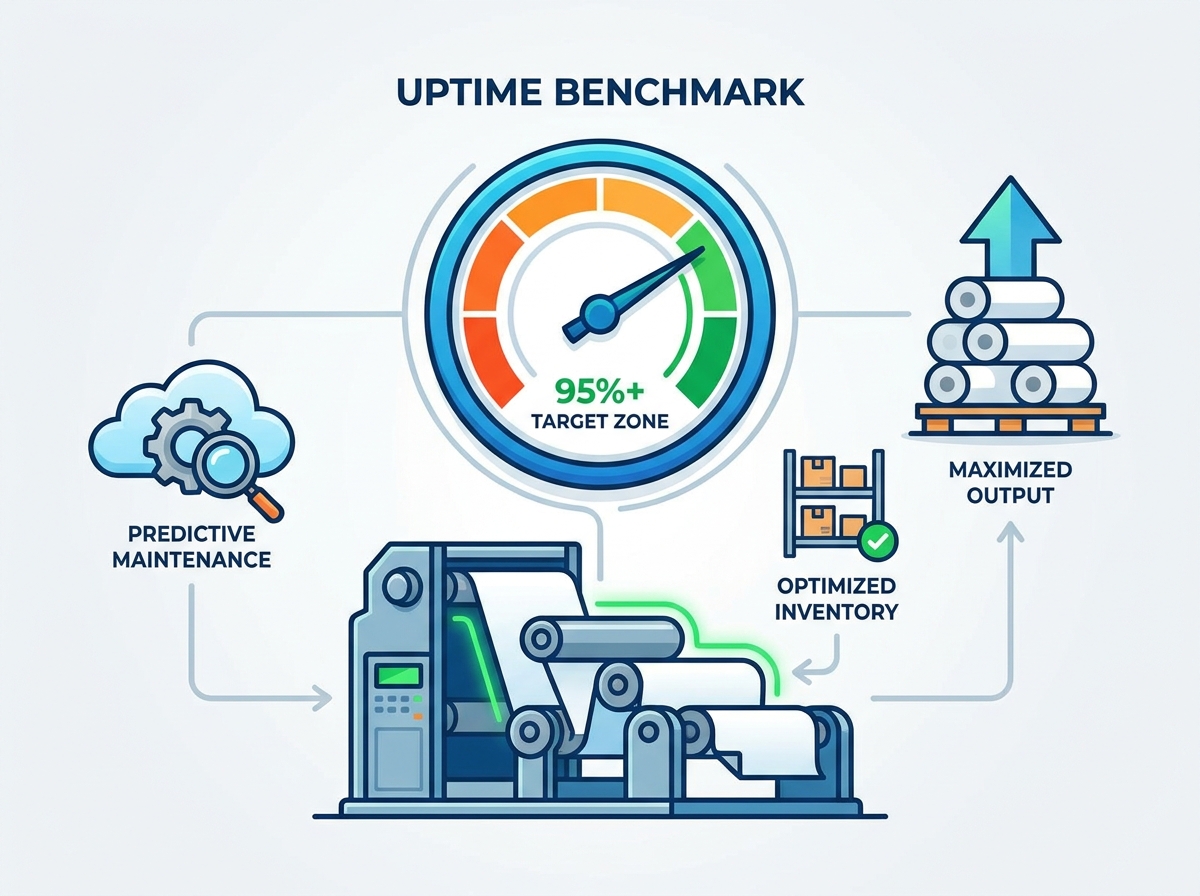
Operational observations and historical data reveal a stark divide between standard facilities and top-tier performers. Many standard mills operate within the 75% to 80% range. These plants frequently experience micro-stops, regular web breaks, and chaotic reactive maintenance events. In contrast, world-class facilities consistently achieve 85% to over 90% availability. They hit these figures through rigorous maintenance schedules, advanced automation, and strict quality control of raw materials.
Furthermore, we must distinguish between scheduled and unscheduled stops. Scheduled pauses are planned well in advance for routine cleaning, machine clothing changes such as forming fabrics or press felts, and system inspections. Unscheduled stops refer to sudden, catastrophic equipment breakdowns. World-class facilities do not just minimize sudden failures; they actively optimize their scheduled maintenance windows to be as fast and efficient as possible.
Key Factors Impacting the Reliability of Paper Making Equipment
Several operational, mechanical, and environmental variables dictate how consistently your system runs day in and day out. Understanding these variables is the first step toward mitigating risks and extending the overall equipment Reliability of your capital assets.
Age and Condition of the Equipment
The physical age of the machinery plays a substantial role in its baseline performance. Legacy equipment inherently struggles to maintain consistent operation compared to modern, highly automated machines. Over decades of continuous operation, high-stress components experience significant mechanical fatigue. Metal wear, microscopic bearing degradation, and slight alignment shifts lead to vibrations that eventually cause catastrophic component failure. Modern lines utilize advanced metallurgy and precision engineering to withstand these continuous stresses much more effectively.
Quality of Raw Materials and Pulp
Mechanical integrity is only one side of the equation. The chemical and physical properties of the raw materials fed into the system are equally critical. Variations in pulp consistency, the introduction of low-quality recycled fibers, and fluctuations in process water chemistry severely disrupt the delicate balance of the wet end. When the fiber matrix collapses, the web breaks. You hear that distinct tearing sound, alarms go off, and your crew is suddenly scrambling to clear broke and painstakingly re-thread the tail. This chaotic process drains time, operator morale, and facility resources.
How Downtime Directly Affects Production and Profitability
Understanding the exact financial stakes of machine stoppages helps corporate stakeholders justify necessary capital investments in maintenance programs and structural upgrades.
Calculating the True Cost of Unplanned Outages
The cost of an idle line extends far beyond the simple loss of manufacturing time. To calculate the true financial impact, plant managers must consider a multi-faceted framework. First are the labor costs: paying operators and maintenance crews while the system produces nothing. Next is the lost revenue, representing the direct market value of the unproduced paper. Finally, there is a massive restart penalty. Bringing a massive industrial setup back to optimal running temperatures and speeds requires threading the tail, stabilizing the basis weight, and balancing the moisture profile. This transition period consumes vast amounts of thermal and electrical energy without generating saleable product.
| Operational State | Average Uptime | Maintenance Approach | Financial Impact |
| Reactive (Lagging) | 70% - 75% | Fix-on-fail; emergency repairs | High waste, severe restart energy penalties |
| Preventive (Standard) | 80% - 85% | Scheduled, calendar-based replacements | Moderate losses, some premature part disposal |
| Predictive (World-Class) | 90%+ | Condition-based, real-time IoT monitoring | Minimized downtime, maximum saleable yield |
Production Metrics You Should Be Tracking
To measure true efficiency accurately, mills should track the total saleable tonnage produced per operational window against the theoretical maximum capacity. Consistent mechanical stability eliminates the drastic peaks and valleys associated with reactive repairs. When production volumes become predictable, supply chain logistics are streamlined. Forecasting becomes highly accurate, and customer satisfaction improves due to reliable, on-time order fulfillment.
The Role of Advanced Maintenance in Maximizing Machine Operations
Transitioning a facility from a reactive fix-it-when-it-breaks mentality to a proactive, data-driven approach is the secret to hitting world-class operational benchmarks.
Moving from Reactive to Proactive Strategies
Preventive schedules involve replacing parts on fixed time intervals, regardless of their actual physical condition. While better than waiting for a failure, this can lead to prematurely discarding perfectly good components. The implementation of Predictive Maintenance protocols relies on continuous condition monitoring to dictate exactly when an intervention is needed. By analyzing real-time data trends, maintenance teams identify the early warning signs of component degradation. This allows repairs to be scheduled during planned outages rather than interrupting an active, profitable production run.
Sensor Technology and Vibration Analysis
Modern smart mills heavily utilize an array of sophisticated diagnostic tools. Acoustic sensors and thermal imaging cameras monitor the heat signatures and operational noises of massive dryer section bearings, identifying excessive friction or electrical resistance. Vibration analysis is particularly critical for high-speed rotating rolls. Sensors attached to the press section detect microscopic changes in vibration frequencies that indicate a bearing is beginning to spall or a shaft is falling out of alignment. When integrated into a centralized dashboard, these tools alert technicians to lubricate or replace parts precisely before they cross the threshold of functional failure.
Managing Inventory to Reduce Repair Delays
Even with the absolute best condition-monitoring strategies in place, physical parts operating in harsh, hot, and wet environments will eventually wear out. How a facility manages its logistics directly dictates how fast it can recover from a mechanical issue.
Critical Components for Industrial Machinery
A strategic and well-audited Spare Inventory is a non-negotiable asset for any high-performing mill. Waiting weeks for a replacement part to be manufactured and shipped from overseas causes extended facility paralysis. Must-have items that must be kept in stock include forming fabrics, press felts, dryer screens, specialized high-temperature bearings, mechanical seals for suction rolls, and critical electrical assets like backup variable frequency drives.
Balancing Carrying Costs with Operational Goals
While stocking every possible part guarantees rapid repairs, it also ties up millions of dollars in stagnant capital. To optimize logistics, plant managers should conduct a criticality analysis. Weigh the carrying cost of the spare part against the potential cost of an outage if that part fails. Tier 1 parts—those essential for operation with long lead times—must be kept on-site. Conversely, Tier 2 and Tier 3 parts can be managed through strategic vendor partnerships. Establishing precise Service Level Agreements with reliable suppliers ensures rapid delivery of standard components, protecting operational goals without unnecessarily bloating warehouse shelves.
Upgrading Your Equipment for Better Performance
There comes a point in the lifecycle of every production line where maintenance alone cannot bridge the gap between average and world-class benchmarks. Hitting higher targets often requires physical modifications and technological retrofits.
When to Retrofit vs. Replace
Decision-makers frequently face the dilemma of upgrading specific sections versus investing in entirely new machinery. A retrofit is highly cost-effective when the core frame is structurally sound, but specific modules are causing bottlenecks. Upgrading to a modern hydraulic headbox can drastically improve paper profile consistency. Installing a shoe press can increase dewatering efficiency, immediately reducing the steam demand in the dryer section.
However, full replacement becomes the most financially sound decision when the annualized cost of ongoing reactive maintenance exceeds the capital expenditure of a new system. When evaluating a new setup, look at the hard numbers. Modern industrial paper making machines designed for high-yield fluting or testliner should offer a trim width between 3200mm to 5800mm to remain globally competitive. Working speeds need to comfortably hit the 800 to 1200 m/min range without generating excessive frame vibration. If your current machine maxes out at 400 m/min and suffers from chronic basis weight fluctuations, a simple retrofit won't cut it. You need a full system replacement featuring automated profiling and advanced Distributed Control System integration.
Best Practices to Achieve World-Class Excellence
Achieving operational excellence requires a holistic approach that seamlessly integrates dedicated people, standardized processes, and advanced technology.
Operator Training and Routine Inspections
The most advanced sensor technology cannot entirely replace the value of a highly trained, observant operator. Operators serve as the first line of defense against prolonged downtime. They must be intimately familiar with the unique sounds, smells, and visual cues of a healthy running line. Establishing a culture of autonomous maintenance—where operators are responsible for basic daily tasks like visual inspections, minor cleaning, and simple lubrication—ensures immediate anomaly detection. This frees up dedicated engineers to focus on complex, predictive tasks.
Partnering with Reliable Equipment Manufacturers
No paper mill operates in a vacuum. Sustaining top-tier benchmarks requires establishing long-term relationships with proven Original Equipment Manufacturers. Collaborating with a reputable supplier ensures access to ongoing technical support, expert engineering consultation, and genuine replacement parts. A strong partner will provide detailed lifecycle management plans, conduct periodic audits, and offer customized upgrade pathways designed specifically to enhance the output and profitability of your unique facility.
Conclusion
Sustaining high equipment availability is not an accident; it is the result of a clear, deliberate engineering strategy. By understanding established industry standards, paper mills can identify their operational gaps and target specific areas for mechanical improvement. Investing in data-driven condition monitoring and optimizing spare parts logistics drastically reduces unexpected operational delays. Furthermore, empowering operators through continuous training and partnering with reliable manufacturers builds a highly resilient production environment.
Ready to stop fighting daily breakdowns and start maximizing your yield? Whether you need a complete high-speed kraft paper line or a targeted wet-end rebuild, evaluating your baseline is the first step. Visit Leizhan Paper Tech to explore advanced, high-efficiency machinery. Partner with engineering experts who understand exactly what it takes to keep your cylinders turning and secure sustainable profitability in today's demanding market.
FAQ
What is a good uptime percentage for an industrial paper making machine?
A standard industry benchmark for general availability is around 75% to 80%. However, highly optimized, world-class paper mills actively aim for an operational rate of 85% to 90% or higher, diligently minimizing both scheduled maintenance stops and unscheduled mechanical breakdowns.
How does predictive maintenance improve paper mill reliability?
This proactive strategy uses advanced condition-monitoring tools like continuous vibration analysis and thermal imaging to detect early signs of equipment wear. It allows maintenance teams to schedule necessary repairs during planned outages, preventing unexpected mechanical breakdowns and drastically improving overall equipment lifespan.
Which spare inventory items are most critical for paper machines?
Critical reserves include specific items that have notoriously long lead times or are absolutely essential for the machine to operate safely. This typically includes machine clothing, specialized heavy-duty bearings, mechanical seals, high-capacity pumps, drive motors, and critical process sensors.
What causes the most downtime in paper mills?
Web breaks are historically the most frequent cause of unplanned downtime. These are typically triggered by fluctuations in pulp consistency, poor wet-end chemistry, or sudden tension changes. Mechanical failures in rotating equipment, such as bearing seizures in the dryer section, cause less frequent but significantly longer outage periods.
How often should paper machine clothing be replaced?
The lifespan of machine clothing depends heavily on the machine's operating speed and the type of paper being produced. Generally, forming fabrics may last anywhere from 30 to 90 days, press felts typically require replacement every 30 to 45 days, and dryer screens can last up to a year. Condition monitoring and permeability testing should dictate the exact replacement schedule.
How is shift output calculated in paper manufacturing?
It is typically calculated by accurately measuring the total saleable tonnage of paper produced during a specific operational window. This metric is heavily influenced by the running speed of the machinery, the width of the paper web, and the total continuous operating time maintained throughout the duration of the shift.
When should I consider replacing my industrial paper making machine to improve performance?
You should seriously consider full replacement or a major structural retrofit when the annualized cost of ongoing reactive maintenance and the revenue lost to constant stoppages exceed the annualized capital cost of a completely new line. Replacement is also necessary when legacy equipment can no longer meet modern market quality standards regarding speed and trim width.


