Introduction
Picture yourself sitting at a desk. You are reviewing a massive, multi-page quote for a new production line. The final number can seem staggering. Investors and procurement managers often wonder where the capital actually goes. Investing in a paper manufacturing plant requires a major financial leap. Understanding exactly what you are paying for is the first critical step toward building a profitable, resilient business.
What exactly drives the capital expenditure of these industrial behemoths? Is it more financially prudent to purchase a modest, localized setup? Or should you pour capital into a high-capacity, fully automated industrial complex? In this comprehensive breakdown, we will pull back the curtain on heavy machinery costs. We will explore how specific engineering choices affect your total investment. From the fluid dynamics of the wet end to the precision of the final winding, you will gain the clarity needed to make an informed, bottom-line-friendly decision.
Key Takeaways
Scale Dictates the Baseline: The core financial outlay heavily depends on your desired production capacity. Options range from compact localized setups to massive, fully automated plant infrastructures.
Component Quality Matters: Upgrading high-performance components and increasing thermal capacity will raise upfront costs. However, these choices drastically slash long-term energy and operational expenses.
Automation is an Investment: Transitioning to intelligent motor controls ensures smoother operations, fewer web breaks, and superior paper quality. This upgrade easily justifies a higher initial expenditure.
Installation is Not Free: The final budget extends far beyond the factory floor. Civil engineering, international shipping, and professional assembly are substantial factors in your total financial planning.
ROI Over Initial Cost: Bargain-bin equipment frequently leads to inflated maintenance schedules and excessive power consumption. Evaluating the total cost of ownership is the only true measure of long-term profitability.
The Baseline: What Determines the Initial Quote?
Before diving into the granular mechanics of specific cylinders and pumps, it is essential to understand the overarching macro-factors. These set the foundation for your machinery quote. The baseline Machine Price is rarely a one-size-fits-all figure. Rather, it is a highly customized calculation based on your unique operational goals and physical plant constraints.
Production capacity and target speed are the most significant cost drivers. Imagine the deafening roar and intense vibration of a facility engineered to churn out 750 tons per day. To sustain speeds of up to 800 meters per minute without tearing the paper web, the machinery requires exceptionally heavy, durable cast-iron framing and aerospace-level dynamic balancing. Conversely, a quiet 50-ton-per-day mill operates under vastly different physical stresses. This smaller scale requires a much lighter structural footprint and lower-rated motor drives.
Furthermore, your choice of raw materials fundamentally shifts the equipment requirements. If your business model relies on recycling Old Corrugated Containers instead of processing virgin wood pulp, the production line must integrate specialized stock preparation systems. High-density cleaners and fine screens must rigorously filter out abrasive impurities like staples, sand, and plastics. This mandatory preparation stage adds a distinct layer of complexity and cost to the initial budget.
The Wet End and Press Section: Engineering for Quality
Stepping onto the floor of a paper mill, the wet end is where the magic begins. A highly diluted suspension of pulp and water is transformed into a continuous, fragile web. Because this environment is perpetually soaked in water and processing chemicals, standard metals would rust away in weeks. Manufacturers must utilize premium, corrosion-resistant 304 or 316L stainless steel. This material requirement transforms the forming zone into a major financial center.
At the heart of this section lies the headbox. A standard open-type headbox might suffice for low-grade fluting. However, producing high-strength kraft paper demands advanced hydraulic headboxes. These sophisticated units orchestrate a precise fluid dynamic dance. They ensure every millimeter of the paper has uniform fiber distribution and consistent basis weight across trimmed widths reaching up to 5800 millimeters.
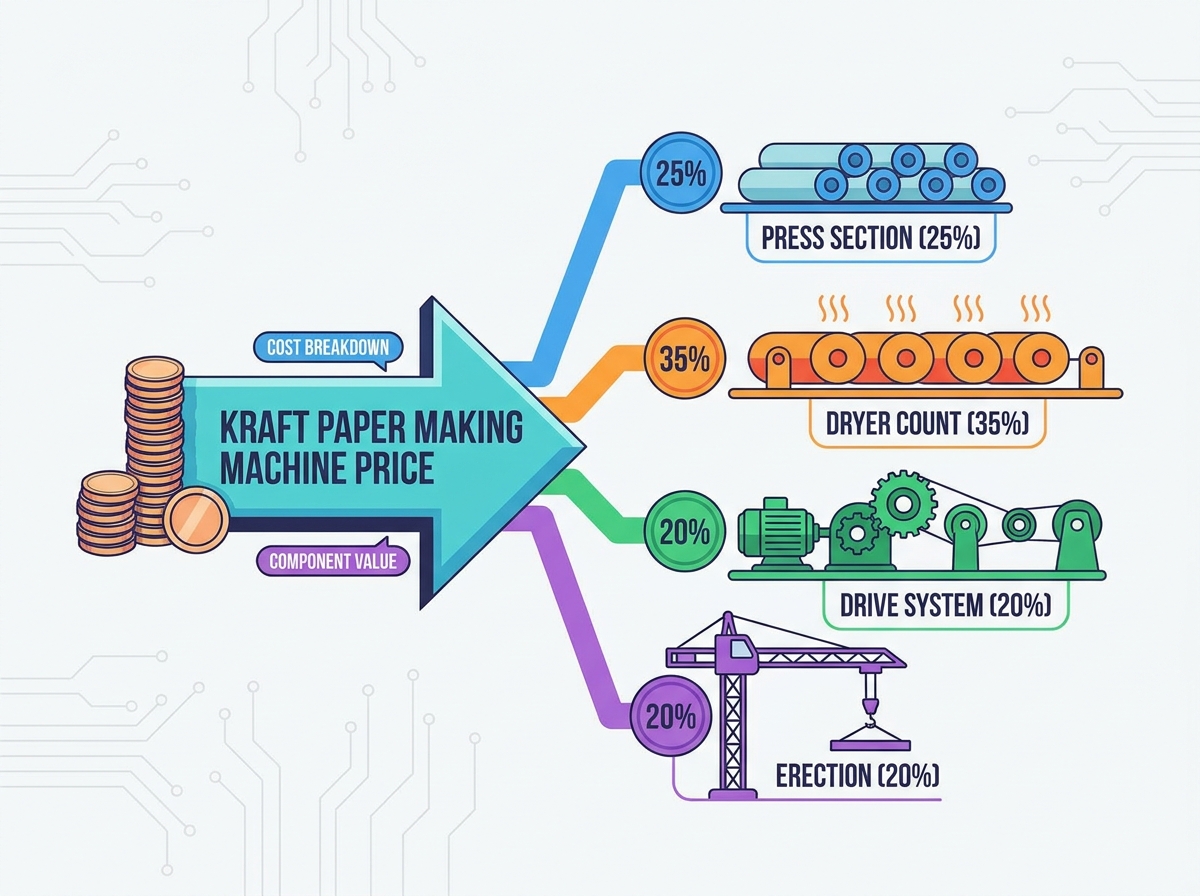
Immediately following formation, the fragile web enters the Press Section. This is a critical juncture for mechanical water removal. Investing in heavy-duty jumbo presses or state-of-the-art shoe presses requires a steep initial capital injection. The physics of manufacturing are unforgiving in this regard. Squeezing water out mechanically is exponentially cheaper than boiling it away with steam later in the process. A masterfully engineered pressing module can increase web dryness by just a few percentage points. Yet, that tiny margin translates to massive thermal energy savings over a two-decade operational lifespan.
The Drying Process: How Thermal Management Impacts Your Budget
Once the damp paper leaves the pressing rollers, it plunges into the dryer section. Factory engineers universally recognize this as the longest, heaviest, and most energy-hungry segment of the entire manufacturing line. The cost drivers here are tied directly to thermal efficiency and sheer physical mass.
Calculating the optimal Dryer Count is a rigid engineering formula. It is dictated by your target speed and the maximum basis weight, typically ranging from 80 to 220 grams per square meter for standard kraft paper. Pushing faster speeds or heavier board requires extended drying times. This inevitably means adding more cast-iron steam cylinders to the line. Attempting to artificially shrink your budget by removing cylinders is a dangerous game. It will create a permanent bottleneck, capping your facility's maximum daily output regardless of how fast the wet end operates.
In addition, modern drying is not merely about heating up metal drums. It relies heavily on complex steam and condensate management systems. Integrating high-quality rotary joints, stationary siphons, and fully enclosed steam hoods is mandatory for capturing exhaust heat and recycling it. These advanced heat recovery ecosystems demand a higher initial capital outlay. Specifically, their ability to drastically reduce boiler fuel consumption ensures a rapid return on investment, protecting profit margins against volatile global energy prices.
Power and Precision: Investing in the Right Drive Architecture
A modern production line is a synchronized beast. It consists of dozens of independent rotating sections that must operate in absolute harmony. If the drying cylinders pull the paper even a fraction of a percent faster than the pressing section feeds it, the wet web will snap under the tension. This failure triggers costly production halts and raw material waste.
Historically, budget-tier machines relied on mechanical line shaft drives. While these legacy systems are mechanically simpler and cheaper to acquire, they suffer from relentless friction losses, mechanical wear, and nightmarish maintenance profiles. In contrast, today's high-efficiency plants utilize Sectional Variable Frequency Drive architectures.
By assigning independent, precisely controlled electric motors to each section, an advanced Drive System inevitably elevates the initial equipment quote. Yet, this level of automation is non-negotiable for serious players. Integrated with premium Programmable Logic Controllers and Distributed Control Systems, these drives provide operators with real-time fault diagnostics and automatic tension control. The result is a drastic reduction in manual labor, practically zero web breaks, and optimized electrical draw that slashes monthly utility bills.
From Delivery to Installation: The Hidden Logistics Costs
Many investors meticulously negotiate the factory-floor equipment quote. However, they often fail to budget accurately for the logistical reality of moving hundreds of tons of industrial steel across the globe. The ex-works price of the machinery is merely the starting line of your financial journey.
Navigating the labyrinth of international shipping is a complex endeavor. A mid-sized kraft paper machine requires dozens of heavy-duty shipping containers, flat racks for oversized cylinders, and specialized inland freight handling. When you factor in customs duties, port fees, and comprehensive maritime insurance, the logistical expenditure becomes a formidable line item.
Once the crates arrive at your facility, civil engineering presents the next major hurdle. These machines cannot sit on a standard warehouse floor. They demand perfectly leveled, heavily reinforced concrete foundations capable of absorbing relentless dynamic vibrations. Deep basements are often required to house white-water recovery tanks and vacuum pumps. Finally, the professional Erection of the machine requires a multidisciplinary team of expert millwrights and electricians. Using laser measurement tools to align cylinders to fractions of a millimeter is tedious, highly skilled work that forms a substantial, unavoidable cost component.
Actionable Selection Guide: Matching Specs to Your Budget
The global machinery market is diverse. Determining where to allocate your capital depends entirely on your business model, regional market demand, and access to sustainable raw materials. To move away from abstract pricing, procurement managers must evaluate equipment based on strict operational parameters. Below is a practical framework to help align your capital expenditure with expected production capabilities.
| Production Scale | Trimmed Width | Operating Speed | Daily Capacity | Ideal Investment Profile |
| Small-Scale / Regional | 1575 mm - 2400 mm | 150 - 250 meters per minute | 50 - 100 tons per day | Emerging markets, localized recycling centers. Accessible upfront capital and swift installation timeline. |
| Medium-Scale / Commercial | 2800 mm - 3600 mm | 300 - 500 meters per minute | 150 - 300 tons per day | Growing packaging firms. Balances moderate initial investment with excellent energy recovery systems. |
| Large-Scale / Industrial | 4200 mm - 5800 mm | 600 - 800 meters per minute | 400 - 750+ tons per day | Global commodity suppliers. Requires formidable capital but offers the lowest production cost per ton due to massive economies of scale. |
Mini and small-scale machines are highly attractive for businesses with limited initial capital. However, because they lack the extreme energy recovery ecosystems found in larger setups, the operational cost to produce a single ton of paper is generally higher. Conversely, large-scale turnkey plants require a formidable upfront investment. The sheer volume of output and optimized energy efficiency make these massive facilities fiercely competitive in the global commodities market.
Industry Market Trends: Navigating the Future of Manufacturing Costs
To truly understand equipment pricing, one must look at the macroeconomic forces reshaping the pulp and paper industry. Driven by the explosive, sustained growth of global e-commerce, the demand for high-strength, lightweight corrugated packaging is pushing manufacturers to innovate rapidly. Current market analysis reveals a massive shift toward producing 80 to 120 grams per square meter lightweight kraft paper. This trend forces machinery builders to engineer press sections that can handle delicate webs without crushing fibers.
Specifically, stringent global sustainability mandates are forcing a shift away from rudimentary, energy-wasting machines. Modern quotes now heavily feature Internet of Things sensor integration, artificial intelligence-driven quality control scanners, and closed-loop water recycling systems. While these cutting-edge additions undeniably inflate the initial capital expenditure, they are no longer viewed as optional luxuries. They are essential survival tools. These technologies insulate manufacturers from volatile global energy prices and increasingly strict environmental taxation, ultimately safeguarding long-term profit margins.
Long-Term ROI: Why the Cheapest Option Isn't Always the Best
When reviewing competitive tenders, the lowest initial quote is often a glaring warning sign rather than a lucky bargain. In the unforgiving environment of heavy industry, capital expenditure is only a small fraction of the total cost of ownership. Operational expenditure—which encompasses electricity, steam, water, raw materials, and maintenance labor—will quickly eclipse the purchase price over the machine's multi-decade lifespan.
Cheaper machines frequently achieve their attractive price points through dangerous material substitution. Replacing high-grade stainless steel with lower-grade alloys in the wet end guarantees rapid corrosion. This failure forces the plant into premature, unplanned shutdowns. A machine that suffers from chronic downtime costs an enterprise exponentially more in lost revenue and broken delivery contracts than whatever was saved on the initial invoice.
Furthermore, future-proofing is a critical financial strategy. Investing in a modular machine architecture allows for seamless future upgrades. You can integrate additional drying cylinders or update control software without requiring a complete mechanical overhaul. By prioritizing engineering integrity over the lowest possible upfront cost, astute investors secure a reliable, long-term asset capable of thriving in a hyper-competitive industrial landscape.
Conclusion
Understanding where your capital truly goes empowers you to make smarter, more strategic purchasing decisions. It is never just about the raw tonnage of steel. It is about the sophisticated fluid dynamics in the wet end, the thermal capacity dictated by the drying infrastructure, the precision of automated motor controls, and the specialized expertise required for flawless installation.
By looking beyond the initial sticker shock and focusing relentlessly on energy efficiency, automation, and long-term mechanical durability, you can build a kraft paper manufacturing plant that delivers a strong, reliable return on investment for decades to come. When you are ready to evaluate real-world specifications and secure a production line engineered for profitability, visit https://www.leizhanpapertech.com to find the perfect machinery match for your operational ambitions.
FAQ
What is the average kraft paper making machine price?
The total investment varies wildly based on production capacity, operating speed, and integrated technology. A compact, small-scale machine designed for localized use might range between $50,000 to $100,000. In stark contrast, a large-scale, fully automated industrial plant capable of producing hundreds of tons per day can demand anywhere from $1 million to well over $10 million.
Why is the pressing stage so expensive to manufacture?
This critical section utilizes massive heavy-duty framing, specialized rubber or polyurethane-covered rolls, and complex hydraulic systems. Its primary objective is to aggressively squeeze water out of the delicate paper web without crushing the actual fibers. This level of extreme precision engineering is costly to fabricate. It is absolutely vital for maximizing energy savings in the subsequent thermal drying stages.
Can I reduce the number of drying cylinders to save money?
While reducing the cylinder count will certainly lower the initial equipment quote, it comes with severe operational penalties. Fewer dryers directly limit your machine's maximum production speed and restrict the maximum basis weight of the paper you can successfully dry. It is always a better financial strategy to calculate the exact thermal requirements for your target output rather than cutting corners on drying capacity.
Does the manufacturer handle the physical installation of the equipment?
Most reputable global manufacturers offer comprehensive installation and commissioning services, frequently referred to as turnkey projects or supervised assembly. This highly specialized service is usually quoted separately from the base machinery cost. It includes the travel, accommodation, and skilled labor of their engineering team to ensure the massive equipment is aligned and running perfectly.
How much physical space do I need for a kraft paper making plant?
Space requirements are dictated by the machine's trim width, total linear length, and the necessary footprint for stock preparation. A small-scale setup might fit comfortably within a warehouse of 1,000 to 2,000 square meters. However, a large-scale industrial plant requires a massive facility, often exceeding 10,000 square meters, plus extensive additional acreage for raw material storage and wastewater treatment facilities.
How long does it take to install and commission a kraft paper machine?
The timeline heavily depends on the scale of the operation. A small, modular machine can often be assembled and tested within two to three months. A large-scale industrial facility, however, involves complex foundation pouring, piping, and electrical integration. This massive undertaking typically requires six to twelve months from the time the equipment arrives at the site until the first commercial roll of paper is produced.
What is the expected lifespan of a commercial paper making machine?
When properly maintained, a high-quality paper machine is a multi-generational asset. Built with heavy cast iron and premium stainless steel, the core mechanical structure can easily last 30 to 50 years. Naturally, wear parts like forming fabrics, press felts, and rotary joints require regular replacement. The electrical drives and control software will also need modernization every 10 to 15 years to maintain peak efficiency.


