The global tissue and hygiene paper market is shifting rapidly. Driven by stringent sanitary standards and a booming takeout sector, commercial buyers no longer settle for generic paper products. Recent industry trend analyses highlight a massive pivot toward application-specific formats. Quick-service restaurants are aggressively adopting interlocking dispenser napkins to minimize waste and ensure touchless dispensing. Meanwhile, upscale dining establishments are demanding ultra-premium, cloth-like rectangular folds to elevate the guest experience. For investors and plant managers, aligning your machinery with these market realities is a critical survival strategy.
Standing out in this competitive landscape requires more than just turning on a machine. From my years on the factory floor troubleshooting tissue converting lines, I constantly see operators struggling with paper jams, web breaks, and inconsistent creasing. These issues almost always stem from a mismatch between the chosen Fold Type, the raw material, and the equipment's mechanical limits. This guide strips away the marketing fluff. We will break down the exact mechanical nuances of tissue converting, evaluate material thickness, and show you how to configure a highly profitable production line.
Key Takeaways
Market Alignment: Choosing between a standard square, a cutlery-ready rectangle, or an interlocking dispenser style dictates your entire business model and target demographic.
Mechanical Reality: High-speed tissue converting is unforgiving. Understanding the physical boundaries of your specific folding unit prevents catastrophic downtime.
Quality Drivers: The structural integrity of your finished product relies entirely on the engineered synergy between the fold geometry, the paper's Ply Count, and the mechanical bonding from textured steel rollers.
End-to-End Efficiency: A fast folder is useless if your downstream Packing system cannot keep up. Synchronization is the secret to high ROI.
What Is a Napkin Paper Making Machine and How Does It Work?
To make a sound capital investment, you must first understand the physics happening inside the machine. A commercial tissue converting system is a continuous, high-tension ecosystem engineered to transform massive raw material rolls into consumer-ready products at breakneck speeds.
The Core Process from Jumbo Roll to Finished Product
The manufacturing cycle starts at the unwind stand. A massive jumbo tissue roll, often weighing well over a ton, is securely locked into place. Advanced electronic tension control systems take over here. If the web tension is off by even a fraction, the delicate paper web will stretch, warp, or snap completely. The paper then navigates through an embossing unit. Heavy steel rollers apply immense localized pressure to create tactile texture and mechanically weld multiple paper layers together.
If your clients require branding, optional flexographic printing stations apply water-based inks to print logos or decorative borders. The processed web then surges into the folding section. Mechanical guides and high-suction vacuum cylinders sculpt the continuous sheet into individual units. Finally, a high-speed rotary blade severs the paper before discharging the stacks onto a conveyor for wrapping.
The Vital Role of the Folding Unit
Within this intricate assembly, the Napkin Folder acts as the operational heartbeat of your plant. This highly specialized module dictates the final geometric shape and dimensional accuracy of your product. Its internal architecture determines whether you are producing standard symmetrical squares or complex overlapping dispenser formats. Because these mechanisms operate under tight engineering tolerances at speeds often exceeding 1500 sheets per minute, the build quality of this specific module directly dictates your maximum daily yield.
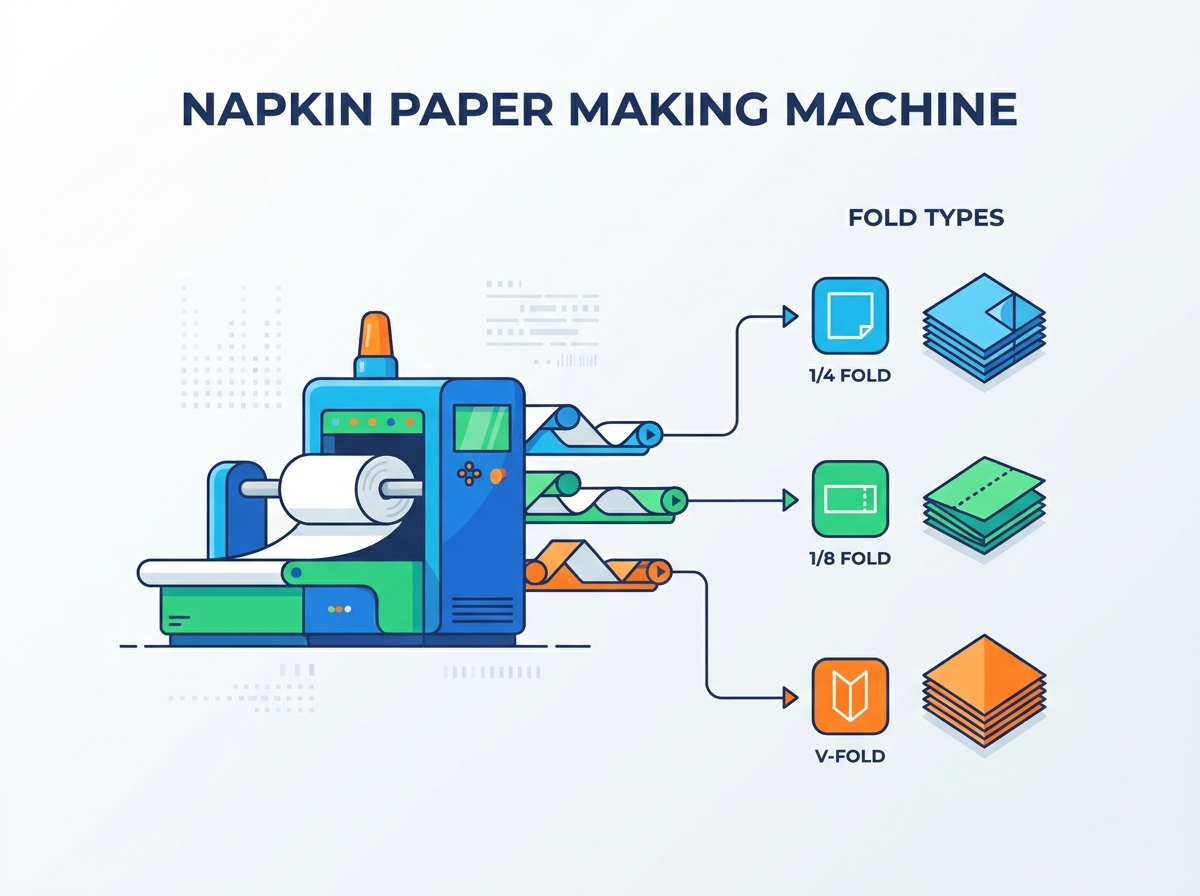
Exploring Popular Fold Types for Your Production Line
Selecting the correct fold configuration is your most important business decision. Every fold style caters to a distinct demographic. Your machinery must be precisely calibrated to serve that specific market segment.
Core Comparison: Fold Types and Applications
| Fold Type | Primary Application | Machine Complexity | Typical Speed | Recommended Material |
| 1/4 Fold | Cafes, Bars, Casual Dining, Household | Low to Medium | Very High | 1-ply to 3-ply |
| 1/8 Fold | Fine Dining, Hotels, Cutlery Wrapping | High | Medium to High | 2-ply to 3-ply |
| Dispenser (N/V Fold) | Fast Food, Drive-thrus, Cafeterias | Very High | Medium | 1-ply to 2-ply |
The 1/4 Fold: The Industry Workhorse
Recognized globally as the standard square napkin, the 1/4 fold dominates the market. You will find it in local cafes, bustling bars, and everyday household kitchens. The mechanical execution is elegantly straightforward. The machine folds the continuous paper web in half vertically, then folds it in half horizontally after the cutting phase. Equipment engineered exclusively for 1/4 folds prioritizes raw throughput. High-performance models from industry leaders like Leizhan Paper Tech routinely achieve staggering output rates, easily handling demanding round-the-clock shift work.
The 1/8 Fold: Engineered for Premium Hospitality
Luxury hotel chains and upscale restaurants rely heavily on the 1/8 fold. This elongated, rectangular shape is specifically tailored for wrapping silverware or presenting a refined aesthetic on a dining table. Producing a flawless 1/8 fold requires a highly specialized converting machine. The mechanism must execute additional directional creases without skewing the delicate paper edges. Achieving this level of precision demands advanced electronic web-guiding sensors and specialized rotary heads to maintain absolute dimensional accuracy.
Dispenser Folds: High-Volume Interlocking
Fast-food franchises and high-traffic diners depend entirely on dispenser variants. These include tall fold, low fold, or asymmetrical off-fold designs. The folding unit must seamlessly interlock the individual sheets. This guarantees smooth, one-at-a-time dispensing from spring-loaded countertop containers. The mechanical complexity of these interlocking systems heavily overshadows standard square folders. They require painstaking calibration and rigorous routine maintenance to prevent disastrous paper jams during peak production hours.
How Material Thickness Dictates Machine Specifications
The physical thickness of your raw tissue material fundamentally alters the folding mechanics on the factory floor. You cannot run thick luxury paper through a machine calibrated for cheap single-ply without facing severe operational headaches.
Single-Ply vs. Multi-Ply Handling
Standard commercial offerings range from economical 1-ply to luxurious 3-ply configurations. Processing a higher ply count inherently demands a significantly more robust manufacturing line. Thicker materials present substantial physical resistance to mechanical folding. Your machine requires intensified pneumatic pressure to forge crisp, permanent creases that will withstand handling. If your equipment lacks adequate pressure controls, multi-ply products will aggressively unfold on the conveyor belt. This results in a bulky, unprofessional presentation inside the final packaging.
Matching Specifications to Market Needs
Strategic market positioning dictates your material specs. Single-ply paper is exceptionally cost-effective and pairs flawlessly with dispenser folds. This makes it the optimal choice for high-volume, margin-sensitive environments. In stark contrast, 2-ply and 3-ply configurations deliver a premium, highly absorbent tactile experience. These thicker options are the mandatory standard for hospitality settings where customer perception is absolutely paramount.
Enhancing Quality Through Engineered Embossing
Embossing is far more than mere decoration. It is a critical value-adding engineering process that transforms a flat, flimsy sheet of paper into a highly functional commercial product.
The Mechanics of Mechanical Bonding
Applying an Emboss Pattern achieves crucial functional objectives. The process leverages heavy, engraved steel rollers running against rubber or paper bowls to apply extreme localized pressure. This mechanically welds multi-ply paper together without relying on messy chemical adhesives. This bonding ensures the individual layers remain perfectly intact during rigorous consumer use. Furthermore, the textured micro-pockets created by the steel rollers drastically expand the paper's surface area. This supercharges liquid absorbency and significantly enhances perceived softness.
Synchronizing the Rollers with the Folder
To achieve a truly professional finish, the textured design must align flawlessly with the chosen fold geometry. Precision alignment guarantees that proprietary company logos or elegant decorative borders are prominently showcased right in the center of the folded product. When evaluating machinery, you must rigorously scrutinize the embossing unit's synchronization capabilities. Ensuring the rollers and folding stages operate in perfect mechanical harmony drastically reduces material waste.
Streamlining Production: From Cutting to Wrapping
Manufacturing efficiency does not end at the cutting blade. The seamless handling of the finished product is the true bottleneck in most tissue converting plants.
Integrating Automated Transfer Systems
A high-speed machine churning out thousands of units is completely useless if your downstream packaging line cannot keep up. Bottlenecks at the discharge point instantly negate your production advantages. This leads to chaotic pile-ups and forced machine downtime. Integrating automated transfer systems ensures a continuous production flow. Modern automated lines utilize rapid optical sensors and programmable logic controllers to count, stack, and pneumatically transfer the folded stacks directly into wrapping units. This slashes variable labor costs and entirely mitigates the risk of human contamination.
Wrapping Solutions for Different Formats
Packaging protocols vary drastically depending on your format. Standard 1/4 folds are typically stacked vertically and wrapped tightly in pristine polyethylene film using high-speed flow wrappers. Conversely, interlocking dispenser folds are frequently packed densely into bulk corrugated cartons. This preserves their structural integrity during rough transit and allows for rapid restocking by restaurant staff. Seamless electronic integration between the folder discharge and the packing unit is absolutely essential to maximize your overall equipment effectiveness.
Actionable Guide: Selecting the Right Equipment
Strategic equipment procurement requires a thorough grasp of local market dynamics and hard engineering specifications. Do not rely on industry assumptions.
Before committing capital, audit your target demographic. Supplying a network of local fast-food chains requires prioritizing raw production speed and acquiring machines strictly optimized for interlocking dispenser folds. Securing contracts with luxury hotel conglomerates demands machines capable of manipulating high-ply materials and executing intricate embossing patterns. Analyzing local procurement data will rapidly reveal which machine configuration guarantees the fastest return on investment.
When reviewing technical specifications, look for equipment that offers operational agility. High-end tissue finishing equipment from Leizhan Paper Tech often features adjustable jumbo roll width capacities ranging from 1700mm to 3500mm, alongside advanced Siemens PLC control systems. This level of automation empowers plant managers to maintain consistent quality while minimizing operator error.
Top Engineering Factors to Verify Before Purchasing
Navigating the procurement process requires a rigorous evaluation of machine specifications. Bring this critical checklist to your equipment supplier:
Stable Running Speed: Do not just look at the maximum theoretical speed. Assess the machine's stable, continuous output rate. Ensure this operational capacity aligns comfortably with your projected sales volume to prevent chronic motor overexertion.
Roller Customization: Verify whether the machine architecture accommodates custom engraving rollers. Unique, proprietary patterns help forge a strong brand identity in a highly commoditized market.
Web Tension Control: Evaluate the integration of automatic web tensioning and pneumatic loading systems. Poor tension control is the number one cause of paper jams on the factory floor.
Technical Support Infrastructure: Partner exclusively with reputable manufacturers who provide comprehensive technical backing. Reliable suppliers deliver essential operator training, remote PLC diagnostics, and rapid spare parts availability.
Conclusion
The ultimate success of a tissue manufacturing enterprise hinges on a series of calculated technical decisions. You must select the ideal fold format, optimize the material's ply count, deploy an attractive embossed texture, and ensure highly efficient downstream wrapping. Each of these mechanical elements must work in perfect concert to produce a product that resonates with your target buyers.
Ultimately, commercial tissue converting equipment is far more than an assembly of steel frames and servo motors. It is a strategic investment engineered to meet specific consumer demands and secure long-term plant profitability. By thoroughly understanding the mechanical capabilities and limitations of your equipment, you position your operations to thrive.
Ready to eliminate production bottlenecks and scale your tissue output? Explore the advanced engineering solutions at Leizhan Paper Tech. Contact our technical sales team today to configure a high-speed finishing system that perfectly matches your exact production requirements and market ambitions.
FAQ
What is the most common format produced by tissue converting machines?
The 1/4 fold is the most universally utilized format, predominantly found in households, local cafes, and casual dining establishments. It offers exceptional production efficiency and high throughput. However, the optimal style for your specific operation depends entirely on the unique demands of your target buyer.
Can a single machine produce multiple fold types?
Standard industrial machines are typically engineered for one specific fold style to maximize processing speed and mechanical precision. Advanced, multi-functional tissue converting machines can be designed with interchangeable modular heads or adjustable folding boards to switch between formats, though this flexibility requires a higher initial capital investment and longer changeover times.
How does material thickness affect the embossing process?
A higher ply count requires a deeper, more aggressively defined engraved pattern utilizing elevated pneumatic pressure. This ensures the multiple layers of dense tissue are securely bonded together mechanically without the use of chemical adhesives. Proper pressure calibration prevents the product from delaminating or tearing during consumer use.
What is the difference between V fold and N fold napkins?
Both are interlocking dispenser formats, but they differ in their folding geometry. A V-fold is folded once in half, interlocking with the next sheet to pull it up when dispensed. An N-fold is folded twice to form a Z or N shape, allowing for a narrower dispenser profile. N-folds generally require more complex folding mechanics on the production line.
How much does a commercial napkin making machine cost?
Pricing varies wildly based on production capacity, automation levels, and fold complexity. Entry-level, semi-automatic 1/4 fold machines can start around $10,000 to $20,000. Fully automated, high-speed lines with integrated embossing, multi-color printing, and robotic transfer packing systems can range from $50,000 to well over $150,000. The investment should be calculated based on your required daily tonnage and target market.
Do modern machines come with integrated packaging solutions?
Many fully automatic manufacturing lines offer integrated packaging modules as part of a turnkey solution. The folded stacks are automatically counted via optical sensors, pneumatically transferred, and wrapped in film or cartons. This drastically reduces manual labor expenses on the factory floor and elevates overall production hygiene.


