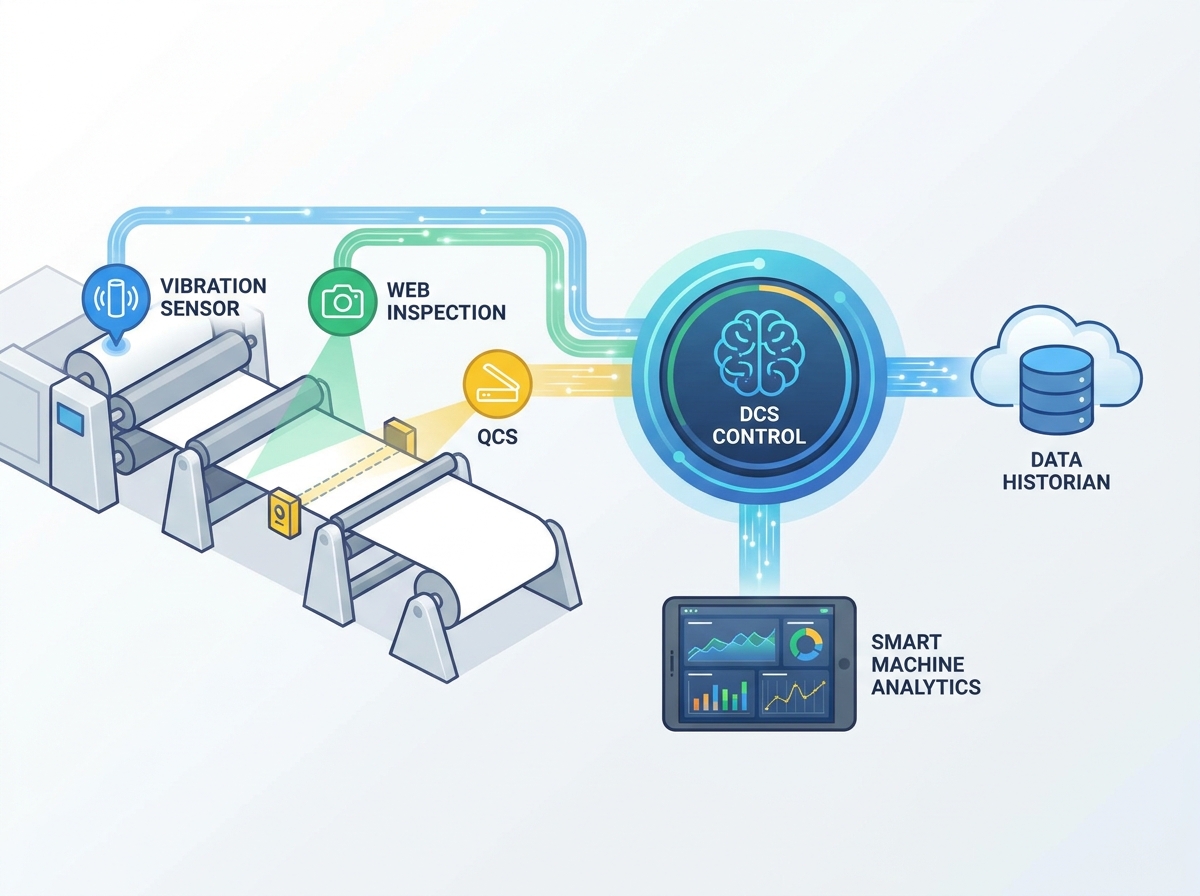
The pulp and paper industry is undergoing a profound digital revolution. Gone are the days of relying solely on manual labor and operator intuition. Today, facilities are rapidly transitioning toward highly automated, data-driven smart mills. Traditional paper mills frequently grapple with unexpected downtime, inconsistent paper quality, and exorbitant energy waste. A modern paper making machine resolves these core issues by integrating advanced industrial digitization, soft-sensors, and machine learning capabilities. Ultimately, the secret to a smart machine is not merely its heavy iron framework, but the intricate network of sensors that act as its eyes, ears, and central nervous system.
The Anatomy of a Smart Modern Paper Making Machine
From Heavy Machinery to Digital Ecosystems
A truly intelligent machine represents a complete digital ecosystem. It seamlessly integrates physical equipment with real-time sensor feedback to create an uninterrupted production workflow. Industry trends indicate a massive shift toward Industrial Internet of Things integration. The future of papermaking belongs to interconnected networks where edge computing processes data right at the sensor level. This evolution means sensors are no longer just passive measurement tools; they are proactive diagnostic devices capable of self-calibration and predicting their own failure.
The Core Benefits of Sensor Integration
By leveraging advanced sensor technology and machine learning, plant managers can now visualize their entire production line in real-time. This level of process transparency leads to unprecedented efficiency gains. It significantly reduces raw material waste and lowers energy consumption, transforming a traditionally resource-heavy process into a streamlined, sustainable operation.
Quality Control Systems for Precise Specifications
The QCS acts as the vigilant guardian of the dry end. Imagine a high-speed scanner traversing a continuous web of paper moving at thousands of feet per minute; its primary job is to maintain strict product specifications without slowing down production.
Basis Weight and Moisture Sensors
These sophisticated devices utilize radioactive or infrared technology to measure the exact weight and moisture content of the paper web. If the moisture level deviates by even a fraction of a percent, the system detects it instantly, allowing for immediate corrective action before the paper reaches the reel.
Caliper and Ash Sensors
Simultaneously, magnetic and X-ray sensors continuously monitor paper thickness and filler content. This rigorous scanning ensures that every single roll meets industry standards, preventing costly rejections and maintaining brand reputation.
Soft-Sensors in Quality Control
In scenarios where physical hardware cannot reach a specific point in the harsh environment of a paper machine, virtual soft-sensors step in. These complex algorithms analyze surrounding data to accurately predict quality metrics in real-time, bridging the gap between physical limitations and digital oversight.
Automated Governance with Distributed Control
If the scanners are the eyes, the DCS Control serves as the central nervous system for the entire mill. It is the overarching automation platform that dictates how the mechanical and fluid processes behave.
Connecting the Mill Floor
The system gathers inputs from thousands of individual flow, pressure, and temperature sensors distributed across the pulping and papermaking stages. It aggregates this massive influx of operational data to maintain a holistic view of the machine's state.
Automated Decision Making
Rather than relying on operators to manually tweak settings, the system makes automatic, split-second adjustments. For instance, if a slight drop in headbox pressure is detected, the platform immediately modulates the fan pump speed and adjusts valve positions to compensate. This ensures unparalleled operational stability entirely without human intervention.
Predictive Maintenance via Vibration Analysis
Shifting focus from process control to equipment health, modern mills must manage thousands of moving parts. A single bearing failure on a massive press roll can bring production to a grinding halt instantly.
How Vibration Sensors Work
To combat this, a wireless Vibration Sensor network utilizes highly sensitive piezoelectric accelerometers. These devices are mounted directly onto critical components to monitor the frequency and amplitude of rotating machinery continuously.
Moving from Reactive to Proactive
By analyzing subtle shifts in vibration patterns, maintenance teams can detect microscopic bearing spalling or shaft misalignment months before a failure occurs. This proactive shift allows mills to schedule part replacements during planned outages, saving significant capital in potential lost production.
High-Speed Flaw Detection Systems
While process sensors monitor physical properties, the Web Inspection system acts as the visual inspector, identifying surface defects that compromise structural integrity.
Optical Imaging and Laser Technology
Operating in a blur of motion, high-resolution cameras and laser arrays capture crisp images of the paper web at incredible velocities. Lighting and shutter speeds are synchronized to freeze the motion, revealing minute details.
Defect Classification
Advanced algorithms scan these images to identify grease spots, pinholes, or edge streaks. The system maps the exact coordinates of the defect, allowing operators to trace the issue back to its source, such as a damaged felt, preventing mass production of waste.
Strategic Data Management
With millions of data points generated every minute, plant managers face a critical challenge regarding information storage. The answer lies in the implementation of a Data Historian, a highly specialized time-series database engineered to capture industrial data at millisecond intervals.
Centralized Data Aggregation
In legacy operations, data is often siloed. A historian eliminates these barriers by aggregating inputs into a single repository. If a web break occurs, engineers can query the database to retrieve the precise steam pressure and pump vibration data at the exact millisecond the sheet tore.
Fueling Machine Learning
Storing data is only the foundational step. Engineers utilize this repository to identify long-term operational trends. By feeding years of process variables into machine learning algorithms, modern mills develop predictive models that anticipate quality deviations before they occur.
Flow, Temperature, and Pressure Sensors
While high-tech optical scanners often steal the spotlight, fundamental process sensors remain the unsung heroes of the wet and dry ends. Papermaking is essentially an exercise in precise fluid dynamics and thermodynamics.
Managing Pulp Slurry
At the wet end, the goal is to deliver a perfectly uniform suspension of fiber to the forming fabric. Electromagnetic flow meters ensure volumetric flow rates are exact, while pressure transmitters monitor the headbox. If the pressure fluctuates, the jet-to-wire ratio is compromised. The control system relies on these inputs to maintain the precise mix.
Optimizing the Dryer Section
The dryer section is the most energy-intensive part of the mill. Resistance Temperature Detectors and thermocouples are embedded within steam cylinders. By monitoring surface temperatures and exhaust steam, the mill optimizes thermal usage, preventing over-drying and directly reducing the facility's carbon footprint.
Choosing the Right Modernization Path
As legacy equipment ages, mills face a critical capital expenditure decision: retrofit existing machinery or invest in an integrated smart machine. Retrofitting offers lower initial costs but often faces integration challenges. Legacy machines are frequently unable to accommodate the precise mounting tolerances required by modern high-resolution sensors.
Purchasing new equipment provides an out-of-the-box digital ecosystem where sensors are natively embedded into bearings and hydraulic systems. While the initial investment is higher, the long-term operational expenditure is drastically reduced through superior energy efficiency and minimized maintenance.
Comparison Summary for Mill Upgrades
| Factor | Retrofit Solution | New Smart Machine |
| Integration | High Complexity | Native Compatibility |
| Maintenance | Reactive Focus | Predictive Capability |
| Energy ROI | Limited | Optimal |
Conclusion
A modern papermaking machine is a highly intelligent, sensor-driven ecosystem. By utilizing advanced technologies, mills can drastically improve daily operations. Investing in integrated systems guarantees better paper quality, lower energy costs, and higher profit margins. Mill managers must evaluate their infrastructure today to secure a competitive edge for tomorrow.
What is the difference between QCS and DCS control?
The quality system focuses on the final physical properties of the paper, such as weight and moisture. The distribution system is the overarching platform that manages the machine's mechanical and fluid processes, such as pump speeds and steam pressure.
How do vibration sensors reduce mill costs?
They enable predictive maintenance. By detecting minute changes in vibration frequencies, they alert teams to bearing or shaft issues months before failure occurs, preventing unplanned, multi-million dollar production shutdowns.
Can legacy machines be upgraded with smart sensors?
Yes, many machines can be retrofitted, but they often lack the structural rigidity required for high-precision optics. For maximum efficiency, investing in a new, sensor-ready machine is often the most cost-effective long-term strategy.
Why is a data historian essential?
It acts as a centralized repository for high-frequency time-series data. Standard databases cannot handle the millions of data points generated by a smart mill. A historian is necessary for troubleshooting, regulatory reporting, and training artificial intelligence models.


