The Crucial Role of Finishing in Paper Production
Did you know that even the most masterfully formed paper web can be rendered useless by inadequate finishing? The quality of your printed output is ultimately decided in the final stages of production. While the initial fiber formation creates the paper base, the surface treatment acts as the critical bridge between raw cellulose and a high-fidelity printing substrate. Integrating the right sizing technology into a printing paper making machine is not just an operational choice. It is a fundamental requirement for meeting today stringent print-quality standards. This guide walks mill managers and engineers through selecting the optimal configuration for specific production needs.
Key Takeaways
Technology Choice: Transitioning from a traditional pond setup to a metered film setup drastically enhances runnability and stability on high-speed production lines.
Quality Control: Implementing precise mechanical and chemical management is the most effective path to guaranteeing uniform paper surface characteristics.
Defect Prevention: An optimized strategy acts as a primary defense against printing defects, ensuring consistent ink hold-out for high-resolution reproduction.
Efficiency: Modernizing the finishing section significantly reduces drying energy consumption while simultaneously increasing total net output.
The Role of Surface Sizing in a Printing Paper Making Machine
In the realm of commercial paper manufacturing, surface sizing is the precise application of a continuous thin film onto the partially dried paper web. This film usually consists of starch, PVA, or synthetic agents. The process is transformative. It re-engineers the surface energy and topography of the sheet. Sealing the porous fiber network prepares the paper for the rigors of offset or digital printing.
Without this crucial step, raw paper behaves like a sponge. Capillary action pulls ink solvents deep into the fiber network. This causes the dreaded feathering effect and reduces color vibrancy. By creating a controlled barrier, the culture paper finishing equipment restricts ink penetration. Pigments stay on the surface for a crisp and professional finish.
Furthermore, we must distinguish this process from internal chemicals added directly to the pulp slurry. Internal addition provides basic water resistance. However, surface treatment remains non-negotiable for fine paper grades. Visual integrity and ink receptivity are the ultimate metrics of success here.
Current Industry Trends: The Shift Toward High-Fidelity and Low-Energy Production
Recent market analyses reveal a decisive shift in the commercial printing sector. Printers now demand substrates capable of handling high-speed digital inkjet technologies without compromising resolution. This trend forces paper mills to rethink their dry-end operations. The focus has moved from merely adding strength to engineering a microscopic barrier that prevents ink vehicle migration.
At the same time, rising global energy costs are pushing facilities to minimize the moisture added during finishing. Consequently, outdated application methods that soak the sheet are rapidly being replaced by precision metering systems. These modern systems ensure maximum surface hold-out while slashing steam usage in the final dryer section. Adapting to these trends is essential for mills wanting to maintain a competitive edge.
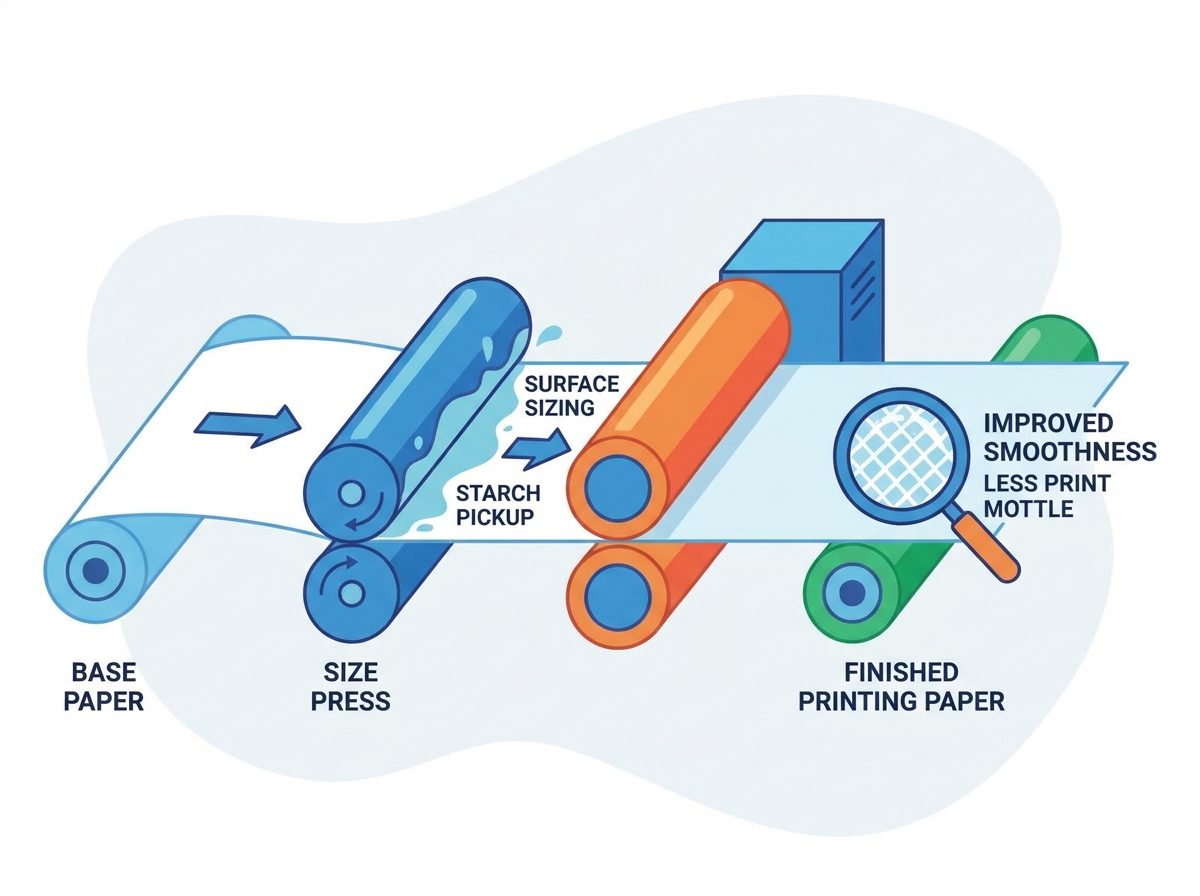
Pond Size Press vs. Film Size Press: Which Fits Your Operations?
Industry trends are shifting decisively toward efficiency. The traditional pond setup has been a staple for decades. However, the industry increasingly favors metered film technology to meet the demands of modern high-speed production.
The traditional pond design relies on a simple nip between two rolls with a pond of solution sitting above the interface. This method is cost-effective and straightforward for slower specialty paper machines. Yet, the hydrostatic pressure forces the sizing agent too deep into the paper. Deep penetration increases moisture content significantly. This puts a heavy load on the drying section and creates a high risk of web breaks at speeds exceeding 800 meters per minute.
In contrast, the metered film design decouples the metering of the solution from the actual application. Using a specialized rod or blade, a precise film is applied to the applicator rolls before transferring to the paper. This mechanism allows for exact control over paper smoothness and moisture levels. It prevents deep penetration and allows machines to run at speeds well over 1200 meters per minute. The energy requirements drop significantly, making it the standard for competitive paper mills today.
| Feature |
Traditional Pond Press |
Metered Film Press |
| Operating Speed |
Up to 800 m/min |
1200 to 1500 m/min |
| Moisture Addition |
High deep penetration |
Low controlled surface film |
| Energy Consumption |
High steam demand |
Up to 30% reduction in drying energy |
| Surface Uniformity |
Moderate |
Excellent and highly consistent |
| Best Suited For |
Low-speed specialty grades |
High-speed culture and offset papers |
Optimizing Chemical Pickup for Maximum Surface Quality
The visual appeal of your paper is governed by the rheology of your chemical bath. Operators must manage the starch pickup with surgical precision. For standard fine printing grades, a target of 2.0 to 4.0 grams per square meter is common.
To hit this target consistently, engineers must balance nip pressure, roll cover hardness, and solution viscosity. As market demands lean toward higher gloss and sharper halftone reproduction, many mills are turning to Polyvinyl Alcohol as a co-binder. This polymer provides a superior and flexible film that bridges microscopic voids between cellulose fibers more effectively than starch alone. This reinforcement prevents surface cracking during calendering. It also provides the refined topography necessary for high-end digital printing.
How the Right Strategy Prevents Print Mottle
There is perhaps no greater frustration for a quality control team than print mottle. This cloudy and irregular appearance in solid color blocks is a death knell for product reputation.
The phenomenon is fundamentally caused by uneven ink absorption. Where the base paper has inconsistent density or surface energy, the ink vehicles sink in at different rates. This leaves pigment stranded in some areas and over-absorbed in others. An optimized application strategy acts as the corrective lens for this problem. By applying a perfectly metered film, the equipment levels the playing field. It seals the porous zones and standardizes the surface energy. When the entire sheet is sealed uniformly, the ink remains on the surface. This produces the crisp and vibrant solid blocks that high-end users demand.
Actionable Factors When Upgrading Your Equipment
Planning an equipment upgrade requires evaluating clear engineering parameters. Consider these three non-negotiable factors for your next investment.
First, match your equipment type to your target machine velocity. Do not persist with a pond setup if your production goals exceed 800 meters per minute. Second, ensure your system handles rapid grade switches. A modern setup must feature pneumatic or hydraulic nip load controls. It should allow for quick rod configuration changes to accommodate everything from 40 GSM reprographic paper to 150 GSM high-grade offset sheets.
Finally, never overlook the post-application drying capacity. Because the process reintroduces moisture, you must evaluate your current cylinder capacity. Integrating an infrared or air-float drying system immediately after the press is often the secret to preventing binder migration.
Maintenance and Troubleshooting from the Field
Even the most advanced technology fails if the maintenance schedule is lax. Your applicator rolls are the most critical interface. If the cover hardness measured in P and J values is uneven, your distribution will be skewed. A worn crown profile leads to immediate quality drops.
Implement a rigorous schedule for regrinding and nip-impression testing using electronic profile tools. Specifically, keep a close watch on your chemical preparation system. Bacterial growth or inconsistent cooking temperatures lead to viscosity fluctuations. These fluctuations manifest instantly as picking or dusting on the press rolls. Such defects ruin the exact quality you are working so hard to achieve.
Maximizing the Commercial ROI of Your Investment
Investing in a modernized finishing section is a powerful way to enhance mill profitability. Moving to advanced film metering slashes steam consumption in the drying section. This provides an immediate reduction in operational energy costs.
Simultaneously, eliminating surface defects drastically reduces your percentage of rejected rolls and customer returns. Upgrading your equipment allows your facility to transition from producing low-margin commodity grades to premium printing substrates. This strategic move ensures your production line remains a highly profitable asset.
Conclusion and Next Steps
The finishing section is far more than an accessory. It is the final gatekeeper of your paper printability. Whether you are fine-tuning your current process or retrofitting a line for higher speeds, the combination of equipment choice, chemical formulation, and precise application separates market-leading products from the rest.
Evaluate your current machine performance today. If your mill struggles with high steam costs or inconsistent print quality, it is time to upgrade. We recommend exploring the advanced culture paper finishing equipment available at Leizhan Paper Tech. By selecting the right machinery tailored to your specific parameters, you can elevate your product quality and secure a stronger bottom line.
Frequently Asked Questions
What is the difference between internal sizing and surface application?
Internal chemicals are introduced directly into the fiber slurry during the wet-end phase to provide base-level water resistance. In contrast, surface treatment is applied during the dry-end phase to coat the sheet. This creates a barrier essential for improving print fidelity and ink hold-out.
How does starch pickup affect the final printing paper?
The pickup rate directly influences sheet strength and topography. Achieving the correct grammage is vital. Too little leaves the paper too absorbent, leading to poor print results. Too much makes the sheet brittle and needlessly increases the drying load on your machinery.
Can an older paper machine be retrofitted with new film technology?
Yes. Retrofitting is a common and highly effective way to modernize a legacy line. Installing a metered film system allows older machines to achieve higher speeds and produce premium grades. This effectively extends the lifespan and profitability of your existing infrastructure.
Why is my paper experiencing cloudy print defects, and how can finishing fix it?
Cloudy defects occur when ink absorption is uneven across the sheet. An optimized application mitigates this by applying a uniform layer that standardizes porosity. This ensures that ink stays on the surface for a smooth and even finish.
What role does roll cover hardness play in the application process?
Roll cover hardness dictates the nip footprint and pressure distribution. An incorrect hardness level leads to uneven film transfer and cross-machine moisture variations. Engineers must select the precise polyurethane or rubber compound based on the specific paper grade and operating speed.
How can modern finishing equipment reduce mill energy consumption?
Modern equipment utilizes precise metering rods to apply high-solids and low-moisture films. By minimizing the amount of water introduced to the paper web, the demand on the post-dryer section drops significantly. This leads to substantial savings in steam and overall energy costs.


