The Economic and Technical Imperative of Mineral Fillers
In the fiercely competitive paper manufacturing sector, mill managers face a constant battle. You must produce high-quality A4 or copy paper while keeping a tight grip on operational expenses. If you run a continuous paper production line, you know firsthand that wood pulp consumes the lion's share of your raw material budget. Modern paper mills rely heavily on a specific industrial mineral to protect their profit margins without sacrificing sheet integrity: calcium carbonate.
From an engineering standpoint, pushing mineral content higher is no longer just a neat trick for better brightness. It is a fundamental survival strategy. By transitioning to alkaline papermaking environments, operators can feed this mineral directly into the short circulation system. This deep dive uncovers the mechanical and chemical shifts that occur when you increase ash content, boosting essential metrics while shielding your bottom line from volatile pulp markets.
Global Industry Trends: The Drive Toward High-Ash Papermaking
Market analysts monitoring the global fine paper sector are observing a massive structural shift. Fluctuating prices for Northern Bleached Softwood Kraft and stringent carbon emission regulations are forcing mill directors to rewrite their furnish recipes. Relying entirely on virgin fiber is becoming economically unsustainable.
Consequently, the industry is aggressively moving toward high-ash papermaking. Facilities that previously capped their filler content at 15 percent are now pushing their wet-end chemistry to handle 20 to 25 percent. This trend is driven by the urgent need to decouple production costs from timber market volatility. Furthermore, major printing equipment manufacturers are demanding smoother, more dimensionally stable substrates. This dual pressure from raw material economics and end-user quality standards has cemented calcium carbonate as the most critical non-fibrous component in modern culture paper production.
Key Takeaways for Mill Operators
Structural Cost Reduction: Replacing expensive cellulose fibers with mineral powders directly slashes raw material expenditures per ton of paper produced.
Optical Superiority: Proper dosing drastically improves light-scattering capabilities, meeting the strict demands for duplex commercial printing.
Mechanical Durability: Strategic integration reinforces the internal fiber matrix, ensuring jam-free runnability in high-speed copiers.
Optimized Sizing Efficiency: A dense mineral base prevents surface starch from sinking into the sheet, creating a crisp barrier for inkjet and laser printing.
Targeted Material Selection: Choosing between mined and precipitated variants depends entirely on your specific headbox configuration and target paper grade.
The Vital Role of Calcium Carbonate in Wet-End Dynamics
The Mandatory Shift to Alkaline Environments
Decades ago, the industry relied on acid-based processes utilizing alum and rosin. Operating at a low pH severely restricted additive choices. Pumping calcium carbonate into an acidic stock would trigger an immediate chemical reaction, releasing carbon dioxide gas and causing catastrophic foaming in the headbox. The universal shift toward alkaline papermaking changed everything. By maintaining a pH between 7.5 and 8.5, modern production lines can safely load massive amounts of minerals without corroding stainless steel components or destroying synthetic forming fabrics.
Mechanical Integration on the Wire
Think of this mineral as a functional structural component rather than a simple additive. As the highly diluted stock rushes out of the slice lip onto the forming fabric, microscopic mineral particles settle into the microscopic gaps between interlaced cellulose fibers. This physical embedding transforms a naturally porous web of wood fibers into a dense, uniform substrate capable of handling intense mechanical stress.
Immediate Dewatering Advantages
Beyond structural upgrades, integrating these minerals delivers instant benefits to machine efficiency. Minerals shed water significantly faster than hydrated cellulose. Therefore, the forming section achieves much higher dewatering rates. Faster drainage on the wire translates directly into increased machine speeds, elevating your daily tonnage and maximizing overall plant capacity.
Maximizing Efficiency Through Advanced Dosing
Precision in the Approach Flow System
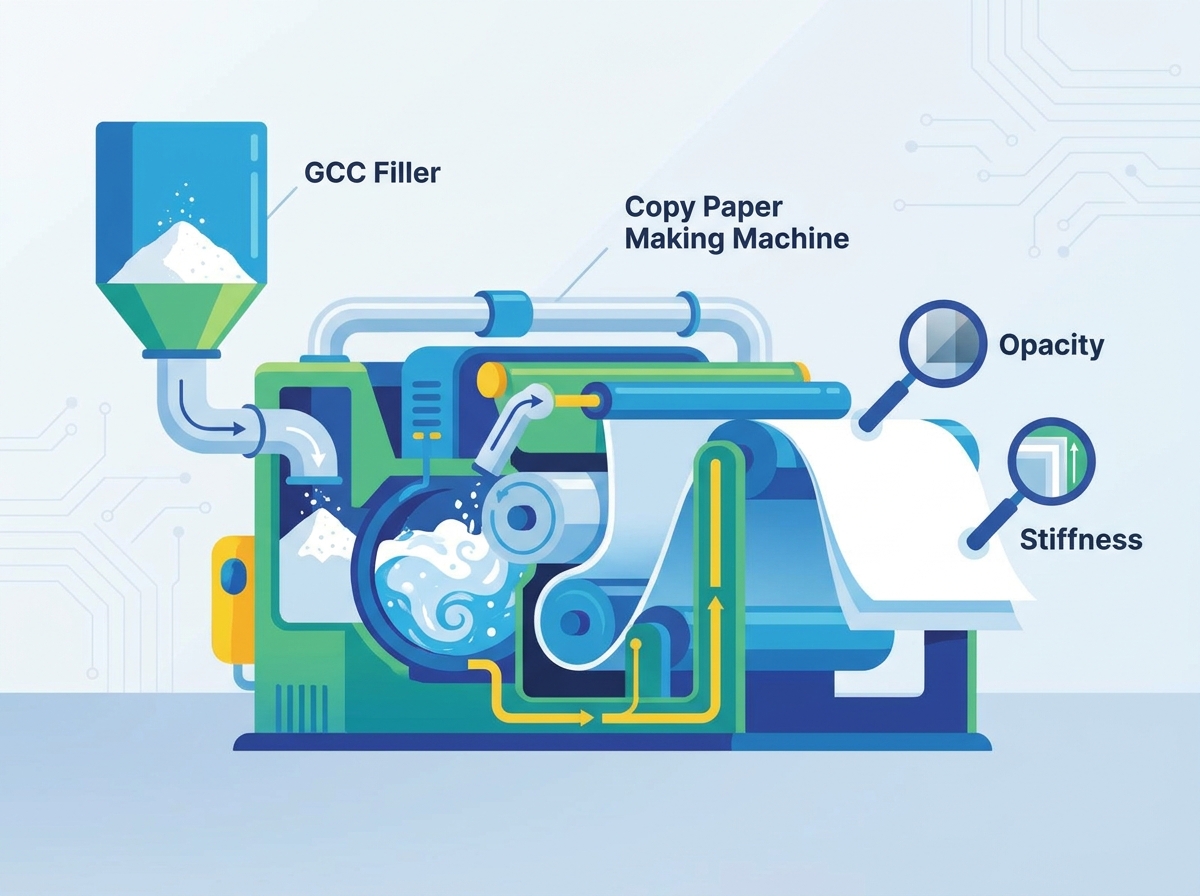
Injecting non-fibrous powders into the furnish requires absolute precision. In a modern setup, DCS operators use automated dosing stations to introduce a measured mineral slurry into the short circulation loop. This injection usually happens just before the fan pump. This strategic placement ensures severe turbulence, creating a perfectly homogenous dispersion of particles among the fibers before the stock hits the forming board.
Replacing Expensive Virgin Fibers
The core commercial logic behind Filler Loading is undeniable for high-capacity mills. Bleached kraft pulp is expensive to process and subject to wild market swings. Minerals, conversely, are abundant and price-stable. By pushing the ash content from a conservative 15 percent up to 25 percent, you directly replace a quarter of your expensive fiber costs. Over a 300-day production year, this substitution yields millions in raw material savings.
Balancing Ash Content with Tensile Strength
While high loading is profitable, it introduces severe technical risks. Cellulose fibers rely on hydrogen bonds for tensile and tear strength. Mineral particles do not form these bonds; they simply take up space. Pushing the loading limit too far will destroy the web's structural integrity, leading to disastrous web breaks in the press section. To prevent this, engineers deploy multi-component retention aids and synthetic dry-strength resins. These chemical systems lock the minerals onto the fibers, maintaining sheet durability even at peak ash levels.
Enhancing Visual Quality for Premium Markets
The Chemistry of Brighter Paper
In the culture paper sector, optical brightness dictates market value. Minerals naturally possess an outstanding ISO brightness, often exceeding 95 percent. By embedding these brilliant crystals throughout the sheet, operators elevate the overall whiteness without overdosing harsh bleaching chemicals or expensive optical brightening agents. Cutting back on aggressive bleaching saves money and preserves the natural strength of the wood fibers.
Achieving Flawless Double-Sided Printability
Corporate consumers demand A4 paper that supports duplex printing. This requires exceptional Opacity to prevent text from bleeding through to the reverse side. The high refractive index of these minerals solves this problem entirely. As light hits the paper, the countless interfaces between cellulose and mineral crystals force the light rays to scatter violently. This intense light scattering creates an impenetrable visual barrier, keeping text crisp and legible on both sides.
Boosting Machine Runnability and Structural Rigidity
Surviving the High-Speed Copier Environment
Commercial laser printers drag paper through complex, heated pathways at blistering speeds. If a sheet lacks internal rigidity, it will curl, misfeed, and jam. Strategic mineral inclusion reinforces the microscopic matrix of the sheet. This reinforcement dramatically increases the overall Paper Stiffness, allowing the substrate to withstand intense mechanical and thermal stress during the printing process.
Optimizing Press Section Consolidation
This structural enhancement actually begins the moment the wet web enters the press section. Heavy granite and polyurethane rollers apply massive nip pressure to squeeze out water. Because the mineral particles have already filled the natural voids in the fiber network, they stop the web from crushing completely under the load. This interaction compacts the sheet into a dense, uniform profile, greatly reducing the flexibility of individual fibers.
The Impact on Surface Chemistry and Printability
Mastering the Size Press Operation
Located near the dry end of the machine, the size press applies a thin film of modified starch to the semi-dried web. When a sheet is heavily loaded with minerals, its internal capillaries are already blocked. This altered surface topography forces the applied Surface Size to stay on the absolute exterior of the paper. Instead of soaking uselessly into the core, the starch forms a highly efficient, uniform film, drastically reducing your chemical consumption.
Preventing Ink Feathering
The ultimate goal of surface sizing is controlling liquid ink dynamics. The combination of a dense mineral base and a solid starch layer creates a perfect hydrophobic barrier. When inkjet droplets hit the page, this barrier stops the pigment from wicking laterally along the fibers. The ink dries instantly on the surface, delivering sharp text, deep blacks, and vibrant color gamuts.
Evaluating Mineral Types: A Technical Comparison
To formulate the perfect furnish, engineers must select between two distinct mineral forms. Each offers unique physical properties tailored to specific machine speeds and quality targets.
| Technical Feature | Mined Variant (GCC) | Synthesized Variant (PCC) |
| Production Method | Mechanically crushed from natural limestone. | Chemically precipitated via controlled carbonation. |
| Particle Morphology | Irregular, rhombohedral shapes. | Highly uniform, engineered scalenohedral or aragonite crystals. |
| Wire Drainage | Excellent. Promotes maximum machine speeds. | Moderate. Holds slightly more water due to crystal shape. |
| Optical Performance | Good brightness and standard scattering. | Superior bulk, exceptional brightness, and maximum opacity. |
| Primary Application | High-speed economy and standard copy paper. | Premium, ultra-bright presentation and inkjet papers. |
Mined directly from the earth, GCC provides unmatched drainage on the wire, making it the undisputed champion for mills prioritizing absolute maximum production speeds and cost efficiency. Conversely, the synthesized variant offers engineered perfection, delivering the extreme bulk and brightness required for top-tier premium brands.
Sustainable Manufacturing and Steam Reduction
Slashing Drying Energy Requirements
One of the most powerful engineering advantages of high filler utilization is its impact on thermodynamics. Cellulose fibers are hydrophilic; they trap massive volumes of water inside their cell walls. Mineral particles are inherently hydrophobic. By swapping fiber for minerals, the total water retention value of the wet web drops significantly. When the sheet hits the drying cylinders, there is simply less water to boil off. This mechanical reality translates to a massive reduction in steam demand, slashing your boiler fuel costs.
Driving the Circular Economy
From an environmental compliance perspective, heavy mineral loading shrinks a facility's ecological footprint. Less virgin fiber means reduced demand on commercial forestry. Additionally, many modern synthesized mineral plants are built on-site at the paper mill. These satellite facilities capture waste carbon dioxide directly from the mill's power boilers, using the exhaust gas to manufacture the mineral slurry. This closed-loop system actively reduces the total carbon emissions of the manufacturing site.
Upgrading Your Production Line for High-Ash Operations
Critical Machinery Specifications
Transitioning to high-ash production often exposes hidden bottlenecks in older machinery. High mineral content is abrasive. It will accelerate wear on standard forming fabrics and press felts. To counter this, proactive mill managers upgrade to specialized ceramic dewatering elements and heavy-duty foils. Furthermore, maintaining sheet strength requires advanced, multi-stage chemical dosing skids tied directly to the DCS.
Selecting the Right Finishing Equipment
When upgrading your facility, matching equipment parameters to your production goals is vital. For instance, modern culture paper machines engineered for high-ash content typically feature trim widths ranging from 1092 to 3200 millimeters, with operating speeds pushing from 150 up to 1200 meters per minute. Capable of handling grammages between 40 and 80 grams per square meter, these advanced lines utilize state-of-the-art film size presses and calender stacks to ensure the mineral-loaded sheet achieves a flawless, glossy finish without breaking under tension.
Conclusion: Securing Your Mill's Future
Industrial minerals have evolved from cheap extenders into the absolute backbone of profitable papermaking. By strategically upgrading your wet-end chemistry and approach flow systems, you can drastically reduce your dependency on volatile wood pulp markets. The result is a highly profitable, premium sheet boasting brilliant optics, rigid runnability, and excellent printability. For ambitious mill operators determined to dominate the culture paper market, optimizing your production line to handle maximum mineral loading is the most secure, high-return investment you can make.
Ready to upgrade your production line for high-efficiency mineral loading? Explore advanced headbox designs, sizing machines, and complete culture paper production lines tailored to your mill's specific capacity. Visit Leizhan Paper Machinery to consult with our engineering team and find the exact equipment configurations you need to maximize your operational profitability today.
Frequently Asked Questions
Can older acid-based machines utilize these modern mineral fillers?
No. Machinery configured for acid-based papermaking cannot process these minerals. The acidic environment reacts violently with the powder, dissolving it instantly and causing severe foaming and scaling throughout the wet end. The entire approach flow and chemical dosing system must be converted to an alkaline process before introducing these materials.
What is the main operational difference between mined and synthesized variants?
The mined variant is mechanically crushed, offering irregular shapes that promote rapid water drainage, making it ideal for maximizing machine speed. The synthesized variant is chemically engineered to produce uniform crystals. While it drains slightly slower, it provides vastly superior bulk, brightness, and light scattering for premium paper grades.
How does increasing the ash content impact the tensile strength of the web?
Replacing wood pulp with minerals lowers costs but disrupts the natural hydrogen bonding between cellulose fibers. If left unmanaged, this will severely compromise the web's tensile and tear strength. Engineers solve this by injecting sophisticated retention chemicals and dry-strength resins to bind the matrix together.
Why does adding mineral powder improve the stiffness of A4 paper?
During the heavy pressing phase, the microscopic particles fill the voids between the interwoven fibers. This internal reinforcement prevents the fiber matrix from crushing flat under the extreme nip pressure. The result is a denser, highly compact sheet that resists bending and prevents jams in commercial printers.
Does high filler loading actually reduce steam consumption in the dryer section?
Yes, significantly. Because minerals do not absorb water internally like cellulose fibers do, a high-ash sheet exits the press section with a lower overall moisture profile. Consequently, the steam-heated drying cylinders require far less thermal energy to evaporate the remaining surface water, leading to massive fuel savings.
What is the ideal ash content target for standard A4 copy paper?
For standard economy-grade A4 paper, modern mills typically target an ash content between 18 and 22 percent. Pushing toward 25 percent is possible with advanced retention chemistry and state-of-the-art film size presses, maximizing cost savings while maintaining acceptable runnability and print quality.
How do high mineral levels affect the lifespan of machine clothing?
Minerals are inherently abrasive. High loading levels can accelerate the wear and tear on forming fabrics, press felts, and dryer screens. To mitigate this, mills must upgrade to high-durability synthetic fabrics and install abrasion-resistant ceramic dewatering elements in the forming section to maintain normal maintenance cycles.


