Introduction
The dryer section consumes the vast majority of thermal energy in any paper mill. Efficiency here dictates your overall profitability. But cranking up steam pressure is not the answer. Using the wrong Dryer Fabric triggers operational nightmares. Erratic moisture profiles, sky-high steam bills, and frustrating sheet breaks will rapidly erode your bottom line.
How do you stop this? This guide provides an objective engineering perspective for mill managers and process engineers. We will explore structural types, critical selection criteria, and real-world parameters to help you pinpoint the exact clothing for your machine setup.
Key Takeaways
Permeability is Crucial: Selecting the correct air permeability ensures optimal moisture evaporation without inducing aerodynamic sheet flutter.
Material Matters: The structural choice between woven, spiral, and double warp designs relies heavily on your machine speed, paper grade, and specific heat requirements.
Contact Area Dictates Efficiency: A higher physical contact area maximizes conductive heat transfer from the steam cylinder to the wet paper sheet. This directly reduces specific steam consumption.
Maintenance Extends Lifespan: Proper mechanical tensioning and regular chemical cleaning of your machine clothing are just as critical as the initial engineering selection.
Industry Trends: The Push for Energy Efficiency
Papermakers globally face soaring energy costs and strict carbon neutrality targets. This reality is radically reshaping procurement strategies on the plant floor. Modern mills are moving away from standard commodity textiles. Furthermore, they now invest heavily in advanced designs featuring 100 percent Polyphenylene Sulfide polymers and custom aerodynamic profiles. This strategic upgrade combats hydrolysis in extreme steam pressures. It allows mills to achieve higher heat transfer efficiencies at lower overall energy expenditures.
What is Dryer Fabric and Why Does It Matter?
Modern papermaking relies on highly engineered synthetic permeable meshes. Seasoned operators often still call this a Dryer Felt. That term nods to an older era of thick, moisture-absorbing canvas or wool. Today, production speeds demand more. We use advanced synthetic polymers like Polyester and Polyphenylene Sulfide. Instead of soaking up water, these open-mesh screens let evaporated vapor pass directly through.
The core purpose of this component is mechanical and thermal. It pins the fragile wet paper web tightly against blistering hot dryer cylinders. You need uniform pressure across the entire width of the sheet. This pressure maximizes conductive heat transfer and forces rapid water evaporation. Ultimately, this drives the most energy-intensive phase of your entire production cycle.
Key Functions of Paper Machine Clothes in the Dryer Section
The dryer section must remove the final 40 to 50 percent of moisture from the traveling web. Operating in this harsh, humid environment, Paper Machine Clothes perform three indispensable engineering functions.
Heat Transfer Optimization: The primary barrier to efficient drying is the microscopic boundary layer of insulating air trapped between the paper and the cylinder. The fabric applies vital mechanical tension to press the sheet firmly against the hot metal surface. This effectively squeezes out those air pockets. Direct contact exponentially increases the heat transfer coefficient, meaning less steam energy is wasted.
Moisture Evaporation and Ventilation: As the wet web contacts the heated cylinder, embedded water flashes into steam. The open-mesh structure provides a highly controlled pathway for this vapor to escape into the dryer pocket. Proper ventilation prevents localized humidity buildup. Without it, moisture would condense, drip back onto the sheet, and ruin the moisture profile of the finished reel.
Sheet Support and Runnability: The wet paper web is incredibly fragile at high production speeds. The fabric acts as a continuous mechanical carrier. It supports the sheet as it leaps from one cylinder to the next. By minimizing unsupported draws, it prevents edge curling and wrinkling. This keeps catastrophic web breaks at bay and maintains continuous runnability.
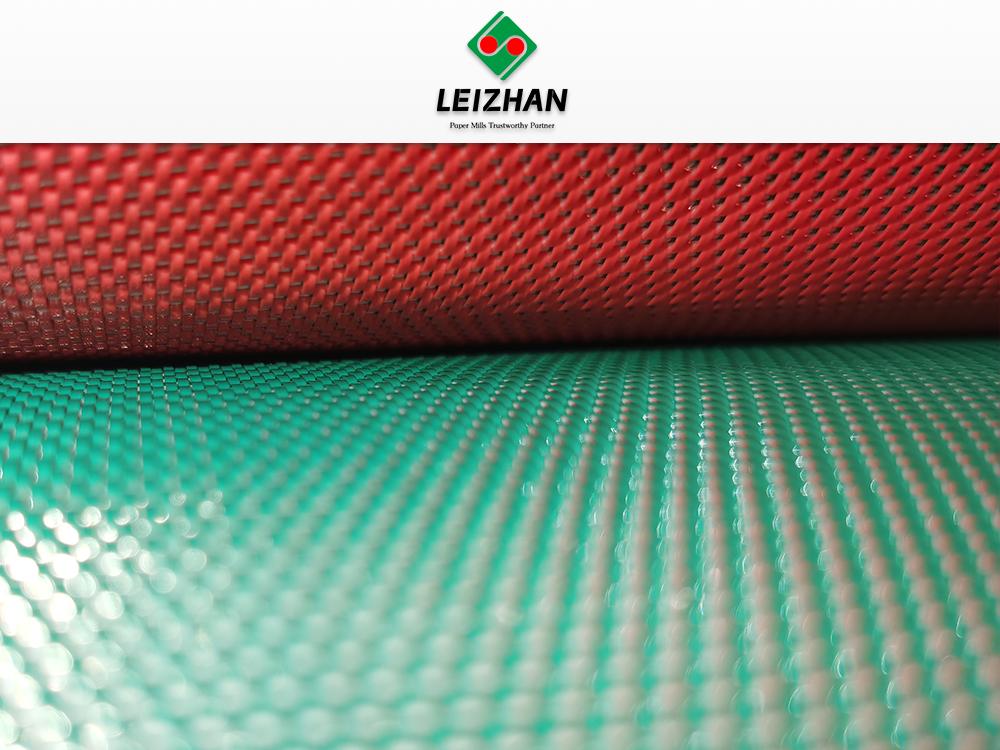
Types of Dryer Fabrics: Classification and Structures
Selecting the correct structural design is fundamental to achieving target drying rates without compromising sheet quality. Manufacturers categorize these textiles based on their weaving patterns and yarn architecture.
Woven Dryer Fabrics: Created using sophisticated loom technology, these designs interlace machine-direction and cross-machine direction monofilament yarns.
Flat Yarn vs. Round Yarn: Flat yarns provide a significantly higher surface contact area and a much smoother face. This is an absolute necessity for preventing marks on sensitive paper grades. In contrast, round yarns offer robust durability and higher void volumes for extreme permeability.
Premium Structures: The Double Warp Dryer Fabric represents the pinnacle of woven design. Utilizing two distinct layers of machine-direction yarns yields exceptional dimensional stability. For instance, high-performance models from Leizhan offer air permeability ranging from 100 to 500 Cubic Feet per Minute and operate flawlessly in temperatures up to 200 degrees Celsius. They provide a seamlessly smooth paper-contact surface while maintaining superior resistance to mechanical wear on the machine side.
Spiral Dryer Fabrics: Instead of traditional weaving, spiral configurations link alternating left-hand and right-hand helical polymer loops using a cross-machine pintle wire.
Advantages: This loop-based structure is inherently seamless. Eliminating the seam entirely removes the risk of seam marking and drastically simplifies the installation process. Specifically, spiral fabrics offer immense void volumes, making them exceptional for moisture handling in high-heat environments.
| Fabric Type | Typical Air Permeability | Surface Smoothness | Best Application |
| Standard Woven | 70 to 400 CFM | Medium | Newsprint, Standard Writing |
| Double Warp | 100 to 500 CFM | High | Fine Paper, Premium Tissue |
| Spiral Mesh | 500 to 1000+ CFM | Low to Medium | Kraft Board, Corrugated Medium |
Crucial Factors to Consider When Selecting Dryer Section Fabric
Procuring the optimal clothing requires a rigorous technical analysis of your specific operating parameters. Relying on guesswork or outdated specifications inevitably inflates operational costs. Modern mills are now investing heavily in advanced Dryer Section Fabric designs to meet these exact parameters.
Air Permeability: Measured in Cubic Feet per Minute, permeability must be precisely calibrated to the machine speed and paper grade. High-speed machines require lower permeability fabrics, such as 70 to 150 CFM, to prevent turbulent aerodynamic currents from blowing the sheet off the cylinder. Conversely, slower machines producing heavy board rely on highly permeable meshes to exhaust massive volumes of vapor.
Surface Smoothness and Contact Area: The physical footprint of the yarns touching the paper directly impacts both heat transfer and product quality. A higher contact area improves conductive heating. More importantly, for fine writing and printing grades, an ultra-smooth topography prevents the fabric weave pattern from embossing onto the delicate wet sheet.
Aerodynamics: As the fabric races through the machine, it drags boundary layers of air with it. In the confined spaces of the dryer pocket, uncontrolled air movement destabilizes the sheet. Modern engineering focuses heavily on creating aerodynamic profiles that manage this air layer. This ensures the sheet remains pinned and stable during transit.
Seam Type: For woven structures, the seam is inherently the weakest point and the most frequent culprit behind sheet marking. Evaluating whether your operation requires a pin seam, an integrated spiral seam, or a completely seamless design depends entirely on the sensitivity of your paper grade and the mechanical tension limits of your machine.
Matching Dryer Fabric to Your Specific Paper Grade
There is no universal solution in machine clothing. The technical specifications must align seamlessly with the physical demands of the final product.
Packaging and Board Paper: Grades such as corrugated medium and kraft linerboard carry massive water loads into the drying zone. Here, the focus shifts entirely to rugged durability, high tension tolerance, and maximum air permeability. Heavy-duty woven structures or spiral fabrics are standard. They easily withstand aggressive mechanical loads and the harsh cleaning chemicals required to strip away recycled fiber contaminants.
Printing and Writing Fine Paper: For copy paper and coated grades, printability is the ultimate quality metric. Consequently, the engineering priority pivots to ultra-smooth surfaces, fine flat yarns, and non-marking seams. A double warp woven structure is frequently deployed. It maximizes the contact area without compromising the flawless finish of the sheet.
Tissue Paper: Imagine running a delicate tissue web at speeds exceeding 2000 meters per minute. Even a slight aerodynamic flutter can cause a catastrophic web break. Fabrics in tissue applications must be exceptionally lightweight to reduce driving energy. They also need to be highly aerodynamic to support the fragile sheet without generating disruptive air currents.
The Impact of Fabric Tension on Dryer Performance
The mechanical tension applied to the fabric is a fundamental variable that dictates both drying efficiency and machine runnability.
The Physics of Tension: Thermal contact resistance exists at the interface between the paper and the cylinder. Increasing the fabric tension compresses the sheet and thins the insulating air boundary layer. This compression exponentially increases the heat transfer coefficient.
Runnability Issues: Maintaining this tension is a delicate balancing act. If tension drops too low, thermal contact degrades. This results in wet streaks, higher steam consumption, and potential sheet wander. In contrast, operating at excessive tension accelerates abrasive wear. It stresses roll bearings to the point of failure and significantly increases the risk of a catastrophic seam rupture.
Optimization: Mill engineers must continuously hunt for the operational sweet spot. This involves utilizing automated tension control systems and precision load cells. These systems maintain consistent pressure across the entire width of the machine, actively compensating for the natural stretching of synthetic polymers over their lifecycle.
Best Practices for Maintaining Your Dryer Fabric
Even the most perfectly engineered textile will fail prematurely if subjected to neglect. Operational lifespan relies heavily on proactive maintenance protocols.
Regular Cleaning: Contaminants like pitch, sizing agents, and sticky recycled adhesives naturally migrate into the void spaces of the fabric. This blinding effect drastically chokes the operating permeability, crippling evaporation. Mills must employ continuous high-pressure showers and schedule specialized chemical boil-outs to keep the mesh open and breathable.
Guiding and Alignment: A fabric that does not run true is destined for a short life. Misaligned guide rolls cause the fabric to oscillate or aggressively track to one side. This leads to severe edge wear. Calibrating auto-guiding systems and keeping guide spades clean are mandatory practices to ensure the clothing tracks perfectly in the machine direction.
Routine Inspections: During planned maintenance shutdowns, crews must conduct rigorous empirical inspections. Measuring caliper loss, inspecting seam loops for abrasion, and checking edges for fraying allows operators to predict end-of-life accurately. You can then schedule replacements before an unplanned failure halts production.
Common Mistakes to Avoid When Buying Paper Machine Clothes
Procurement decisions in the paper industry carry heavy operational consequences. Falling into predictable traps often inflates long-term costs.
Buying Solely on Price: Treating machine clothing as a basic commodity is a critical error. While budget-tier fabrics offer immediate capital savings, they frequently suffer from rapid caliper loss and poor dimensional stability. The subsequent rise in steam consumption and unplanned downtime completely obliterates the initial purchase savings. Total Cost of Ownership must be the guiding metric.
Ignoring the Seam: Buyers often obsess over the body of the fabric while overlooking the seam specification. As the most vulnerable component, a low-quality seam construction leads to localized sheet marking, difficult installations, and premature breakage.
Copying Previous Specs Blindly: Machine conditions are rarely static. If a mill recently increased machine speed, altered steam pressures, or changed the raw material furnish, historical specifications are likely obsolete. Re-evaluating the permeability and yarn structure with an application engineer is necessary to match the current operating reality.
Conclusion
Choosing the right dryer fabric is a complex balancing act. It requires a deep understanding of permeability, contact area, material science, and mechanical tension. Do not base this critical decision solely on historical purchasing habits.
The proper clothing is a vital investment in your operational excellence. Engineered correctly for your specific paper grade, it delivers profound energy savings and eliminates frustrating sheet breaks. Are you ready to optimize your dryer section? Visit Leizhan Paper Tech to explore our full range of high-performance solutions and let our engineering team match the perfect fabric to your machine parameters.
FAQ
What is the difference between a dryer fabric and a dryer felt?
Historically, the term dryer felt referred to thick, heavy materials woven from cotton or wool that functioned by physically absorbing water from the wet paper web. Today, dryer fabric refers to modern, highly engineered synthetic open-mesh screens made of polyester or Polyphenylene Sulfide. Instead of absorbing water, these synthetic fabrics allow evaporated steam to pass right through their structure. While the underlying technology has completely transformed, operators on the factory floor often still use the terms interchangeably.
What is a double warp dryer fabric used for?
This specific structure features two distinct layers of machine-direction yarns. This complex design provides exceptional dimensional stability, preventing the fabric from stretching or narrowing under high running tension. More importantly, it creates an incredibly smooth surface area on the side contacting the paper. This dramatically reduces sheet marking and improves conductive heat transfer, making it the premier choice for high-speed machines producing fine paper grades where flawless printability is critical.
How long should a typical dryer fabric last?
The operational lifespan varies significantly based on several harsh variables, including machine speed, operating temperature, the chemical acid and alkaline levels, and the rigor of the maintenance program. On average, a well-maintained synthetic fabric can last anywhere from 6 to 18 months. Implementing proper automated tensioning protocols and routine chemical cleaning to prevent sticky contamination will significantly extend this timeframe.
Why is air permeability important in the dryer section?
Air permeability dictates how easily evaporated water, in the form of steam, can escape through the fabric mesh. If the permeability is too low for the application, moisture remains trapped in the pocket, and drying efficiency plummets. Conversely, if the permeability is too high on a fast-moving machine, it generates turbulent aerodynamic currents that can cause the fragile paper sheet to flutter, wrinkle, or tear apart completely.
How do I know if my dryer fabric needs to be replaced?
Operators should monitor both machine performance data and physical wear conditions. Data-driven red flags include a sudden, unexplained spike in steam consumption or the emergence of wet streaks in the finished paper rolls. Physical signs requiring immediate replacement include visible fraying at the fabric edges, a significant reduction in overall thickness which is thinning due to wear, blinding by unremovable pitch and stickies, or visible distortion and broken loops at the seam.
How does operating temperature dictate material selection?
Standard polyester yarns begin to degrade rapidly when exposed to extreme steam pressures and temperatures above 160 degrees Celsius. In these harsh early dryer groups, engineers must upgrade to Polyphenylene Sulfide yarns. This advanced material resists chemical hydrolysis and maintains its tensile strength in blistering, high-moisture environments.
Can the wrong seam type cause sheet breaks?
Absolutely. The seam is the most vulnerable point of any woven mesh. If the seam is too thick or poorly constructed, it creates a localized pressure point. Every time this bulky seam hits the heated cylinder, it stamps an impression into the wet sheet. On high-speed machines, this repetitive impact weakens the paper web and frequently triggers catastrophic breaks.


