Paper mill operators constantly push equipment to maximize production capacity and machine speeds. You need higher output without degrading sheet formation, web stability, or mill margins. When you scale up production, legacy wet-end equipment quickly becomes the primary bottleneck. Older designs fail to manage higher volumetric flow rates. This failure causes severe basis weight variations, uncontrolled pressure pulsations, and poor fiber deflocculation at elevated speeds. Mill managers and process engineers face a strict engineering decision. You must evaluate whether your existing setup can handle optimization or if a complete capital upgrade is mandatory. Upgrading to a Hydraulic Headbox is often the only viable path to support a high speed paper machine environment. This upgrade directly dictates final paper properties and determines long-term operational success.
Speed Thresholds: Air cushion headboxes generally reach their operational ceiling around 800–900 m/min, whereas hydraulic headboxes are engineered to support high-speed paper machines operating from 1,200 m/min up to 2,200 m/min.
Quality & Property Metrics: Hydraulic systems offer superior basis weight control and deflocculation at high velocities, directly determining critical paper properties (like tensile strength and formation) through advanced stock jet geometry and micro-turbulence generation.
System Prerequisites: Upgrading to a hydraulic system requires rigorous auditing of the approach flow system, as it lacks the passive air pad dampening of older models and relies on external pulsation attenuators.
Profitability: While capital-intensive, the hydraulic headbox delivers a lower long-term cost per ton in high-speed applications through reduced web breaks, real-time profile correction, and improved yield.
The Role of the Paper Machine Headbox in Production Scaling
Scaling paper production requires absolute control over fluid dynamics. The paper machine headbox takes a cylindrical flow of stock from the approach piping and transforms it into a wide, uniform, rectangular jet. This jet impinges directly onto the forming fabric. You must establish strict baseline requirements before planning any upgrade to ensure the wet end can handle increased volumetric flows without compromising sheet integrity.
Achieve uniform stock distribution across the entire machine width without edge effects or cross-flows.
Maintain a precise jet-to-wire speed ratio to control fiber orientation and initial drainage rates.
Ensure stable cross-direction (CD) and machine-direction (MD) profiles under varying flow conditions and consistency changes.
Prevent fiber flocculation immediately prior to the slice opening to guarantee uniform sheet formation.
Increasing machine speed magnifies hydraulic instabilities. As stock velocity increases, the kinetic energy within the flow turns minor pressure variations into massive profile disruptions. High speeds induce chaotic turbulence. If unmanaged, this turbulence destroys the fiber matrix before the sheet even forms on the wire. Effective pulp flow control is the most critical variable in high-speed papermaking. You have to manage this flow to prevent hydraulic jumps, eliminate wake effects, and ensure even fiber dispersion across the entire forming section.
The hydraulic performance of your wet-end equipment directly impacts mill profitability. It determines final paper properties. Poor formation creates weak spots in the sheet. These weak spots cause web breaks in the press or dryer sections. Web breaks kill machine efficiency, waste energy, and drive up reject rates. Superior hydraulic stability ensures consistent tensile strength, uniform opacity, and smooth surface characteristics. Optimizing this specific stage reduces unplanned downtime, maximizes fiber yield, and drives overall profitability by allowing you to run at maximum design speeds.
Air Cushion Headbox: Capabilities and Limitations
The air cushion headbox uses a pressurized air pad located above the stock level. This air pad acts as a passive shock absorber. It dampens low-frequency pressure pulsations originating from the fan pump, pressure screens, and approach piping. The internal pond contains rotating rectifier rolls, commonly called hole rolls. These perforated cylinders rotate to create macro-turbulence. This turbulence keeps fibers suspended and distributes the flow evenly across the slice width. Operators control the liquid level and air pressure to manage the total head, which dictates the final jet velocity.
This design maintains relevance for specific applications. It performs well on slower machines operating between 400 and 900 m/min. Mills producing heavy-grade applications often rely on this technology. Kraft papers, heavy board grades, and specialty pulps benefit from the gentle turbulence generated by rectifier rolls. The large internal volume provides excellent dampening for the low-frequency pulsations common in older, less optimized approach flow systems. Operators can visually monitor the pond turbulence through sight glasses and manually tune the air compressor system to maintain stability.
Physics dictate a strict high-speed bottleneck for this equipment. As flow rates increase to support speeds above 900 m/min, the air pad becomes highly unstable. High velocities create excessive turbulence within the pond. This causes the stock level to fluctuate wildly. This resonance completely disrupts the air pad's dampening ability. Liquid level fluctuations translate directly to pressure variations at the slice lip. These variations cause poor jet stability, uneven impingement angles, and compromised basis weight profiles. The mechanical rectifier rolls also reach their rotational limits. They fail to provide adequate deflocculation at high throughputs, leading to severe fiber spinning, stringing, and poor formation.
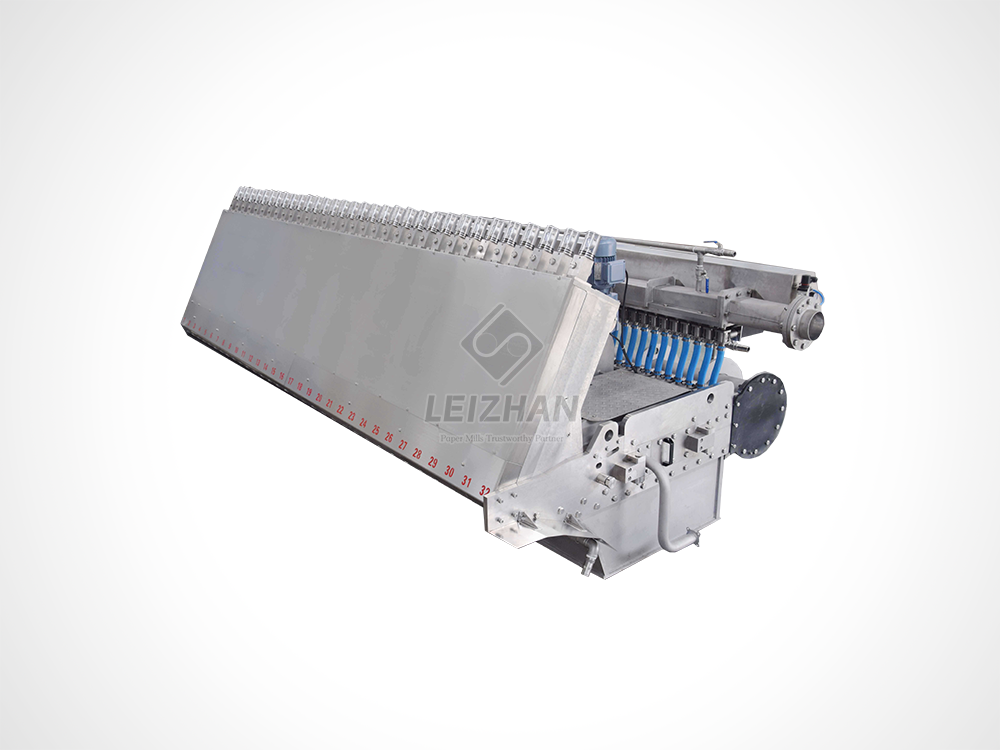
Hydraulic Headbox: Engineering for the High-Speed Paper Machine
Modern high-speed production requires a different approach. Engineers eliminated the air pad entirely to create a fully liquid-filled, high-pressure system. This architecture relies on a precisely engineered tapered header and a step-diffuser tube block. The tapered header distributes the stock evenly across the machine width. It maintains constant pressure and velocity from the drive side to the tending side. A recirculation line at the end of the header prevents stock stagnation and balances the cross-machine pressure. The stock then flows through a bank of tubes designed to manage fluid acceleration and deceleration.
Velocity and turbulence management define this technology. The system generates controlled micro-turbulence to achieve optimal deflocculation. As stock passes through the step-diffuser tubes, it encounters sudden expansions in the tube diameter. These physical steps create intense, localized shear forces. This friction-induced micro-turbulence breaks up fiber flocs instantly. It ensures a highly uniform fiber suspension just before the stock reaches the slice. This mechanism operates flawlessly at extreme velocities. It prevents the reflocculation that plagues older designs when running high-consistency stock.
Delivering a precise, low-consistency stock stream to the Fourdrinier wire requires exact stock jet geometry. You must continuously monitor and adjust this geometry to maintain jet stability at speeds exceeding 1,200 m/min. The impingement angle dictates initial drainage and fiber orientation. Advanced sensors monitor the slice opening and header pressure in real-time. This continuous monitoring ensures the jet velocity perfectly matches the wire speed. You optimize the jet-to-wire ratio for superior sheet formation and maximum retention. Edge flow control valves are also utilized to prevent fiber orientation issues at the extreme edges of the sheet, ensuring uniform quality across the entire reel.
Head-to-Head Technical Evaluation: Hydraulic vs. Air Cushion
Pulp Flow Control and Deflocculation
Air cushion designs utilize rotating rectifier rolls to manage fiber dispersion. These perforated cylinders create macro-turbulence. While effective at lower speeds, rectifier rolls cause stringing and fiber spinning at higher velocities. They struggle to break up tight flocs in high-consistency applications. The mechanical rotation introduces a variable that disrupts the delicate flow dynamics near the slice. You often see wake effects downstream of the rolls that show up as visible streaks in the final sheet.
Hydraulic designs utilize static friction and step-diffuser elements. They contain no moving parts within the flow path. The sudden expansion in the diffuser tubes creates high-frequency micro-turbulence. This method provides superior fiber dispersion. It prevents flocculation across varying consistencies and excels at high velocities. The static nature of the diffusers ensures absolute consistency in turbulence generation. You get a perfectly homogenous stock suspension delivered to the slice lip every time, eliminating the mechanical variables that cause streaking.
Basis Weight Control and Profile Correction
Older systems rely heavily on mechanical slice lip adjustments to control the CD basis weight profile. Operators or motorized actuators bend the slice lip to restrict or open the flow locally. This mechanical bending has severe limitations. Adjusting one zone often affects adjacent zones. This creates a cascading correction problem across the width of the machine. It lacks the precision required for modern quality standards and often leads to permanent deformation of the slice lip over time, requiring expensive replacements.
Hydraulic systems integrate seamlessly with modern automated dilution profiling systems. This integration achieves tighter basis weight control. Instead of bending the slice lip, dilution control injects precise amounts of white water into specific zones of the header using rotary plug valves. This alters the local consistency without changing the slice geometry or local velocity. It allows for rapid, real-time correction of CD and MD profile deviations. You achieve a significantly flatter basis weight profile. This reduces fiber giveaway and drastically improves roll build quality at the winder.
Pulsation Dampening Mechanisms
The internal, passive air pad of the air cushion design naturally absorbs low-frequency pressure waves. The compressible air acts as a spring. It smooths out the flow before it reaches the slice. This makes the system relatively forgiving of upstream pressure variations caused by older fan pumps, poorly designed screening systems, or vibrating approach piping. It can mask significant flaws in the wet-end approach flow.
Hydraulic systems lack this internal compressible volume. They act as rigid fluid conduits. Any pressure pulsation entering the header transmits directly to the slice lip. This causes immediate MD basis weight variations. Therefore, hydraulic setups require external, active pulsation attenuators installed in the approach piping. These dampeners must be precisely tuned to absorb specific high-frequency approach flow pulsations. If the external dampening is inadequately sized or poorly tuned, the hydraulic system becomes highly vulnerable to upstream instability. You must also utilize deaeration systems, like Deculators, to remove entrained air, as hydraulic units cannot vent air internally.
Operational Trade-Offs and Mill Profitability
Upgrading your wet end involves significant operational shifts. Energy and pumping requirements change drastically. Hydraulic systems operate at much higher pressure drops across the step diffusers to generate the necessary micro-turbulence. This requires larger, more powerful fan pumps. You will see an increase in baseline energy consumption for the approach flow system. You must weigh this energy cost against the massive gains in production speed, reduced breaks, and overall machine efficiency.
Maintenance and cleaning protocols also shift. Hydraulic units eliminate moving parts like rectifier rolls and their associated drives, bearings, and seals. This drastically reduces mechanical wear and tear. You spend less time replacing bearings during annual outages. However, the step-diffuser tubes require strict internal cleanliness. Any scale buildup, biological growth, or debris caught in the diffusers will cause stringing and ruin the sheet profile. You must implement rigorous chemical boil-out procedures. You need high-velocity caustic washes to maintain highly polished internal surfaces and prevent any accumulation within the friction zones.
Physical footprint heavily favors the hydraulic design. These units are significantly more compact because they do not require a large internal pond volume or a massive air pad chamber. This provides significant spatial advantages during rebuilds. You can easily fit a hydraulic unit into the existing space of an older Fourdrinier section. This often leaves room to add top-wire formers, upgrade the drainage elements, or install additional vacuum boxes to handle the increased water load from higher machine speeds.
Evaluate the initial capital expenditure against long-term profitability. The upfront cost of a hydraulic unit, combined with approach flow modifications, is substantial. Yet, the return on investment materializes rapidly. Minimized paper rejects, fewer web breaks, and optimized fiber distribution drive down the cost per ton. You achieve higher overall equipment effectiveness (OEE) and produce premium grades that command better market prices.
| Operational Parameter | Air Cushion Headbox | Hydraulic Headbox |
| Optimal Speed Range | 400 - 900 m/min | 1,200 - 2,200+ m/min |
| Deflocculation Method | Mechanical (Rectifier Rolls) | Static (Step-Diffuser Tubes) |
| Pulsation Dampening | Internal (Passive Air Pad) | External (Active Attenuators) |
| Profile Control Mechanism | Slice Lip Bending | Automated Dilution Control |
| Physical Footprint | Large / Bulky | Compact / Streamlined |
| Primary Maintenance Focus | Mechanical Wear (Rolls/Bearings) | Internal Cleanliness (Diffusers) |
| Energy Consumption | Lower (Lower Pressure Drop) | Higher (High Pressure Drop) |
Implementation Risks and Mitigation Strategies
Installing new equipment without preparing the surrounding infrastructure causes immediate operational failures. Approach flow system readiness is your primary risk factor. You cannot bolt a rigid hydraulic unit onto a highly pulsative approach flow. You must conduct a comprehensive wet-end pulsation audit. Measure pressure pulses at the fan pump discharge, the screen accepts, and the header inlet. Upgrade your approach flow piping to eliminate dead legs, sharp elbows, and unsupported pipe runs that cause vibration. You will likely need to install a low-pulsation fan pump with a staggered vane impeller. You must also upgrade your pressure screens with specialized low-pulse rotors to minimize baseline pressure variations.
Control system integration presents another hurdle. Hydraulic dilution control requires rapid response times. Legacy Distributed Control Systems (DCS) and Quality Control Systems (QCS) often lack the processing speed to handle the high-resolution data and rapid actuator adjustments required. You must upgrade your QCS scanners to provide high-resolution CD profile data. Ensure your DCS can process this data and execute valve adjustments in real-time. If your valves react too slowly, the dilution profiling will chase the errors rather than correct them, leading to unstable basis weight profiles.
Operator adoption requires focused attention. Transitioning from visual, manual stock level management to fully enclosed, sensor-driven management changes the daily workflow. Operators can no longer look through a sight glass to gauge pond turbulence. They must learn to interpret digital pressure readouts, jet geometry metrics, and automated dilution profiles. Invest heavily in simulator training and OEM-led workshops. Ensure your team understands the fluid dynamics occurring inside the enclosed header. They need to know how recirculation valve adjustments impact edge flows and overall header balance.
Conclusion
Conduct a comprehensive wet-end pulsation audit using high-frequency pressure transducers to map current approach flow stability.
Evaluate your existing fan pump impeller design and pressure screen rotors to identify sources of high-frequency pulsation generation.
Assess your current QCS scanner resolution and DCS processing speeds to determine if they support real-time automated dilution control.
Initiate consultations with OEM application engineers to model the physical footprint and piping modifications required for a wet-end rebuild.
FAQ
Q: What is the maximum speed of an air cushion headbox?
A: Air cushion headboxes typically reach their operational limit around 800 to 900 m/min. Above this threshold, high volumetric flow rates cause severe turbulence in the internal pond. This turbulence destabilizes the air pad, causing resonance and liquid level fluctuations that destroy jet stability and sheet formation.
Q: How does a hydraulic headbox control pulsation without an air pad?
A: Because it lacks an internal compressible air volume, it relies entirely on external pulsation dampeners. These active attenuators are installed directly in the approach piping just before the header. They are precisely tuned to absorb high-frequency pressure waves generated by the fan pump and pressure screens.
Q: Can an existing paper machine be upgraded to a hydraulic headbox?
A: Yes. Hydraulic units are highly compact, making them ideal for wet-end rebuilds. They easily fit into the footprint of older equipment. However, the upgrade requires strict prerequisites, including a low-pulsation approach flow system, upgraded fan pumps, and modern automated control systems to handle the rigid fluid dynamics.
Q: Which headbox type provides better basis weight control?
A: Hydraulic systems provide vastly superior control. They integrate seamlessly with automated dilution profiling. By injecting white water into specific zones of the header, they adjust local consistency without altering slice geometry. This allows for rapid, real-time correction of cross-direction and machine-direction profile deviations.
Q: How does the headbox impact final paper properties?
A: It dictates the initial fiber orientation and distribution on the forming fabric. Uniform hydraulic flow and precise stock jet geometry ensure even fiber dispersion. This directly determines critical metrics like tensile strength, opacity, surface smoothness, and overall sheet formation, which reduces weak spots and web breaks.
Q: What are the maintenance differences between hydraulic and air cushion headboxes?
A: Air cushion units require mechanical maintenance for rotating rectifier rolls, bearings, and drives. Hydraulic units have no moving parts, eliminating mechanical wear. However, hydraulic units require rigorous chemical boil-outs and strict cleaning protocols to prevent scale or debris from clogging the internal step-diffuser tubes.
Q: Does a hydraulic headbox require a different approach flow system?
A: Yes. It acts as a rigid conduit, transmitting upstream pressure variations directly to the slice lip. You must optimize the approach flow by installing low-pulsation fan pumps, specialized screen rotors, and external attenuators to ensure absolute baseline pressure stability before the stock enters the header.


