Are oversized extrusions and heavy paper rolls causing end-of-line bottlenecks on your warehouse floor? When manufacturing outputs exceed the standard 48x40-inch footprint, standard pallet wrappers consistently fail. This structural limitation forces facilities into a corner. Plant managers often have to rely on slow, hazardous manual labor or inefficient metal strapping to secure these awkward loads.
Recent industry analyses reveal a sharp pivot in supply chain logistics. Global shipping regulations now demand rigorous load stability and verifiable environmental defense. Consequently, facility operators are rapidly moving away from manual banding. The current trend heavily favors automated horizontal wrapping solutions. These modern systems offer high throughput, integrate seamlessly with predictive maintenance networks, and provide superior transit defense. At the forefront of this industrial transition is the Orbital Stretch Wrap Machine, a highly specialized piece of equipment engineered specifically for awkward, elongated, or heavy-duty cylindrical goods.
In this comprehensive guide, we will break down the exact mechanics of horizontal wrapping. You will learn why it outperforms traditional vertical systems and uncover how it solves the most complex packaging challenges on the factory floor.
Key Takeaways
- Unique Orientation: Unlike traditional equipment that spins a pallet on a vertical axis, horizontal wrappers pass the product linearly through a rotating ring.
- Mastering Awkward Loads: These systems are explicitly engineered to secure extended items like raw timber, PVC pipes, and architectural extrusions that protrude far beyond standard pallet dimensions.
- Hollow Core Capabilities: This technology is indispensable for heavy-duty sectors handling paper rolls and metal coils, delivering total 360-degree environmental encapsulation.
- Superior to Strapping: Horizontal wrapping delivers enhanced moisture defense, uniform load stability, and better long-term cost-efficiency compared to manual metal or plastic strapping.
- Advanced Material Efficiency: Specialized carriages maintain mathematically precise tension and minimize plastic waste, directly accelerating operational return on investment.
What Exactly is an Orbital Stretch Wrap Machine?
Frequently referred to in the packaging sector as a horizontal stretch wrapper, this machinery is defined by its horizontal operating axis and its signature spinning mechanism. Instead of relying on gravity and vertical stacking, this equipment secures items as they travel parallel to the factory floor. It serves as the ultimate automated solution for non-standard manufacturing outputs that simply cannot be stood upright.
The Mechanics of Ring Rotation
From a mechanical standpoint, the core engineering marvel of this equipment lies in the dynamics of Ring Rotation. During a standard operational cycle, the product is fed into the machine via a synchronized infeed conveyor belt. As the product moves forward at a controlled pace, a heavy-duty aluminum or steel ring spins rapidly around the item's horizontal axis.
This spinning ring dispenses plastic film continuously, generating a tight, helical wrapping pattern along the entire length of the bundle. Because the product itself remains stationary relative to the rotational force, the risk of centrifugal momentum dislodging top-heavy loads is completely eradicated. This continuous flow design allows operations managers to integrate the wrapper directly into high-speed extrusion or milling lines, establishing a seamless packaging process devoid of traditional bottlenecks.
The Role of the Specialized Film Carriage
The overall effectiveness of the wrapping cycle depends heavily on the Film Carriage, which is bolted directly onto the rotating ring. Far from being a simple metal holder for the plastic roll, this component is a complex mechanical module responsible for advanced pre-stretch technology and dynamic tension control.
Modern carriages utilize motorized, geared rollers to mechanically elongate the film by up to 300 percent before it ever makes contact with the cargo. This aggressive elongation increases the yield strength of the plastic, ensuring it acts like a high-tension rubber band around the load. The tension control system guarantees the film grips the product firmly without applying excessive crush force. When operators package delicate items like hollow composite tubing or polished aluminum profiles, preventing this excessive corner pressure is critical to avoiding permanent product damage.
Orbital vs. Traditional Stretch Wrappers: The Key Differences
To fully grasp the unique value proposition of horizontal wrapping, we need to compare it against the two most prevalent types of automated packaging equipment found in standard warehouses. A quick look at the core mechanics reveals why horizontal systems dominate the oversized cargo market.
| Wrapper Type | Operating Axis | Best Suited For | Load Stability Limitations |
| Orbital Wrapper | Horizontal | Long extrusions, paper rolls, pipes, lumber | None. Product moves linearly without spinning. |
| Turntable Wrapper | Vertical | Standard 48x40 square pallets, stable boxes | High risk of top-heavy loads toppling due to centrifugal force. |
| Rotary Arm Wrapper | Vertical | Extremely heavy or fragile square pallets | Restricted to the vertical footprint of the pallet. Cannot wrap long items. |
Orbital vs. Turntable Wrappers
Turntable wrappers represent the standard baseline for warehouse packaging. They function by placing a wooden pallet on a rotating base while a stationary metal mast dispenses film vertically. The primary limitation of turntables is their strict dimensional requirement. The product must fit neatly within the footprint of a standard square pallet. Furthermore, the load must be inherently stable. If a warehouse worker attempts to wrap a top-heavy pallet, the centrifugal force generated by the spinning base will inevitably cause the items to topple mid-cycle. With a horizontal machine, the structural difference entirely bypasses these limitations, permitting the safe securing of highly unbalanced or uniquely shaped items.
Orbital vs. Rotary Arm Wrappers
Rotary arm wrappers utilize a stationary floor base where the pallet rests, while an overhead mechanical arm swings rapidly around the load to apply the protective layer. This overhead design is exceptionally well-suited for excessively heavy or highly fragile palletized loads that cannot endure the spinning motion of a turntable. Nevertheless, it remains fundamentally restricted to vertical application. Horizontal machines wrap parallel to the ground, making them the sole viable automated choice for continuously extruded materials or architectural fixtures that defy vertical stacking.
Solving the Long Product Packaging Challenge
Manufacturing facilities producing construction materials or architectural hardware routinely face a significant logistical hurdle. Packaging items that absolutely refuse to fit onto a standard pallet is a daily nightmare. When goods exceed these standard dimensions, traditional automated wrapping becomes obsolete. Companies are often forced to revert to slow, hazardous manual labor.
An automated horizontal wrapper effortlessly secures any Long Product that would otherwise require a team of workers to handle. Items such as wooden doors, window frames, and raw lumber present unique challenges due to their awkward weight distribution. When warehouse staff attempt to wrap these items manually, walking backward while navigating around forklift traffic and tripping hazards, the applied tension is inherently erratic. This manual inconsistency leads to loose tails and a high probability of the bundle shifting during transit. The automated wrapper standardizes this entire workflow, applying mathematically precise tension across the full surface area.
Another major operational advantage is the machine's capacity to bundle multiple elongated items together tightly. This process forges a rigid, self-supporting unit that actively resists bending. The equipment can also strap the products directly to a custom wooden runner. By encapsulating the product and the skid together horizontally, the machine effectively locks the load to its foundation, preventing dangerous sliding during harsh transit conditions on open flatbed trailers.
The Power of Through-Eye Wrapping for Cylindrical Loads
Beyond bundling long extrusions, this technology possesses another highly specialized capability. Wrapping through the hollow center of a product is a distinct mechanical obstacle for traditional vertical masts.
How Through-Eye Wrapping Works
Traditional turntable systems can only apply plastic to the exterior circumference of a cylinder, leaving the flat ends and the hollow core completely exposed to the elements. Through-Eye Wrapping resolves this vulnerability through a specialized mechanical process. The equipment's ring is designed to open, pass directly through the hollow center of the product, and close again to form a continuous track. As the mechanism rotates, the carriage threads the film through the center hole and around the outer edge in a continuous looping motion.
This overlapping technique creates a tight, radial seal that covers the interior core, the flat side walls, and the exterior circumference simultaneously. The resulting hermetic cocoon conforms perfectly to the curved geometry of the load, ensuring total surface encapsulation while preventing the tightly wound layers of the cylinder from telescoping outward during warehouse handling.
Industry Spotlight: Paper Rolls and Metal Coils
In heavy-duty sectors like paper manufacturing and metalworking, environmental defense is equally as critical as structural stability. A massive roll of kraft paper can be catastrophically compromised by minor exposure to humidity or sudden condensation. For paper mills, standard exterior coverage is grossly insufficient. Moisture easily penetrates the exposed core, causing the paper layers to warp, swell, and lose their structural integrity.
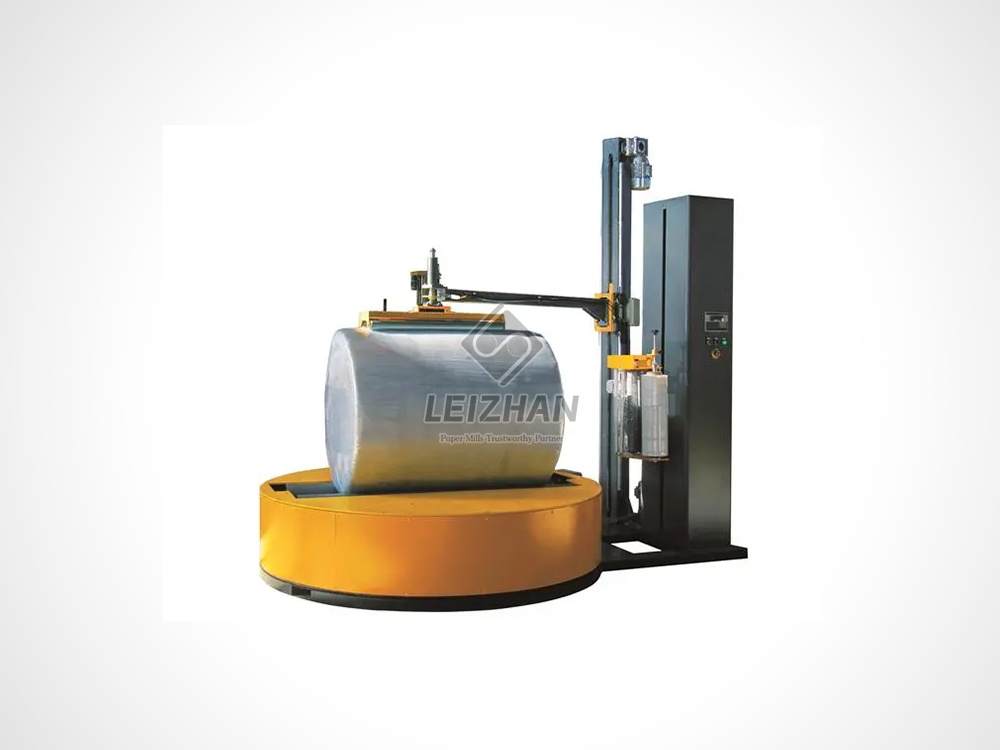
To combat this massive financial risk, facility managers deploy heavily engineered systems designed specifically for industrial roll applications. High-performance paper roll wrappers are built to handle extreme dimensions. Typical industrial models can accommodate roll diameters up to 1500mm and roll widths reaching 3500mm. Integrated with advanced Programmable Logic Controllers and heavy-duty pneumatic ejectors, these machines transform a manual bottleneck into a streamlined, automated flow. By tightly encapsulating the entire roll inside and out, the wrapping prevents moisture ingress and shields the delicate paper edges from accidental forklift impacts.
Orbital Stretch Wrap Machine vs. Traditional Strapping
A frequent dilemma for operations managers evaluating bottom-of-funnel packaging upgrades is deciding whether to transition from manual metal strapping to an automated stretch wrapping line. While metal banding has served as an industry standard for decades, horizontal wrapping introduces measurable advantages in both load distribution and environmental shielding.
Load Protection and Damage Prevention
The primary physical distinction between strapping and wrapping lies in how force is distributed across the cargo. Strapping secures a bundle by applying extreme tension to an exceptionally narrow surface area. This localized tension creates highly concentrated point loads. If the cargo is softer than the strap, the band will inevitably dig into the product's corners, causing permanent crush damage and necessitating the purchase of additional cardboard edge protectors.
In contrast, a horizontal wrapper operates on the principle of distributed tension. The wide web of the stretch film acts as a flexible, compressive sleeve, spreading the containment force evenly across the entire surface area of the bundle. It holds the items together just as rigidly as steel banding but entirely eliminates localized pressure points. This uniform compression drastically reduces edge damage and subsequent customer rejection rates. The elastic memory of the plastic absorbs transit shocks, maintaining its tight grip even if the load settles slightly during a long haul.
Moisture, Dust, and Environmental Defense
Beyond structural containment, packaging must actively protect valuable goods from harsh environments. Traditional strapping only holds a bundle together. It provides absolutely zero environmental protection. If a strapped bundle of architectural aluminum is transported on an open flatbed truck through a rainstorm, the metal will arrive soaked and potentially oxidized.
Horizontal wrapping completely encapsulates the cargo. This presents a massive operational advantage for manufacturing plants located in humid regions or those shipping overseas. In sweltering manufacturing hubs where condensation and salt air are prevalent, exposed metal extrusions can rust overnight. A multi-layered wrap creates an airtight, water-resistant barrier that open-air strapping simply cannot replicate.
5 Facts You Didn’t Know About Orbital Stretch Wrapping
To fully appreciate the sophisticated engineering behind these systems, we need to look beyond their basic functions. The mechanics of horizontal wrapping involve several advanced principles that directly impact factory floor efficiency.
Continuous Operation Capabilities
Because the product moves linearly on a conveyor through the rotating ring, these machines are virtually unconstrained by length. In facilities producing continuous plastic extrusions or composite decking, the wrapper can run non-stop, perfectly matching the exact output speed of the extrusion die.
Dual-Layer Protection Integration
Advanced horizontal models frequently feature secondary material dispensers. Before the outer plastic is applied, the machine can automatically dispense a protective underlayer of bubble wrap, polyethylene foam, or anti-corrosion paper. The rotating ring immediately secures this shock-absorbing layer with stretch film, creating a highly protective package in a single pass.
Smart Sensor Adaptability
Modern automated lines do not require a technician to manually reprogram the machine for every new batch. They utilize sophisticated photoelectric sensors to detect the precise width, height, and trailing edge of the incoming product. These smart sensors allow the machine to dynamically adjust the ring speed, conveyor speed, and film tension on the fly.
Drastic Reduction in Workplace Injuries
Securing awkward products manually forces employees into highly unergonomic positions. Bending low, reaching high, and walking backward while maintaining tension on a heavy roll of plastic is a leading cause of musculoskeletal disorders. Automating this dangerous task removes operators from the immediate hazard zone, drastically lowering slip-and-fall accidents.
Rapid Financial Payback
While the initial capital expenditure for an automated wrapping line is notably higher than purchasing manual banding tools, the return on investment is typically realized in under 18 months. This rapid financial payback is driven by a massive reduction in manual labor hours, a near-total elimination of transit damage, and profound material savings.
Key Features to Look for When Buying an Orbital Wrapper
For decision-stage buyers, selecting the correct machinery requires matching the equipment's technical specifications to the physical realities of your production line. Requesting a quote without thoroughly understanding your operational requirements often leads to under-equipped installations. Here are the actionable, on-site standards to evaluate.
Rule 1: Sizing the Ring and Load Clearance
The most fundamental specification is the internal diameter of the rotating ring. Simply measuring the width and height of your product is insufficient. Using a standard tape measure, you must calculate the maximum diagonal cross-section of your largest anticipated bundle from corner to opposite corner. The ring diameter must be at least 20 percent larger than this diagonal measurement to allow the carriage to rotate safely around the corners without catastrophic collisions.
Rule 2: Conveyor Integration and Speed Synchronization
An automated wrapper is only as efficient as the material handling system feeding it. The quality of the wrap is determined by the relationship between the ring's rotational speed and the conveyor belt's linear speed. If the conveyor moves too fast, the film is applied in a loose spiral with wide gaps. Demand machines equipped with Variable Frequency Drives and automated synchronization. These advanced controls automatically adjust the ring speed to perfectly match any fluctuations in the conveyor.
Rule 3: Automated Cut and Clamp Systems
For true hands-free end-of-line automation, a manual cut-and-tie process is highly inefficient. Industrial buyers must prioritize machines equipped with a robust automated cut and clamp module. At the end of a cycle, this pneumatic system securely grabs the trailing edge of the plastic, slices it cleanly with a specialized blade, and holds it in perfect position for the next incoming product. Without this vital feature, a forklift operator must dismount to manually cut the tail after every single cycle.
Conclusion
An orbital stretch wrap machine fundamentally transforms how modern factories secure non-standard items. Its unique horizontal design effortlessly handles elongated materials and heavy cylindrical goods that traditional vertical masts simply cannot process. By replacing localized manual strapping with uniform, distributed tension control, this technology prevents edge crushing while providing unmatched environmental encapsulation.
For operations managers, the transition to horizontal wrapping represents a strategic opportunity to drastically reduce product damage, lower manual labor costs, and streamline high-volume production lines. Take the time to evaluate your current packaging bottlenecks and calculate your hidden labor expenses. Upgrading your end-of-line systems with specialized wrapping technology is a proven method to improve warehouse safety while fiercely protecting your valuable cargo. Ready to optimize your packaging line? Explore the industry-leading solutions at Leizhan Paper Tech to find the exact automated wrapper engineered for your specific production demands.
FAQ
What industries benefit most from an orbital stretch wrap machine?
Industries that manufacture elongated, bulky, or cylindrical items see the highest return on investment. This includes lumber and timber processing, metalworking and aluminum extrusion, plastics manufacturing, industrial textiles, paper manufacturing, and the commercial furniture sector. These industries frequently handle awkward products that cannot be safely secured on standard wooden pallets.
Can an orbital stretch wrap machine handle standard square pallets?
Generally, no. Horizontal wrappers are specifically engineered for linear, long, or cylindrical loads that pass through a rotating ring. Standard square pallets holding vertically stacked boxes are much better suited for traditional turntable or rotary arm stretch wrappers, which spin the load on a vertical axis.
How does the film carriage on an orbital machine save money?
Advanced carriages utilize powered pre-stretch technology. Inside the module, a series of motorized, geared rollers mechanically stretch the plastic film before it is applied to the cargo. By elongating the film by up to 300 percent, the machine drastically reduces the total volume of plastic required to secure a load. This efficiency leads to massive reductions in annual consumable expenditures.
What is through-eye wrapping and why is it important?
Through-eye wrapping is a highly specialized application method where the stretch film is mechanically passed directly through the hollow center hole of a cylindrical product, such as a massive steel coil or an industrial paper roll. This process wraps the inside core and the outside surface simultaneously, ensuring complete surface coverage. It is absolutely critical for preventing rust, blocking moisture damage, and stopping the unspooling of tightly wound industrial materials during harsh transit.
How much does an orbital stretch wrapper cost?
The cost of an orbital stretch wrapper varies significantly based on the ring diameter, automation level, and custom conveyor integrations. Entry-level semi-automatic models for small lumber or pipe bundling can start around ten thousand to fifteen thousand dollars. Heavy-duty, fully automated industrial systems designed for massive paper rolls or metal coils, featuring advanced PLC controls and automated cut-and-clamp modules, typically range from forty thousand to over one hundred thousand dollars.
What kind of stretch film is used for orbital wrappers?
Orbital wrappers typically use cast stretch film or blown stretch film, depending on the required puncture resistance and load type. High-performance machine-grade film is essential, usually ranging from 70 to 90 gauge thickness. Because the specialized film carriage aggressively pre-stretches the material by up to 300 percent, the plastic must possess high tensile strength and excellent elastic memory to prevent tearing mid-cycle.


