Picture a bustling factory floor. Production is humming perfectly. Suddenly, you hit a massive bottleneck at the end of the line. Inefficient packaging is a common headache for plant managers. Choosing the wrong equipment wastes precious time. Worse, it can completely derail your fulfillment process. When investing in a horizontal orbital stretch wrapping machine, getting the technical specifications right is critical. It is the definitive difference between a seamless packaging line and a costly operational nightmare.
Among all the engineering variables, the most critical factor is the ring size. This specific dimension dictates exactly what products can physically pass through the equipment. It determines the maximum velocity. It also defines the overall footprint the system will consume on your factory floor. Are you securing a lightweight bundle of plastic tubing? Or perhaps a heavy, cumbersome stack of lumber and wide doors? Selecting the correct specification ensures maximum mechanical efficiency and minimal film waste. In this comprehensive guide, we will walk buyers and engineers through the nuanced process of selecting the perfect dimensions for your facility.
Key Takeaways
- The Diagonal Rule: The ideal machine size is determined by the maximum diagonal cross-section of your product plus a mandatory safety clearance. Simple width or height is not enough.
- Application Specificity: Compact rings are engineered for high-speed aluminum profiles. Massive steel structures are required for wide panels and heavy building materials.
- Cost vs. Performance: Larger frameworks require a higher capital investment and rotate at slower speeds. Accurately sizing your equipment balances your budget with optimal throughput velocity.
- Future-Proofing: Intentionally oversizing offers operational versatility for future product lines. However, it must be carefully weighed against potential film waste and factory footprint constraints.
- End-to-End Solutions: A properly specified machine operating in perfect synchronization with automated conveyors guarantees a premium packaging finish.
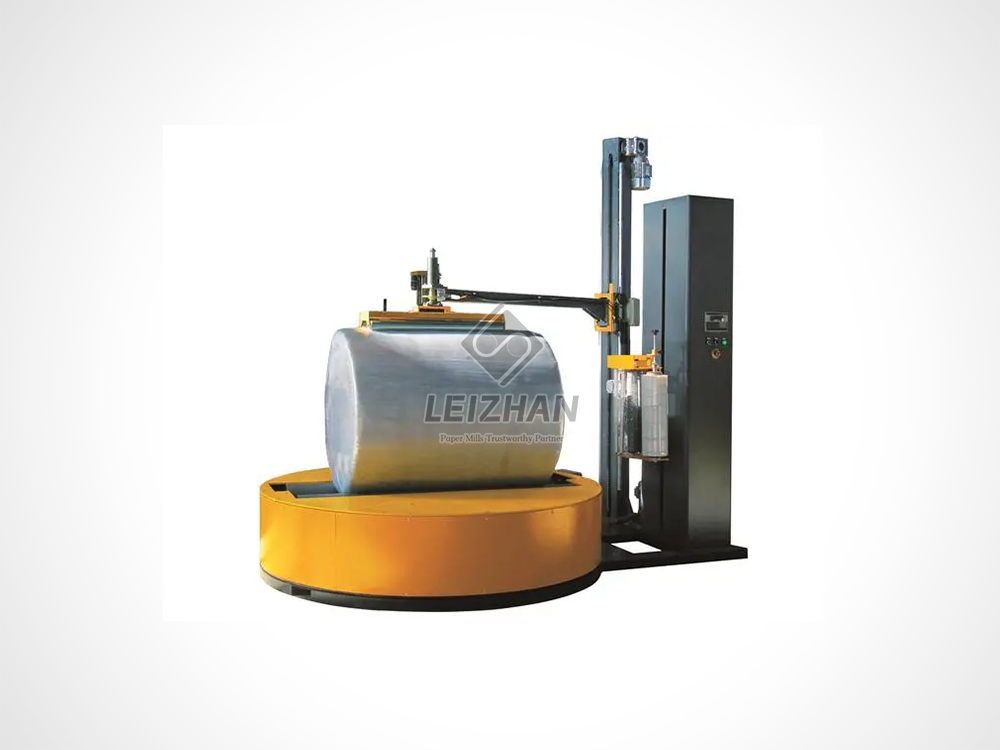
Understanding the Mechanics of the Equipment
To make informed procurement decisions, engineering teams must first grasp the fundamental mechanics. This specialized industrial packaging process involves a rotating circular carriage. It dispenses stretch film around a product as it moves continuously along a horizontal conveyor system. Unlike vertical turntable wrappers that spin the palletized product itself, this horizontal architecture keeps the product entirely stationary. The film carriage revolves rapidly around the horizontal plane.
This specific mechanical design explains why this technology is the absolute industry standard for securing a long load. Products such as timber boards, extruded aluminum profiles, and PVC pipes simply cannot be wrapped on a traditional turntable wrapper. Their sheer length would cause them to strike the factory floor during rotation. By moving the load linearly through a rotating tunnel, facilities can continuously wrap products of theoretically infinite length.
Key Components of the Machine
The architecture of these systems relies on three primary components working in precise synchronization. First is the rotating ring. Often considered the beating heart of the machine, this circular aluminum or heavy-duty steel structure houses the film carriage. Its internal diameter strictly dictates the maximum volumetric capacity of the entire line.
Next, we have the infeed and outfeed conveyors. These transport mechanisms must be perfectly aligned with the exact center of the wrapping zone. They ensure the product feeds smoothly into the machine and exits without shifting. This stability is vital for maintaining consistent film tension.
Finally, the film carriage and tension controls play a crucial role. Mounted directly onto the rotating framework, the carriage holds the stretch film roll. Advanced models feature powered pre-stretch rollers. These rollers elongate the linear low-density polyethylene film before it hits the product, maximizing material yield and load containment.
Why Ring Diameter is the Most Critical Specification
When evaluating technical data sheets, the Ring Diameter represents the absolute physical constraint of your packaging line. It forms a rigid physical tunnel. Every single product must safely pass through this space. If the clearance is too tight, the product physically cannot enter the wrapping zone without risking a collision.
The operational risks of an undersized machine are severe. Attempting to force a slightly oversized bundle through inadequate clearance leads to catastrophic product jams. This causes immediate cosmetic damage to the goods. More importantly, it results in severe equipment failure. A single collision can bend conveyor axles, shatter trunnion wheels, and break film carriages. For engineers, calculating the exact required clearance is a non-negotiable first step.
Impact on Wrapping Speed and Film Tension
Beyond mere physical clearance, the size of the framework fundamentally alters the operational physics. The diameter directly dictates the maximum safe rotations per minute. Smaller, lightweight aluminum rings possess less mass and a tighter circumference. This allows them to spin at blistering speeds, often exceeding 100 rotations per minute. In stark contrast, massive industrial rings must rotate much slower. The exponential increase in centrifugal force and the heavy mass of the steel framework demand a reduced velocity to prevent flexing.
Furthermore, physical dimensions influence the distance between the film carriage and the product surface. If a narrow product is wrapped inside a massive tunnel, the film must travel a significant distance through the air. This extended travel distance causes the film to narrow. This phenomenon is known in the industry as "neckdown". It causes the film to lose its optimal pre-stretch tension, ultimately compromising the structural integrity of the wrapped load.
How to Calculate the Perfect Ring Size
Selecting the correct size is a matter of pure geometry. Buyers frequently make the critical error of matching machine specs directly to the simple width or height of their product. Because the product is typically rectangular and the machine opening is circular, the most extreme points of the product are always its corners.
Therefore, engineers must utilize the standard Pythagorean theorem to calculate the diagonal of the product cross-section. The formula is straightforward: Diagonal equals the square root of [Width squared plus Height squared]. For example, if a forklift operator loads a bundle of engineered timber measuring 400mm in width and 300mm in height, the diagonal is exactly 500mm. Purchasing a 500mm machine would mean the corners of the timber perfectly scrape the inner edge of the framework. That is mechanically impossible to operate safely.
Factoring in Safety Clearance
To guarantee seamless daily operation, procurement teams must add a mandatory safety margin. Standard industry practices dictate adding a 10 percent to 20 percent clearance. This typically translates to roughly 150mm to 200mm of extra breathing room.
This safety clearance accounts for several unpredictable real-world variables. Primarily, it accommodates minor load shifting. This inevitably occurs as the product transitions from the infeed conveyor rollers into the wrapping zone. Additionally, it provides necessary space for irregular shapes, protruding edges, or slightly bowed natural materials that do not conform perfectly to their theoretical CAD dimensions.
| Product Width [mm] | Product Height [mm] | Calculated Diagonal [mm] | Recommended Clearance [+200mm] | Minimum Required Machine Size [mm] |
| 200 | 150 | 250 | 450 | 500 [Standard Size] |
| 400 | 300 | 500 | 700 | 800 [Standard Size] |
| 800 | 600 | 1000 | 1200 | 1200 - 1400 |
| 1200 | 1000 | 1562 | 1762 | 1800 [Standard Size] |
Standard Machine Sizes and Real-World Parameters
Understanding the standard tiers of machinery helps align your production needs with available technology. Let us break down the typical categories found on the factory floor.
Small Diameters [400mm - 600mm]
These compact units are highly specialized machines engineered for maximum velocity. Characterized by the distinct hum of high-speed rotation, they are typically deployed in industries manufacturing slender, continuous products. They are exceptionally well-suited for aluminum extrusions, plastic tubing, and architectural moldings. They are also the perfect solution for securing a pipe coil.
Due to their low mass, they achieve extremely high speeds. They boast a very tight factory footprint and consume minimal electricity. The short distance between the carriage and the product ensures excellent film tension on narrow items. Standard equipment in this range typically utilizes a 125mm to 250mm film roll width to maintain agility.
Medium Diameters [800mm - 1200mm]
The medium category represents the universal sweet spot for most general manufacturing and logistics plants. These machines expertly balance reasonable throughput speed with highly versatile capacity. Facilities producing wooden boards, engineered flooring, standard cabinetry, and flat-pack furniture rely heavily on this size range.
They offer the highest degree of operational flexibility. They are large enough to handle bundled orders of multiple items while maintaining a fast rotation speed. Modern units in this tier often feature programmable logic controllers and inverter-driven motors for precise speed regulation. They generally accommodate standard 250mm to 500mm stretch film rolls, delivering the fastest return on investment for diverse product mixes.
Large & Custom Diameters [1600mm - 3000mm+]
When dealing with massive industrial goods, standard friction-drive units are often replaced with heavy-duty chain-driven orbital wrapping technology. This is necessary to safely manage the immense weight and torque requirements.
These colossal machines handle wide residential doors, large drywall panels, and composite aerospace panels. They are built for pure durability and sheer capacity rather than blistering speed. They seamlessly handle bulky items that would otherwise require highly inefficient manual wrapping by multiple laborers. The heavy-duty steel frames provide exceptional stability. Even at slower speeds, the heavy-gauge stretch film is applied with maximum containment force.
Industry Trends: The Shift Towards Adaptive Technologies
A review of recent manufacturing market analyses reveals a distinct evolution in how facilities approach machine sizing. With the rapid rise of just-in-time manufacturing and highly customized orders, the trend is moving firmly away from rigidly specified, single-purpose machines. Today, there is a surging demand for smart, IoT-enabled wrappers.
These modern systems dynamically adjust film tension based on real-time sensor feedback. This adaptive technology compensates for the physics-based drawbacks of oversized machines. It allows facilities to wrap smaller bundles in larger machines without sacrificing load containment. As automation deepens, the ability of a machine to intelligently adapt its wrapping profile to the exact dimensions of the load is becoming a standard expectation rather than a premium luxury.
Budget to Premium: How Specifications Affect Your Investment
The relationship between physical size and initial capital expenditure is fundamentally exponential. As a facility upgrades from a budget 400mm unit to a premium 2000mm industrial wrapper, the procurement price increases significantly. This is due to strict structural engineering requirements.
Larger frameworks require substantially heavier-duty steel weldments to prevent structural flexing. They demand larger, industrial-grade motors to overcome the severe inertia of the heavy steel. They also require much more robust bearing systems to ensure smooth rotation. Consequently, plant managers must understand that specifying a larger capacity directly pushes the procurement from a budget-friendly tier into a heavy-machinery tier.
While upfront capital is a major consideration, engineers must also analyze long-term operational costs. An oversized unit wrapping a small product results in longer film travel distances. This can lead to potential material waste over thousands of cycles. However, performance reviews consistently demonstrate that the labor savings generated by automated wrapping far outweigh the initial capital expenditure. Accurately sizing the equipment prevents you from overpaying for capacity you do not need.
Pros and Cons of Oversizing Your Equipment
When finalizing machine specifications, procurement teams frequently debate the merits of sizing the equipment precisely versus intentionally oversizing it. Oversizing means selecting a capacity significantly larger than what the current maximum product diagonal mathematically requires. This strategic decision introduces a complex matrix of operational trade-offs.
Future-proofing your packaging line is the primary catalyst for selecting an oversized machine. Capital expenditure cycles in industrial manufacturing typically span seven to ten years. By investing in a larger capacity upfront, a facility can seamlessly introduce new, wider product lines in the future without purchasing a secondary wrapping machine. Furthermore, an oversized unit provides the operational flexibility to perform batch wrapping. Operators can bundle multiple smaller products into a single, consolidated master bundle. This drastically reduces material handling time.
In contrast, the drawbacks of oversizing are deeply rooted in physics. The most significant operational penalty is a mandated reduction in rotational speed. Larger structures possess substantially higher rotational inertia. To safely manage centrifugal forces, the maximum speed must be electronically governed. Wrapping smaller items in a massive machine results in lower overall throughput. Additionally, an oversized machine demands a substantially larger factory footprint. Film tension also becomes a critical mechanical issue due to the extended distance between the carriage and the product.
| Evaluation Metric | Exactly Sized Machine | Oversized Machine |
| Throughput Speed | Optimal [High RPM] | Reduced [Electronically Limited] |
| Load Containment | Highly Consistent | Variable on undersized items |
| Factory Floor Space | Minimal / Compact | Extensive [Vertical and Horizontal] |
| Future Versatility | Limited to current specs | High adaptability for new products |
| Initial CAPEX | Lower | Higher |
Optimizing the Wrap: Conveyors and Nice Endings
An automated wrapper is not a standalone asset. It operates as the core of an integrated packaging ecosystem. The peripheral systems must be perfectly synchronized with the selected capacity to achieve optimal packaging results.
The conveyor system is strictly responsible for maintaining the trajectory and stability of the load. If the conveyor is too narrow relative to an oversized opening, wide products may become physically unstable. This leads to tipping or skewed wrapping dynamics. Conversely, if the conveyor is too wide, it risks interfering with the rotating film carriage. Engineers must specify conveyor rollers that match the weight capacity and width requirements of the specific product mix. For specialized cylindrical items, V-shaped trough conveyors are often implemented to prevent lateral rolling.
In the industrial packaging sector, a "nice ending" refers to the clean, automated termination of the stretch film. This is a complex mechanical challenge. An automated mechanical hand comprising a pneumatic clamp and a cutting module must extend toward the product to grab the film web. If the machine is heavily oversized, the mechanical hand must travel a much greater distance. Advanced systems utilize proximity sensors and extended pneumatic cylinders to ensure the cutter reaches the film accurately. Once severed, a mechanical wiper presses the film tail securely against the load.
Buyer & Engineer Guide: Final Checklist for Selecting Specifications
Navigating the procurement of automated packaging machinery requires a systematic approach. Plant managers and packaging engineers should utilize the following technical checklist to validate their selections.
Begin by conducting a comprehensive audit of your product dimensions. Document the minimum, maximum, and average width and height of every item slated for automated wrapping. Apply the Pythagorean theorem to determine the maximum diagonal. It is highly recommended to apply the 80/20 rule. Optimize the machine size for the 80 percent of products that drive your core production volume. Do not severely oversize the machine to accommodate a rare 20 percent outlier.
Next, evaluate your factory environment. A machine equipped with a massive framework requires significant spatial accommodations. Precisely measure the available ceiling height, factoring in overhead cranes and HVAC ductwork. Horizontal floor space must also be mapped out thoroughly. Ensure sufficient room for safety fencing and operator walkways.
Finally, never finalize a machine specification in isolation. Reputable equipment manufacturers possess the empirical engineering expertise to validate your mathematical calculations. Provide exact product dimensions, weight profiles, and throughput requirements to the manufacturer. Request detailed 3D CAD models to visually verify how your product will interface with the equipment. Always stipulate a Factory Acceptance Test using your actual products before the machine ships.
Conclusion
Choosing the precise specifications for your automated wrapping equipment is a foundational decision. It echoes throughout your entire end-of-line packaging process. By accurately calculating the diagonal of your largest load, mandating adequate safety clearances, and meticulously weighing the pros and cons of oversized equipment, you can optimize both your capital budget and your daily packaging efficiency. The right dimensions ensure a highly secure wrap, a clean professional finish, and a rapid return on investment. Take the time to measure twice and consult deeply with packaging experts. Ready to eliminate packaging bottlenecks and upgrade your facility? Explore the full range of high-performance solutions at Leizhan Paper Tech to find the exact machine tailored to your production goals.
FAQ
Can a single machine wrap different sized products?
Yes, a single unit can accommodate a wide variance in product dimensions, provided that the largest item does not exceed the maximum allowable physical clearance. The equipment is typically sized according to the largest anticipated load, inclusive of a 150mm to 200mm safety clearance. Smaller products can easily pass through the same machine. However, wrapping very small items in a significantly oversized tunnel alters the film tension dynamics. Advanced machines utilize programmable logic controllers to adjust film tension dynamically, mitigating this issue for diverse product mixes.
How do I measure my product to find the right size?
Determining the correct size requires calculating the maximum diagonal cross-section of your product strictly as it sits on the conveyor. You cannot simply use the width or height independently. Square the maximum width and the maximum height, add them together, and calculate the square root of the sum. Once the theoretical diagonal is calculated, engineers mandate adding a safety margin of at least 150mm to 200mm. This extra clearance accounts for potential load shifting and irregular product geometries.
What is the difference between a horizontal wrapper and a turntable wrapper?
The primary distinction lies in the orientation of the product and the physical movement of the film dispenser. In a traditional turntable wrapper, the pallet is placed vertically on a spinning base, while the film carriage moves up and down a stationary mast. Conversely, horizontal wrapping pushes a product continuously through a vertically oriented, rotating tunnel. The product moves linearly along a conveyor while the film spins around it. This is the only viable automated solution for securing long items like lumber or extruded aluminum profiles.
Does a larger machine mean a slower wrapping speed?
From a mechanical engineering perspective, yes. A larger framework inherently possesses a greater physical mass and a significantly wider circumference. To maintain safe operational parameters and limit the centrifugal forces exerted on the rotating bearings, the rotation speed must be electronically governed and reduced. While a compact 400mm unit might safely achieve speeds exceeding 100 rotations per minute, a massive 2500mm unit used for wide panels may be restricted to 20 to 30 rotations per minute.
How does the machine achieve a clean cut or "nice ending" on the film?
Achieving a clean cut prevents the stretch film from unraveling during transit. Modern wrappers utilize an automated mechanical hand assembly located near the exit point. As the wrapping cycle concludes, a pneumatic clamp extends to physically grasp the film web. A cutting mechanism then severs the material. Immediately following the cut, a pneumatic wiper brush or a friction pad presses the trailing tail of the film firmly against the surface of the load. This ensures the film adheres to itself without manual intervention.
What is the maximum weight capacity for an orbital wrapper?
The weight capacity of an orbital wrapping system is not actually dictated by the rotating ring itself, but rather by the heavy-duty conveyor system supporting the load. Standard roller conveyors can typically handle anywhere from 500 kg to 2,000 kg per linear meter. For extremely heavy industrial applications like structural steel or dense timber stacks, reinforced chain-driven conveyors or heavy-duty slat conveyors are integrated into the machine design to safely support massive tonnage without stalling the wrapping process.
How do I choose the right stretch film for different ring sizes?
Selecting the correct film depends heavily on the machine's carriage size and rotation speed. Small, high-speed machines typically utilize narrower 125mm to 250mm cast stretch films to maintain agility and prevent tearing at high RPMs. Medium to large machines generally use standard 500mm machine-grade linear low-density polyethylene film. If your machine features a powered pre-stretch carriage, you must select a high-performance film rated for 200 percent to 300 percent elongation to maximize material yield and ensure proper load containment.


