Picture a bustling warehouse floor. Forklifts constantly weave through tight aisles to keep up with demanding shipping schedules. In many of these facilities, moving heavy pallets twice is a massive operational bottleneck. First, operators drive the load to the packaging area. Next, they transport the secured load across the building to a floor scale. This double-handling quietly drains productivity. It consumes valuable labor hours. Worse, it multiplies the risk of forklift collisions and product damage in high-traffic zones.
The most practical solution integrates these two critical end-of-line tasks. A pallet wrapper with scale serves as an efficient two-in-one system. It streamlines your packaging and logistics simultaneously. But when evaluating this hybrid equipment, logistics coordinators often share a common hesitation. Is a scale built into a spinning machine actually accurate enough for commercial shipping?
The short answer is absolutely. Modern integrated systems are engineered for severe industrial environments. Thanks to advanced sensor technology, these machines often boast up to 99.9 percent accuracy. This comprehensive guide explores exactly how these machines function and the baseline precision you can expect. We will also examine how they ultimately protect your bottom line by generating reliable freight metrics.
Industry Trends: Why Precision Matters Now
Before diving into the mechanical details, we must look at current logistics trends to understand why this technology is surging in demand. Freight carriers are aggressively deploying high-speed automated dimensioning and weighing systems at their cross-docking facilities. Fluctuating fuel costs and tight operational margins demand absolute efficiency. Carriers no longer accept estimated freight weights.
The logistics sector is shifting heavily toward strict audit protocols and dynamic pricing models. Consequently, warehouse managers face immense pressure to capture exact metrics before the truck arrives. This industry-wide crackdown elevates highly accurate integrated scales from a luxury upgrade to an absolute operational necessity.
Key Takeaways
- High Precision: Quality machines typically offer an accuracy margin of 0.1 percent to 0.5 percent. This makes them highly reliable for commercial freight documentation and load balancing.
- Advanced Technology: Precision relies on high-capacity sensors strategically placed beneath the turntable. This ensures weight is captured evenly regardless of load distribution.
- Seamless Integration: Automated data capture eliminates manual human error. Metrics sync directly to your Warehouse Management System or Enterprise Resource Planning software.
- Cost Savings: Accurate real-time weighing prevents costly Less Than Truckload carrier chargebacks, re-weigh fees, and administrative disputes.
The Basics: Eliminating Double-Handling
To truly appreciate the value of this equipment, we must look at how it fundamentally changes daily operations. An integrated wrapper is a heavy-duty piece of packaging machinery equipped with an industrial weighing platform built directly into its base. Instead of operating separate stations for securing the load with stretch film and capturing its mass, this system performs both tasks in a single fluid motion.
In a standard staging environment without integrated equipment, operators execute a redundant sequence of movements. By consolidating the footprint, facilities can slash processing time by up to 30 percent. Consider the side-by-side comparison of the two workflows:
| Operational Step | Traditional Process | Integrated Process |
| Step 1 | Forklift picks up the pallet from the staging area. | Forklift picks up the pallet from the staging area. |
| Step 2 | Pallet is driven to the stretch wrapper and loaded. | Pallet is driven to the wrapper and loaded. |
| Step 3 | Machine wraps the pallet. | Machine wraps and weighs the pallet simultaneously. |
| Step 4 | Forklift moves the wrapped pallet to a floor scale. | Forklift moves the pallet directly to the loading dock. |
| Step 5 | Operator waits for the scale to stabilize and logs data. | Process Complete. |
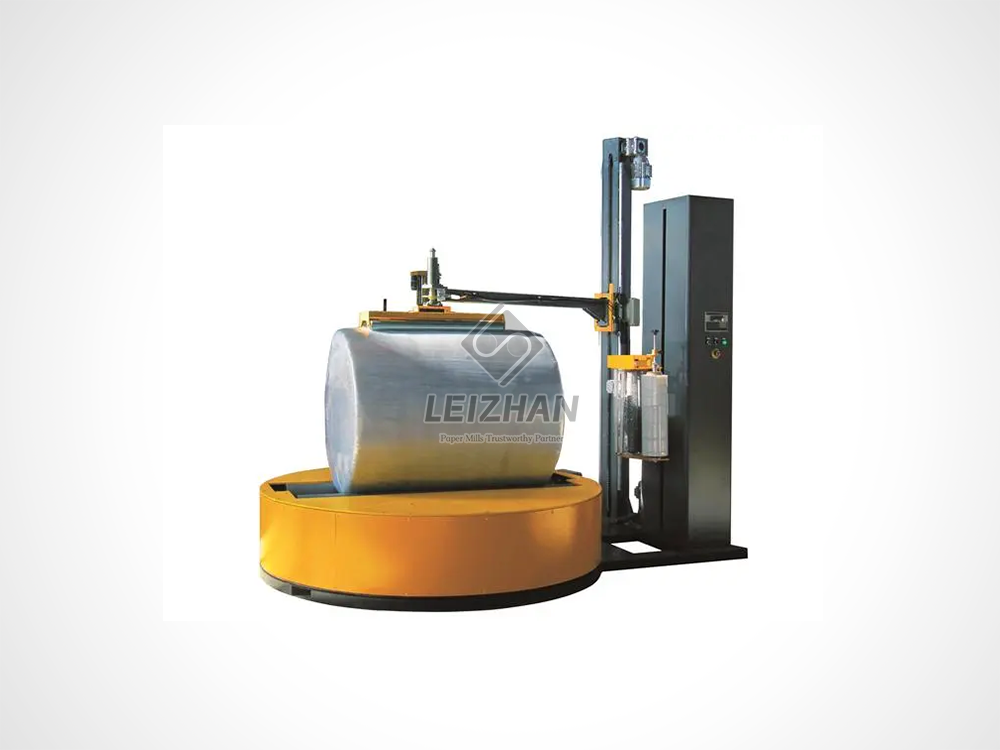
Furthermore, turntable wrappers are the most common models to feature these built-in scales. They house the components directly beneath the rotating platform. Straddle wrappers handle unusually heavy or unstable loads by rotating a film carriage around a stationary pallet. These can feature scales built into the floor beneath the wrapping zone. In contrast, robotic wrappers navigate autonomously around a stationary pallet. Because they drive across the warehouse floor, they do not integrate weighing platforms.
The Core Component: Understanding the Load Cell
The exceptional precision discussed above is not magic. It is the direct result of robust engineering. Understanding this internal hardware is key to grasping how the machine maintains its weighing accuracy over thousands of cycles.
In straightforward engineering terms, a load cell is a highly sensitive transducer. Its primary function is converting a mechanical force into a measurable electrical output. Inside the rugged metal housing sit delicate strain gauges. As the downward gravitational pull of your loaded pallet microscopically compresses the metal, the strain gauge stretches or contracts. This alters the electrical resistance. The digital indicator reads this minute change and translates it into a precise readout displayed in kilograms or pounds.
Top-tier integrated wrappers do not rely on a single central sensor. Instead, they utilize a 4-point system. Engineers position distinct high-grade alloy sensors at the four corners of the base frame directly beneath the turntable. This specific configuration is vital for fast-paced warehouse operations. Forklift operators rarely place a pallet perfectly in the dead center of the platform. A 4-point system ensures that even if a heavy load is placed slightly off-center, the digital summing box calculates the total electrical output from all four corners. This guarantees an accurate aggregate reading.
A weighing platform built into a stretch wrapper must endure significant mechanical stress. It survives the harsh impact of a forklift lowering a heavy load and the rotational torque of a turntable spinning at 12 to 15 revolutions per minute. Industrial sensors feature mechanical overload protection to handle these dynamic forces. To maintain peak performance, facilities should schedule a professional calibration check annually.
Pre-Stretch vs. Post-Stretch: Does Film Add to the Weight?
While hardware dictates baseline precision, operational variables also enter the equation. A common technical question arises during equipment procurement. If the pallet is measured during or after the wrapping cycle, does the plastic skew the metrics?
Yes, stretch film has mass. It does add to the total gross weight of the pallet. However, the addition is usually minimal. For a standard pallet wrapped to a height of 1.5 meters, the applied plastic typically weighs between 0.2 and 0.7 kilograms. For most general shipping purposes, this slight variance is statistically insignificant. Yet, for facilities handling strict pharmaceutical or chemical loads, this tare weight must be calculated and deducted precisely.
This is where the film delivery system becomes crucial. Manual hand-wrapping or basic post-stretch machines rely on the tension of the load to stretch the film. This results in highly inconsistent application. One pallet might use 0.5 kilograms of film, while the next uses a full kilogram. This makes it impossible to establish a reliable tare weight.
Specifically, modern equipment solves this through powered pre-stretch carriages. Premium machines feature internal motorized rollers that elongate the film by 250 percent to 300 percent before it ever touches the load. This advanced technology ensures the exact same amount of plastic applies to every pallet of the same size. Because film usage is completely standardized, warehouse managers can program the indicator to automatically deduct this precise tare weight. This ensures flawless net calculations every single time.
Automating Your Workflow with Digital Integration
Capturing an accurate measurement is only half the battle. If that data is lost, miswritten, or poorly communicated to the logistics team, its value plummets. Modern integrated systems solve this vulnerability through advanced digital weight recording.
In traditional setups, a forklift operator reads the digital display and scribbles the number on a clipboard. Later, a shipping clerk manually types that number into a computer system. This manual process is highly susceptible to human error. A sloppy number seven can easily be misread as a one. These simple clerical errors lead directly to incorrect freight quotes and billing discrepancies. Automated indicators eliminate this risk by removing the human element from data transcription entirely.
Today’s dynamic recording indicators are equipped with advanced communication protocols. These include RS-232 serial ports, USB outputs, and Ethernet connectivity. These connections allow the equipment to communicate directly with your internal warehouse software. As soon as the wrapping cycle concludes, the data pushes instantly to the cloud. This gives the logistics team real-time access to finalize Bills of Lading without delay.
Protecting Your Margins with Reliable Metrics
Ultimately, investing in precise weighing equipment is fundamentally an exercise in margin protection. In the modern logistics landscape, inaccurate metrics are aggressively penalized by freight carriers.
Less Than Truckload carriers operate on tight margins. They rely on precise dimensional data to maximize the profitability of every trailer. If you estimate your pallet at 500 kilograms on the paperwork, but the carrier’s automated terminal scale registers it at 540 kilograms, you will face immediate consequences. The carrier will issue a chargeback for the difference in freight cost. They will also apply an administrative re-weigh fee simply for the inconvenience of correcting your documents.
Generating perfectly accurate shipping data before the truck arrives is your ultimate defense against carrier disputes. By ensuring the numbers listed on your paperwork match the actual physical freight, you improve your Return on Investment rapidly. You eliminate surprise back-end charges. Furthermore, when carriers know your documentation is historically trustworthy, they spend less time auditing your freight. You can leverage this reliability to negotiate better base shipping rates.
Actionable Selection Guide for Integrated Wrappers
If you are in the decision-making stage of purchasing packaging equipment, selecting the right model requires matching the machine's technical specifications directly to your facility's operational realities. Avoid abstract estimates and focus on hard parameters.
First, evaluate weight capacity and turntable size. Standard integrated wrappers typically offer maximum capacities of 2,000 kilograms. It is a strict engineering best practice to select a machine with a capacity that exceeds your heaviest standard load by at least 20 percent. This buffer protects the load cells from shock damage during loading. Additionally, match the turntable diameter to your pallets. A standard 1500mm or 1650mm turntable accommodates standard pallets perfectly. If your loads overhang, you must step up to an 1800mm or 2000mm base to prevent sensor interference.
Next, consider your loading method. If your facility relies on manual pallet jacks or electric walkies, you will need a loading ramp. The addition of a weighing base raises the height of the turntable slightly off the floor. An extended ramp is required to push heavy loads up the incline safely. To save floor space, the machine can be pit-mounted. This sinks the equipment into the concrete so the turntable sits perfectly flush with the ground. If your team exclusively uses forklifts, neither a ramp nor a pit is strictly necessary.
When evaluating the budget, look beyond the initial sticker price. While an integrated machine costs more upfront than a standalone wrapper, the total cost of ownership heavily favors the integrated model. By consolidating the footprint and shaving minutes off every single packaging cycle, an integrated machine typically pays for its premium within the first year through consistent labor savings and the total elimination of carrier penalty fees.
A pallet wrapper with a built-in scale is far more than a warehouse convenience. It is a highly accurate margin-protecting tool driven by robust sensor technology. By combining the tasks of securing and weighing your loads, you guarantee pristine shipping documentation. Assess your facility's daily wrapping volume and load dimensions today. Visit Leizhan Paper Tech to explore high-performance wrapping solutions and find the ideal integrated system tailored to your exact operational specifications.
FAQ
Can I add a scale to my existing pallet wrapper?
While some manufacturers offer retrofit kits, it is often difficult and expensive to install and calibrate them properly. Buying a purpose-built integrated machine is usually more cost-effective. Factory integration guarantees a higher baseline accuracy and better load cell protection right out of the box.
How often should the load cells be calibrated?
For standard warehouse use, a professional calibration once a year is highly recommended. However, high-volume facilities or those operating under Legal for Trade certifications need bi-annual checks to remain compliant and ensure absolute precision.
Does the rotation of the turntable affect the weight reading?
No. High-quality machines feature dynamic recording indicators that stabilize the reading. These advanced digital indicators filter out the mechanical motion and vibration of the spinning turntable. This allows the system to capture the true static mass of the load accurately.
Are integrated scales Legal for Trade?
Some models are, but they are not Legal for Trade by default. If you bill customers strictly based on the weight metrics generated by the wrapper, you must ensure you purchase a specific model equipped with certified and tested scale components approved by your local regulatory body.
What is the standard weight tolerance for an integrated pallet wrapper scale?
Industrial integrated scales typically maintain an error margin between 0.1 percent and 0.5 percent of the applied load. For a standard 1,000 kilogram pallet, the digital readout will generally be accurate within 1 to 5 kilograms.
Can the scale integrate directly with third-party shipping software?
Yes. Modern digital indicators feature RS-232 serial ports, USB outputs, or Ethernet connectivity. These outputs allow the weighing system to send data strings directly to warehouse management systems, ERP software, or third-party shipping platforms to automate label generation.


