Is unexpected machine downtime eating into your daily profit margins? Picture this familiar warehouse scenario. The automated packaging line is humming along with rhythmic predictability. Suddenly, a loud snap echoes across the floor. A Film Tear stops your packaging production fast, creating an immediate bottleneck that frustrates operators and delays shipments. While it may seem like a random inconvenience, recurring plastic breakage is a critical symptom of underlying structural or mechanical issues.
When the plastic suddenly snaps, it usually points to poor machine calibration, substandard materials, or a combination of both. From an engineering perspective, automated equipment fails mid-cycle for very specific, measurable reasons. We will explore actionable troubleshooting frameworks to fix these issues. Furthermore, we will help you determine when it might be time to upgrade your aging machinery to maintain a competitive edge and protect your bottom line.
Key Takeaways
- Precision Calibration is Crucial: Incorrect tension settings or mismatched pre-stretch gears are the leading mechanical causes of plastic snapping.
- Material Integrity Matters: Even microscopic, invisible damage to the roll extremities can cause catastrophic failure during a high-speed wrapping cycle.
- Consumables Cannot Be Ignored: Utilizing cheap, expired, or chemically incompatible plastics will negate the mechanical benefits of even the most advanced automated equipment.
- Load Profiles Dictate Settings: Sharp corners, protruding pallet boards, or unevenly stacked loads require specific wrapping profiles to prevent punctures.
- Routine Maintenance Prevents Downtime: Keeping carriage rollers clean and ensuring the web is threaded correctly eliminates the vast majority of common breakage incidents.
The Hidden Financial Drain of Line Breakages
A mid-cycle snap is not just a minor annoyance. It creates a compounding ripple effect throughout your entire logistics workflow. Understanding the true cost of these interruptions is the first step toward justifying proactive maintenance and process optimization.
Every time the web parts, the wrapping cycle abruptly stops. Consequently, an operator must physically walk over to the carriage, untangle the snapped plastic from the labyrinth of rollers, re-thread it, secure it back onto the pallet, and restart the sequence. Industry time-motion studies indicate that a single break takes an average of three to five minutes to resolve. If a facility experiences just a handful of breaks per shift across multiple lines, this translates to hundreds of lost labor hours annually.
In addition to lost time, material waste becomes a significant financial drain. When a wrap job fails halfway through, the structural containment force of the load is severely compromised. Operators are often forced to strip the partially wrapped pallet completely and start over. This leads to excessive plastic waste, driving up consumable costs and negatively impacting your facility environmental sustainability metrics. Furthermore, if an operator attempts a poor patch job instead of re-wrapping, the pallet is at high risk of shifting during transit. This creates severe safety hazards for forklift drivers and logistics personnel.
Mechanical Root Causes: Why Equipment Settings Matter
When diagnosing a persistent breakage issue, the most logical place to start is the mechanical configuration of the equipment itself. Even minor miscalibrations can exert excessive force on the delicate polymer web. As maintenance engineers often discover, the machine is simply doing exactly what it is programmed to do, even if those parameters are flawed.
Incorrect Calibration and Force Application
Understanding how the machine applies force is vital. If the Tension Control is set too high for the specific micron gauge of the plastic you are using, the material will exceed its ultimate tensile strength and snap. It is important to distinguish between pre-stretch and post-stretch. Pre-stretch occurs inside the carriage where two rollers moving at different speeds elongate the plastic. Post-stretch is the lay-on force applied between the carriage and the rotating pallet. Finding the optimal sweet spot in these settings ensures load containment without exceeding the material breaking point.
Improper Threading Paths
Modern pre-stretch carriages feature a precise labyrinth of urethane rollers. Threading the web incorrectly through these components creates uneven stress points and bypasses the intended feedback mechanisms. For instance, if the material is routed backward over a dancer bar or misses a secondary idler roller entirely, it will drag and snap almost instantly. Operators should always consult and strictly follow the manufacturer threading schematic, typically printed directly on the carriage housing.
Worn, Dirty, or Sticky Rollers
Over time, the tackifier resins used in packaging plastics build up on the pre-stretch rollers. This sticky accumulation, combined with industrial warehouse dust, alters the diameter and grip of the rollers. Additionally, worn-out bearings can cause rollers to drag rather than spin freely. When the rollers resist movement, the drive motor pulls against a static object. This leads to an immediate failure due to the sudden spike in mechanical resistance.
Material Integrity and Evolving Industry Trends
Automated equipment can only perform as well as the material running through it. Attempting to cut operational costs by purchasing inferior packaging consumables often results in higher overall expenses due to continuous downtime.
Current logistics data reveals a massive industry pivot toward ultra-thin, high-performance nano-films. Facilities are rapidly downgauging to reduce material costs and lower their carbon footprints. However, this shift means that Film Quality is more critical than ever. Thinner gauges are highly unforgiving of tension spikes. Using a gauge that is too thin for a heavy, sharp, or irregular load will inevitably result in tearing. High-performance wrapping requires advanced metallocene resin blends that possess the molecular memory and elasticity required to survive aggressive stretching forces. Low-quality resins simply lack this structural integrity.
Many warehouse managers are also surprised to learn that these plastics have a definitive shelf life. Extreme heat causes the layers to fuse together, a condition known as blocking, making it impossible for the carriage to unwind the roll smoothly. In contrast, extreme cold makes the polymer rigid and brittle. Prolonged exposure to UV light breaks down the molecular bonds. Storing consumables in a climate-controlled environment and rotating inventory is essential for maintaining optimal performance.
The Hidden Danger of Physical Damage
Sometimes, the root cause of a failure occurs before the material is even loaded onto the carriage. Technicians often obsess over mechanical settings while completely overlooking the physical condition of the raw material.
Mishandling During Storage and Transit
A standard industrial roll can weigh upwards of 40 pounds, making it incredibly sensitive to blunt force. Picture a warehouse worker accidentally dropping a roll from a forklift, even from a height of just a few inches. The impact crushes the delicate layers of plastic, creating a small dent, flat spot, or white bruise. The Roll Edge is the most vulnerable part of the material. Personnel must be trained to carry them carefully and store them vertically on their core ends to prevent compression damage.
How Pre-Stretch Amplifies Microscopic Nicks
The physics of automated wrapping makes material integrity paramount. Inside the carriage, the plastic is elongated by 200 percent to 300 percent before it even touches the pallet. A microscopic, almost invisible nick acts as a severe stress concentrator. When that tiny fracture hits the high-speed pre-stretch rollers, the massive elongation forces the flaw to propagate across the entire width of the web instantly. This always results in a catastrophic snap.
Pallet Geometry and Load Profile Issues
In some diagnostic scenarios, the equipment is perfectly calibrated, and the consumable quality is exceptional, yet the tearing persists. In these instances, the geometry of the load itself is the variable causing the failure.
Not all pallets are perfectly uniform cubes. Highly irregular loads with sharp cardboard corners, exposed wooden splinters, or protruding metal parts easily puncture the highly tensioned plastic. When the web catches on a sharp corner, the feedback system cannot compensate quickly enough. To mitigate this, operators can apply cardboard corner protectors before the cycle begins or adjust the profile to apply a softer wrap around the base and top edges.
Furthermore, centering the pallet on the turntable is critical. If a load is placed off-center, it creates an elliptical rotation path. As the turntable spins, the distance between the load and the carriage constantly changes, creating severe pulling spikes on the long side of the rotation. The plastic is forced to abruptly speed up and slow down, frequently causing it to snap under the sudden pulling force.
Step-by-Step Diagnostic Framework
When operators face persistent breakage on the warehouse floor, a systematic approach prevents blind guessing. Use this objective progression to isolate and resolve the root cause efficiently.
First, remove the current roll and closely inspect the top and bottom flat sides for nicks, white bruising, or dents. If any physical damage is found, swap it for a pristine roll immediately. A damaged cylinder cannot be salvaged for high-speed automated use and should be repurposed for manual hand-wrapping.
Next, open the carriage door and trace the web path against the manufacturer diagram. Ensure it passes over the load cell and under the correct idler rollers. Correcting a bypassed roller eliminates artificial friction and restores proper elongation dynamics.
Inspect the urethane components for tacky resin build-up, industrial dust, or stray label adhesive. Wipe them down thoroughly with isopropyl alcohol. Avoiding harsh chemical solvents is crucial, as they can degrade the rubberized coating. Clean rollers allow the web to glide smoothly without dragging.
Access the control panel and reduce the secondary lay-on force setting by 10 to 15 percent, then run a test cycle. Lowering this metric reduces the immediate pulling force on the web. Gradually increase it back up in small increments until the pallet is properly secured without exceeding the breaking point.
Finally, walk around the physical pallet and inspect the stacked products. Look for sharp box edges, protruding nails, or off-center placement on the turntable. Repositioning the pallet to the dead center and removing sharp puncture points eliminates external mechanical damage to the web.
Equipment Selection Guide: Upgrading for Reliability
Even with meticulous maintenance and pristine consumables, industrial hardware eventually reaches the end of its functional lifecycle. Older units equipped with outdated friction-brake technology simply cannot handle the precise elongation requirements of modern, high-performance logistics.
If your facility experiences constant breakdowns despite regular servicing, it is time to evaluate new equipment. Modern automated systems utilize electronic PLC load cells that adapt to corner spikes in milliseconds, virtually eliminating standard breakage issues. Let us look at a direct comparison to understand the engineering advantages of upgrading.
| Feature Standard | Outdated Friction-Brake Wrappers | Advanced Powered Pre-Stretch Wrappers |
| Tension Control | Mechanical spring or brake pad. Highly inconsistent. | Intelligent PLC load cells with millisecond feedback loops. |
| Pre-Stretch Ratio | 0 to 50 percent. Relies entirely on load pull. | 250 to 300 percent motorized pre-stretch. Maximizes film yield. |
| Film Breakage Rate | High. Cannot compensate for sharp corners or off-center loads. | Extremely Low. Carriage speed adjusts dynamically to load geometry. |
| Ideal Application | Low volume, uniform lightweight boxes. | Heavy duty industrial loads, paper rolls, irregular pallets up to 2000kg. |
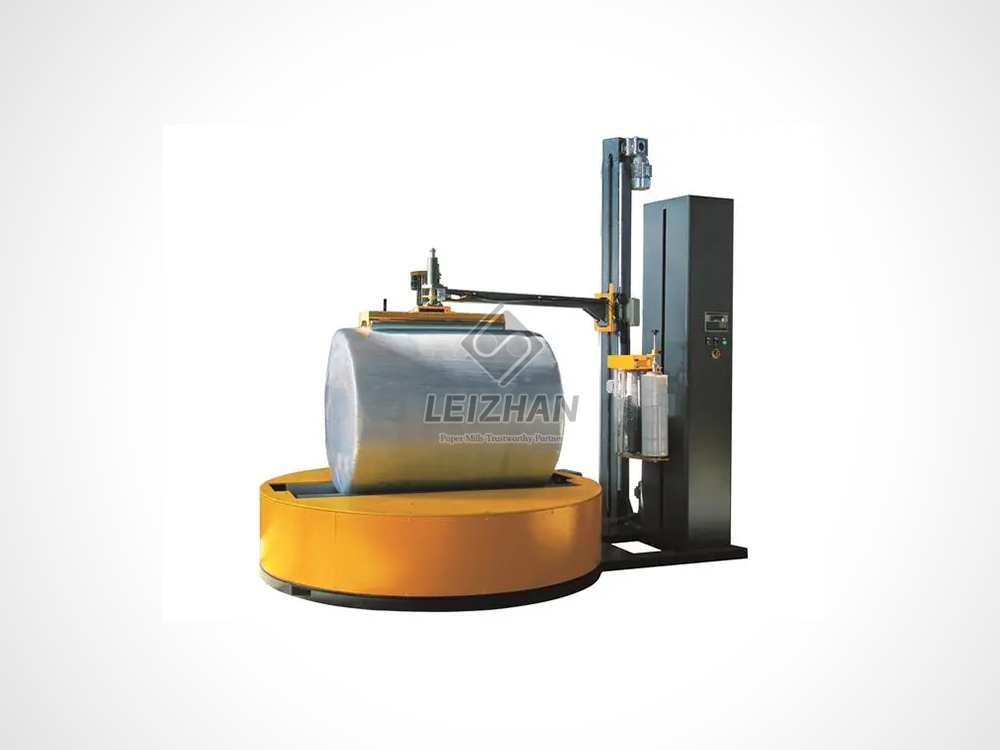
Specifically, different industrial sectors require highly specialized solutions that a standard turntable pallet wrapper cannot provide. For example, heavy-duty applications handling massive cylindrical loads require a specialized Stretch Film Wrapping Machine engineered specifically for extreme weights and unique geometries. High-end equipment often features robust turntable capacities exceeding 2000kg, 250 percent powered pre-stretch capabilities, and intelligent PLC control systems that automatically adjust tension based on the roll diameter. Upgrading to application-specific machinery ensures that your delivery systems are perfectly matched to your products, permanently resolving chronic operational bottlenecks.
Frequently Asked Questions
Why does my plastic keep breaking at the bottom of the pallet?
Usually, this is due to the web catching on sharp wooden pallet corners, exposed splinters, or protruding nails. It can also occur if the lay-on force is set too high during the initial bottom-wrap sequence, where the carriage dwells to lock the load securely to the wooden base.
Can the equipment stretch the material too much?
Yes. Every polymer blend has a maximum yield point. If the pre-stretch gearing inside the carriage exceeds the material maximum stretch capacity, it will result in an immediate and unavoidable tear. You cannot force a wrap rated for 150 percent elongation through a 250 percent gear ratio.
How do I know if my roll is physically damaged?
Inspect the flat top and bottom sides carefully. Look for visible physical indentations, white bruising on the otherwise clear plastic, or tiny nicks on the edges. Even a flaw the size of a pen tip can act as a stress concentrator and compromise the entire web during high-speed elongation.
Does temperature affect performance and cause tearing?
Absolutely. Cold warehouse environments cause the polyethylene molecules to contract, making the material brittle and highly susceptible to snapping. Conversely, extreme heat can make it overly tacky, causing it to stick aggressively to the carriage rollers. Consumables should always be stored in a climate-controlled environment.
How often should I clean the carriage rollers?
A visual inspection of the urethane components should be conducted daily by the operator. However, a thorough cleaning to remove tacky resin build-up using isopropyl alcohol should be performed at least once a month. High-volume, multi-shift operations may require bi-weekly cleaning to maintain optimal performance.
How do I determine the correct pre-stretch ratio for my load?
The correct ratio depends on your film specifications and load weight. Check the manufacturer technical data sheet for the ultimate tensile strength and maximum elongation percentage. For heavy, stable loads, you can utilize gears up to 250 or 300 percent. For lighter, fragile loads, a lower ratio prevents the tension from crushing the boxes.
Why does the film snap only at the beginning of the wrap cycle?
This is typically a threading or startup tension issue. If the film is not securely tucked into the pallet base, or if the initial turntable acceleration is too aggressive, the sudden jerk will snap the web before the load cell has time to register the tension and adjust the carriage feed rate.
Preventing a mid-cycle snap requires a holistic approach encompassing precision calibration, uncompromising material standards, gentle handling, and proper load staging. If your current equipment is holding back your production capacity, it is time to consult with industry experts. Visit Leizhan Paper Tech to explore advanced wrapping solutions tailored to your specific industrial requirements and eliminate unexpected downtime for good.


