Introduction
Investing in end-of-line packaging machinery usually marks a facility's first major step toward operational efficiency. It effectively replaces the tedious, physically demanding process of manual hand-wrapping. For emerging distribution centers, this equipment represents a significant leap forward in standardizing pallet securing and reducing immediate labor strain. However, recent industry analysis indicates a massive shift in warehouse automation strategies. As global supply chains face unprecedented throughput requirements and chronic labor shortages, logistics directors are rigorously scrutinizing legacy equipment. Current market trends reveal a stark reality. While middle-ground packaging solutions were once the gold standard for growing facilities, the escalating costs of industrial labor and the necessity for strict, data-driven throughput metrics have exposed their mechanical ceilings.
Modern fulfillment centers are increasingly abandoning hybrid machinery in favor of fully integrated, hands-free systems. While a Semi Automatic Stretch Wrapper performs adequately for low-to-medium volume operations, it inevitably becomes a bottleneck in high-volume environments. Relying on this tier of machinery in a rapidly scaling plant inadvertently creates new logistical hurdles. These include excessive human dependency, restricted processing speeds, and highly inconsistent containment standards. This technical breakdown will explore the specific engineering limitations of semi-automated systems, the hidden financial costs they incur, and how plant managers can determine when it is finally time for a comprehensive equipment overhaul.
Key Takeaways
- Labor Dependency: The equipment requires constant human intervention to attach and cut the film, tying up valuable workforce resources that could be utilized in revenue-generating tasks.
- Speed Limits: Restricted processing speeds create severe production bottlenecks, particularly when a facility needs to secure more than 30 to 40 pallets per hour.
- Quality Control: Manual intervention frequently leads to inconsistent containment force, which negatively impacts cargo security during transit and increases product damage risks.
- Hidden Costs: Wasted plastic consumables, extensive forklift wait times, and potential ergonomic injuries can quickly negate the initial cost savings of purchasing the machine.
- The Next Step: Recognizing these specific operational shortfalls is the primary catalyst for transitioning to a fully automatic system or an industry-specific wrapping solution.
Understanding the Limits of a Semi-Automated System
Defining the Equipment
In the realm of warehouse packaging, a semi-automated wrapper is defined by its shared division of labor between human and machine. Picture a busy loading dock. The machinery handles the mechanical rotation of the load via a motorized turntable and manages the vertical movement of the film carriage. The process, however, remains entirely stagnant until a floor worker physically loads the pallet onto the platform. That worker must then bend down to manually tie the plastic film to the wooden base, press the start button on the panel, and wait to cut the film tail once the rotation cycle concludes.
The Illusion of Full Automation
Plant managers scaling their operations frequently overestimate the autonomy of these machines. They undeniably save warehouse staff from the back-breaking physical labor of walking dizzying circles around a pallet with a heavy roll of film. Yet, they do not offer a hands-free, set-it-and-forget-it packaging line. The worker remains tethered to the control panel for the duration of the process. This dynamic creates a deceptive illusion of true automation while still draining valuable man-hours.
The Volume Threshold
Industry engineering standards generally dictate that these hybrid wrappers are optimized for a throughput of 15 to 30 loads per hour. When a facility pushes beyond this critical volume threshold, the mechanical and human limitations of the machine become glaringly obvious. Consequently, workflow congestion builds up rapidly on the factory floor, leading to diminishing returns on labor efficiency and severely disrupting warehouse flow.
The Hidden Cost of High Human Dependency
Tying Up Valuable Labor
The most significant drawback of this transitional machinery is the constant operator involvement demanded for every single pallet. This step-by-step intervention creates a highly fragmented workflow. Instead of picking orders, managing inventory, or performing quality assurance, an employee is essentially forced to babysit a spinning turntable. Over the course of a week, these idle minutes compound into entire shifts of wasted labor hours. Those hours could have been allocated to far more productive, revenue-driving activities.
Forklift Wait Times and Inefficiency
Furthermore, this inefficiency extends well beyond the individual managing the control panel. Because the securing process requires manual tying and cutting, forklift drivers often find themselves sitting idle. They drum their fingers on the steering wheel while waiting for the wrap cycle to finish. In a high-volume distribution center, a forklift driver waiting just two extra minutes per pallet disrupts the rhythm of the entire floor. This cascade effect results in a massive loss of overall logistics productivity and severely drives up the cost per shipped unit.
Slower Processing Speeds and Production Bottlenecks
The Cap on Pallets Per Hour
In fast-paced manufacturing environments, the cycle time of a packaging station is a make-or-break metric. The processing speed of a semi-automated machine is strictly capped by two factors. First is the maximum safe rotation speed of the turntable, usually around 12 to 15 RPM. Second is the physical agility of the human worker. Factoring in the manual attachment and cutting phases, a full load cycle typically takes between two to three minutes. In stark contrast, fully automated systems require zero physical intervention and can seamlessly process a pallet in under sixty seconds. When a facility's output demands 50 secured pallets per hour, the hybrid machine simply cannot keep up with the mathematical reality.
The Domino Effect on the Supply Chain
When a bottleneck forms at the end-of-line packaging station, it does not exist in a vacuum. It triggers a severe domino effect upstream. Manufacturing lines may be forced to slow down to prevent overflow. Order picking processes quickly back up onto the factory floor, blocking vital transit aisles. Ultimately, this logistical congestion leads to missed shipping deadlines, delayed outbound freight, and strained relationships with end customers who expect precise, on-time deliveries.
Compromised Cargo Security and Material Waste
The Human Element in Containment Force
The primary engineering objective of applying stretch film is to achieve optimal containment force, which is the squeezing pressure that holds a load together. Unfortunately, load stability relies entirely on how the worker attaches the plastic to the pallet at the very beginning of the sequence. If a worker hastily tucks the film tail or ties it loosely to the wooden base, the critical bottom wraps will inevitably fail. When these foundational wraps loosen, the entire stack becomes highly susceptible to shifting, leaning, or catastrophic toppling during transit. Additionally, staff frequently tamper with tension settings based on personal preference rather than engineering standards. This makes uniform security virtually impossible to guarantee across different operating shifts.
The Financial Impact of Wasted Stretch Film
Manual intervention also heavily drives up consumable expenses. When workers slice the film by hand at the end of a rotation, they frequently leave long, jagged film tails. These sloppy ends not only look unprofessional to receiving clients but also represent a staggering amount of wasted plastic over time. Moreover, if tension settings are manually dialed down to prevent annoying film breaks, the machinery fails to utilize its powered pre-stretch capabilities efficiently. This oversight costs a growing business thousands of dollars annually in excess material purchases.
Workplace Safety and Ergonomic Hazards
Forklift Traffic and Pedestrian Proximity
Industrial safety remains a paramount concern for plant managers across the globe. A semi-automated wrapper inherently creates a hazardous operational zone by requiring a pedestrian worker to constantly step in and out of the active wrapping area. This footprint is the exact same space where heavy forklifts are actively reversing, loading, and unloading pallets. This dangerous overlap of pedestrian movement and heavy machinery traffic significantly increases the statistical probability of workplace collisions and severe accidents.
Repetitive Motion and Physical Strain
Beyond vehicle traffic hazards, the manual tasks associated with this machinery introduce serious ergonomic strains. Workers must repeatedly bend down to floor level to secure the film, and then bend down once again to slice the plastic and wipe the tail flat. Performing this repetitive bending motion 40 to 50 times a shift places immense, cumulative stress on the lower back and knees. Over months and years, this repetitive motion frequently leads to musculoskeletal disorders, resulting in elevated workers compensation claims and increased employee absenteeism.
Specialized Loads: Why Standard Equipment Fails
Handling Heavy or Unusually Shaped Products
Standard turntable wrappers are specifically engineered for uniform, stable pallets, such as perfectly stacked corrugated boxes. They struggle profoundly with extremely heavy, excessively tall, or highly fragile cargo. When a standard turntable spins, powerful centrifugal force is applied to the product. If the stack is top-heavy or inherently unstable, the rapid rotation can easily cause the product to tip over and crash onto the warehouse floor long before the protective film can secure it.
The Need for Industry-Specific Solutions
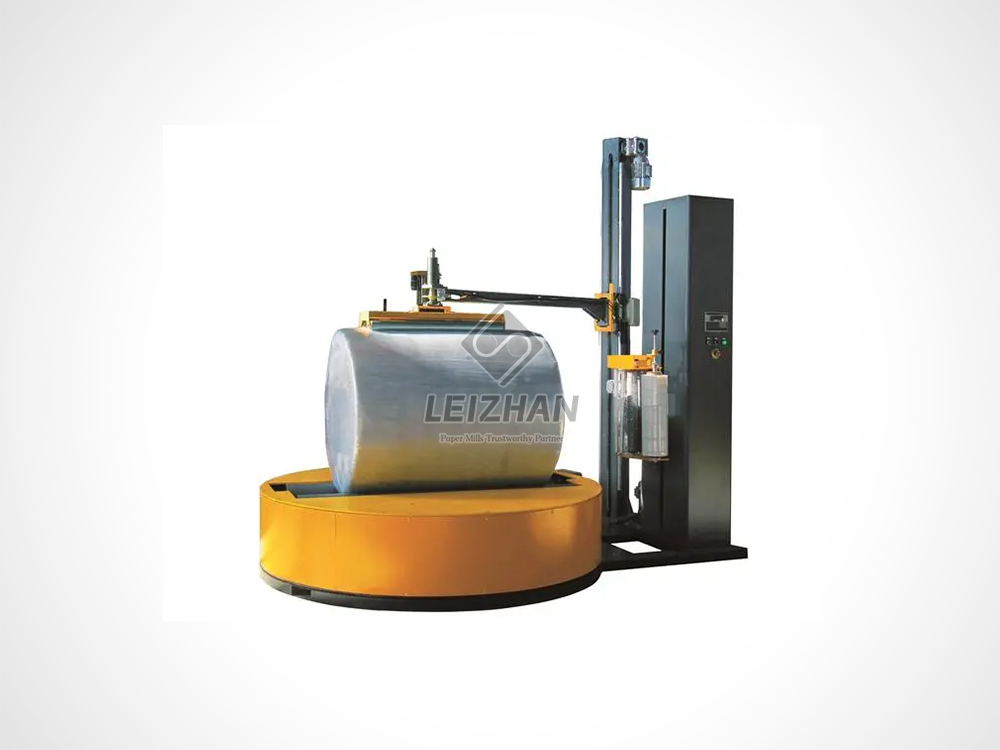
Certain heavy manufacturing sectors require highly specialized securing solutions that standard square-pallet machines simply cannot provide. For instance, the paper manufacturing industry deals with massive, cylindrical jumbo rolls. These rolls often weigh between 1.5 to 3 tons and possess unique handling dynamics. In these highly specialized scenarios, standard equipment falls dangerously short. Facilities dealing with such unique dimensions must implement industry-specific engineering, utilizing heavy-duty pneumatic ejectors and customized radial wrapping systems. This ensures products are secured without risking structural damage or catastrophic safety incidents.
Core Comparison: Finding the Right Fit
To better understand where hybrid machines fall short, it helps to view them alongside advanced alternatives. The following table breaks down the operational differences across various packaging solutions.
| Operational Metric | Semi-Automatic Wrapper | Fully Automatic System | Industry-Specific (e.g., Leizhan Paper Roll Wrapper) |
| Peak Throughput | 15 - 30 loads per hour | 50 - 100+ loads per hour | High-speed continuous radial wrapping |
| Human Dependency | High; requires manual tie/cut | Zero; PLC integrated | Zero; automated conveyor feed |
| Weight Capacity | Standard up to 2,000 kg | Heavy-duty up to 3,000+ kg | Engineered for 3+ ton cylindrical rolls |
| Film Yield Efficiency | Moderate; prone to human error | Maximum; consistent 250-300% pre-stretch | Maximum; optimized for curved surfaces |
Clear Signs Your Business Needs an Equipment Overhaul
Hitting the Capacity Wall
How do you know when your transitional machinery has become a liability rather than an asset? The most glaring sign is hitting the capacity wall. Facility managers should routinely audit their daily throughput. Are you consistently wrapping more than 40 pallets a shift? Are your forklift drivers frequently idling in line at the loading dock? If the packaging area is dictating the pace of your entire operation, your current setup is no longer serving your business needs.
Rising Labor Costs and High Turnover
Another definitive indicator is the escalating cost of industrial labor. In a highly competitive job market, paying a full-time worker solely to stand next to a machine, tie plastic, and push a button is an incredibly inefficient use of payroll. Initiating an upgrade to fully automated systems solves these labor shortages instantly. It allows management to reallocate that worker to a more valuable, revenue-generating task like quality assurance or outbound logistics management.
Frequent Product Damage Reports
Pay close attention to feedback from your distribution partners. If clients are submitting frequent complaints about damaged goods upon arrival, or if freight carriers are actively rejecting loads due to visible instability, your current securing process is failing. Frequent product damage reports are a direct symptom of inadequate containment force, signaling an urgent need for more precise, automated intervention.
Exploring Fully Automatic Alternatives for Your Packaging Line
Seamless Conveyor Integration
When a business finally outgrows its semi-automated constraints, fully automatic systems offer a definitive, long-term solution. One of the primary advantages of this advanced tier of machinery is seamless conveyor integration. These robust systems are built directly into motorized roller lines. Cargo moves effortlessly from the production line, straight into the wrapping zone, and out to the staging area via PLC control. This integration completely eliminates the need for a forklift driver to load the platform directly, drastically improving warehouse flow and entirely removing pedestrian traffic hazards.
Advanced Auto-Cut and Auto-Attach Features
Specifically, fully automatic systems eliminate human dependency through sophisticated mechanical engineering. They are equipped with advanced auto-attach and auto-cut mechanisms. As a pallet enters the zone, mechanical clamps grip the plastic and attach it to the load automatically. Once the cycle finishes, a heated wire cleanly severs the film, and a mechanical brush wipes the tail perfectly flat. By handling the gripping, wrapping, cutting, and wiping autonomously, these systems perfect the cycle time and guarantee uniform security on every single shipment.
Conclusion
While a semi-automated packaging machine serves as a fantastic entry-level tool for emerging operations, its inherent shortcomings in processing speed, ergonomic safety, and containment consistency eventually transform it into a logistical liability for fast-growing businesses. Outgrowing your legacy equipment should not be viewed as an operational failure, but rather as a true indicator of your business scaling success. Plant managers are highly encouraged to audit their current cycle times, labor allocations, and material waste today. Transitioning to a fully automated or industry-specific wrapping system will eliminate costly bottlenecks, safeguard your workforce, and provide a rapid, measurable return on investment.
If your facility is hitting these operational ceilings and dealing with specialized heavy loads, it is time to evaluate high-throughput alternatives. Visit https://www.leizhanpapertech.com to explore heavy-duty, automated packaging solutions tailored for your exact production demands.
FAQ
What is the maximum capacity of a semi automatic stretch wrapper?
Typically, these machines max out at around 20 to 30 loads per hour. This capacity depends heavily on the individual worker's manual speed during the attachment and cutting phases, as well as the specific machine's turntable RPM limits. Pushing the equipment beyond this threshold usually results in severe workflow bottlenecks and increased wear and tear on the drive motor.
How does operator involvement affect load stability?
Workers must manually tie the stretch film to the base of the pallet before the rotation begins. If this crucial step is done incorrectly or too loosely, the load lacks the foundational bottom-holding force required to secure it to the wooden base. Furthermore, personnel may manually adjust tension and pre-stretch settings based on personal preference, leading to highly inconsistent wrapping quality between different operating shifts.
When should a company upgrade from a semi-automatic to a fully automatic wrapper?
A facility should seriously consider an equipment transition when they consistently exceed 30 to 40 pallets per hour. Other major indicators include experiencing unsustainably high labor costs, suffering from continuous forklift traffic jams at the packaging station, receiving frequent damaged freight reports, or needing to integrate the machinery directly into a motorized, hands-free conveyor line.
Does a semi automatic stretch wrapper save film compared to manual wrapping?
Yes, it saves significantly more material than manual hand-wrapping because it utilizes powered pre-stretch carriages that maximize the plastic's yield. However, it still wastes considerably more film than a fully automatic machine. This discrepancy is primarily due to manual cutting, which often results in unnecessarily long film tails, and inconsistent pre-stretch utilization by human operators adjusting the control panel.
What is the true ROI of upgrading to a fully automatic stretch wrapper?
The return on investment is realized through three main channels: eliminating the dedicated labor hours required for manual tying and cutting, drastically reducing forklift idle time, and maximizing film yield through consistent 250-300% pre-stretch application. For a high-volume plant, these combined savings often pay for the machine within 12 to 18 months.
Can a semi-automatic wrapper handle irregular or extremely heavy loads?
Standard semi-automatic turntable wrappers are generally unsuitable for extremely heavy or irregular items like massive paper rolls or top-heavy equipment. The centrifugal force generated by the spinning turntable can cause unstable loads to tip. For these applications, specialized automated machinery, such as radial wrappers or rotary arm wrappers, is required to keep the heavy product stationary while the film carriage rotates around it.


